126, Mange Ram Park, Rohini, Delhi, India


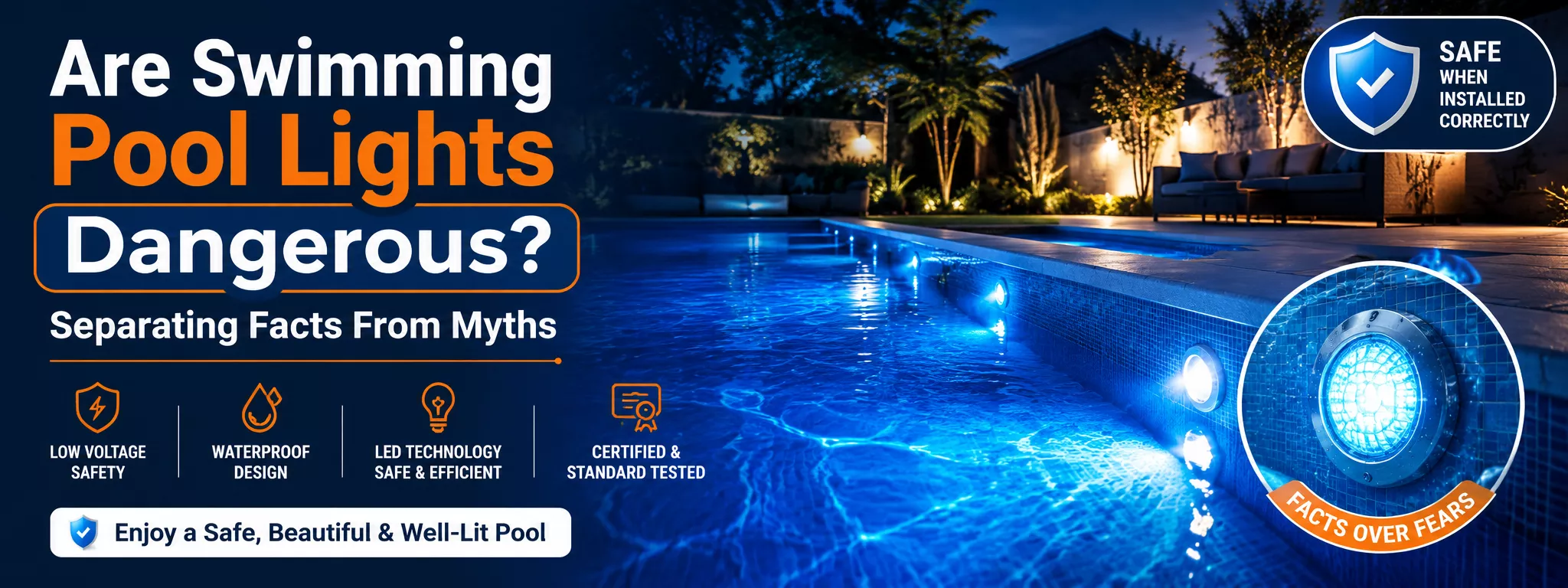
There's a specific kind of hesitation a lot of pool owners feel at night. You flip the switch, the water glows blue, and for half a second your brain does the math: electricity, water, me standing in both. It's not an irrational thought. But it's also not really about the light. Nine times out of ten, when something goes wrong with pool lighting, the fixture wasn't the problem — the wiring behind it was.
We get asked about this often enough at DS Water Technology that it felt worth writing down properly, without the usual scare tactics or the opposite extreme of pretending there's zero risk. Both miss the point.
Where the Fear Actually Comes From
Every summer there's at least one news story about someone getting shocked near a pool or a fountain. These stories travel fast because they're unsettling, and unsettling things get shared more than boring ones. But go read the actual incident reports if you can find them — not the headlines, the reports. The pattern is almost always the same: a cracked housing that let moisture into the wiring, a grounding connection that corroded away years ago and nobody checked, or someone installing a swimming pool under water lights with regular household cable instead of proper underwater-rated wiring, just to save a few thousand rupees.
None of that is "the light being dangerous." That's electrical work done badly near water, which would be a problem with a washing machine too, not just a pool.
What's Actually Inside an Underwater Light
Worth knowing how these things are built, because it explains a lot. A proper swimming pool underwater light sits inside a sealed niche in the pool wall — a waterproof pocket with the fixture behind a thick lens, gasketed shut so water physically cannot reach the bulb or the wiring behind it.
Here's the part most people don't know: these lights almost never run on your regular 220V mains supply directly. They're stepped down to 12V through a transformer, and that transformer sits in a dry spot — an equipment room, a sealed box away from the pool deck, somewhere the splash can't reach it. Even if water somehow got into a 12V circuit, there simply isn't enough current there to hurt someone. That's a different situation entirely from, say, a mains-powered extension cord near the pool edge, which is genuinely risky and has nothing to do with pool lights as a product.
Myths Worth Retiring
"Any light near the pool can shock you if it's on."
Only if it's wired at mains voltage without proper isolation, which shouldn't happen with a correctly installed system in the first place.
"LED lights are automatically safer because they use less power."
Lower wattage on its own doesn't make something safer — the wiring and sealing do the heavy lifting there. What's true about LED lights for swimming pool setups is that they run cooler than the old halogen units, which means less thermal stress on the seals over the years. That's a maintenance benefit more than a shock-risk one, but it's real.
"If the light turns on fine, the electrics are fine."
Not necessarily. A bonding wire can corrode and come loose while the light itself still switches on without a hitch. Function and safety aren't the same test.
"This is only an old-pool problem."
A brand-new installation with a contractor who skipped bonding or never tested the RCD is arguably worse, because you'd assume new means are safe.
The Five Things That Actually Determine Safety
Not a long list, but each one matters:
Low-voltage transformers kept in dry, splash-free locations. Equipotential bonding — every metal part around the pool tied together and grounded so there's no voltage difference between them. A GFCI or RCD on the circuit, one that actually gets tested, not just installed and forgotten. Sealed housings rated for continuous submersion, not just splash resistance. And cable that's specifically jacketed for underwater use, since regular wire degrades faster in constant moisture.
Get those five right and the risk drops to something close to negligible — genuinely lower than a lot of ordinary household hazards people don't think twice about.
Where Problems Actually Come From, In Our Experience
Having serviced pool electrical setups for a while now, the failures we run into aren't design flaws in the swimming pool lights themselves. They're shortcuts. A contractor reusing leftover household wire to save cost. GFCI protection that was installed but bypassed during a later repair and never reconnected. A lens seal that's been slowly failing for a year with nobody noticing the fogging inside the glass. Someone swapped a bulb themselves without cutting power at the breaker — just the wall switch, which isn't the same thing if the switch is wired oddly.
Every one of these is preventable. None of them are inherent to pool lighting as a category.
Keeping Up With It — Pool Light Maintenance That Isn't a Hassle
You don't need a monthly ritual, but a bit of routine attention saves a lot of trouble later.
Once a month, glance at the lens for cracks or that telltale cloudy fog behind the glass — that fogging is usually the earliest sign a seal is starting to fail. Every few months, press the test button on your RCD. If it doesn't trip and cut the power, that's not a minor thing to put off — call an electrician. Once a year, get someone qualified to check the bonding connections and open up the transformer housing to look for corrosion.
And if you ever notice flickering, a light that won't switch off, or a faint burning smell near the equipment pad — don't wait a few weeks to "see if it happens again." Cut power at the breaker and get it looked at.
Types of Pool Lights, and How They Compare on Risk
Halogen and incandescent underwater lights run hot, which puts more strain on the seals over time — they're becoming less common in new builds for exactly this reason. LED units run cooler, last years longer, and have become the default choice mostly because they're easier to live with, not because of a dramatic safety gap.
Fiber-optic lighting takes a different approach entirely — the actual light source stays outside the pool, and only the fiber cable runs into the water, which arguably makes it the lowest-exposure option going, though the installation is more involved. Floating and solar lights skip the wiring question altogether since they're not tied into the pool's electrical system at all — a genuinely risk-free option if you just want some ambient glow without any of this conversation applying to you.
Once Safety's Covered, the Benefits Are Real
None of this is meant to talk you out of pool lighting — quite the opposite. The benefits of underwater pool lights are worth having once the electrical side is handled properly: more usable hours in the evening, much better visibility if anyone's swimming after dark (spotting trouble in a lit pool is a lot easier than in a dark one), and honestly, a pool just looks better lit up for an evening gathering. Safety and good lighting aren't in competition here. They only seem that way when the wiring behind the scenes wasn't done right.
Bottom Line
Pool lights aren't the dangerous part. Bad electrical work near water is, and the light fixture is just the piece you happen to touch and see every day. A modern low-voltage LED unit is built with several layers of protection specifically because it lives in a wet environment — that's the whole point of its design. Your job as the pool owner is mostly upfront: pick fittings from someone who actually follows proper sealing and low-voltage standards, make sure GFCI protection and bonding aren't skipped during installation, and don't let the annual check slide.
If you're not sure where your own setup stands, it's worth having a technician actually open things up and check — rather than judging it by how the light looks when you flip the switch. At DS Water Technology, this is the kind of thing we get called in for often: not to sell a new light, but to look at what's already installed and tell you honestly whether it meets the standard.
FAQs
Q1. Can you get electrocuted from a swimming pool light?
It's very unlikely if the light is a properly installed 12V unit with GFCI protection and correct bonding. The real risk comes from bad installation or bypassed safety devices, not the fixture itself.
Q2. Is it safe to swim with the pool light on?
Yes, as long as it's a certified low-voltage underwater fixture with intact seals and working GFCI protection on the circuit.
Q3. How do I know if my pool light wiring is actually safe?
Watch for flickering, fogging inside the lens, or an RCD that doesn't trip during a test. For real certainty, get a pool electrician to check bonding and transformer condition once a year.
Q4. Are LED pool lights safer than halogen ones?
They run cooler and draw less current, which eases wear on the seals over time. But overall safety still comes down to wiring and bonding more than bulb type.
Q5. How often should pool lights get inspected?
Check the lens monthly, test the RCD every few months, and get a full professional check once a year.
Q6. What should I do if a pool light flickers or won't turn off?
Cut power at the breaker, not just the wall switch, and call an electrician before using the pool again.
Ready to build or
upgrade your pool?
Tell us about your swimming pool project and one of our experts will contact you within 24 hours with the best solution and pricing.
New Delhi - 110086, Delhi, India