126, Mange Ram Park, Rohini, Delhi, India


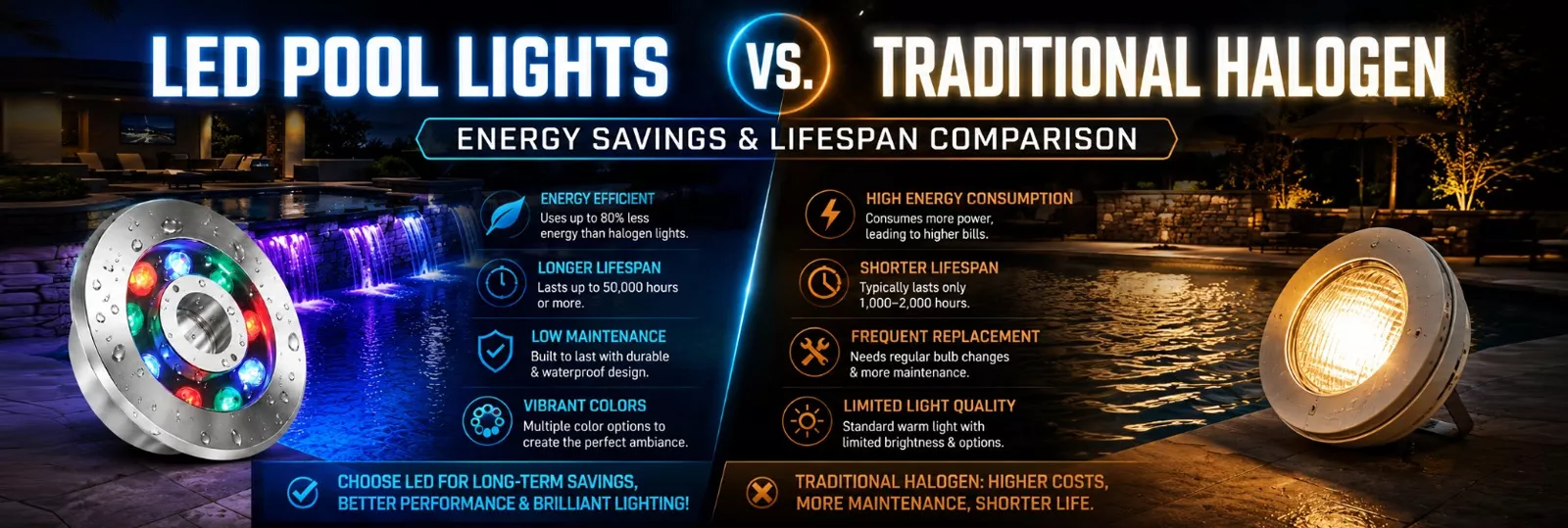
If you're building a new pool or thinking about upgrading your existing one, the type of swimming pool light you choose will affect your electricity bill for years. It's one of those decisions that looks small upfront but adds up fast.
The debate usually comes down to two options: LED or halogen. Both work underwater. Both illuminate a pool. But the similarities stop there.
At DS Water Technology, we've been designing and supplying pool lighting solutions in India for over 15 years. What we see consistently is that most buyers focus on the purchase price and overlook the running cost — which, especially given India's electricity tariffs, is where the real cost lives.
This article breaks down exactly what separates these two technologies, what the numbers look like in real-world Indian conditions, and how to decide which is right for your pool.
How Each Swimming Pool Light Technology Works?
What Makes an LED Pool Light Different
LED stands for Light Emitting Diode. Unlike traditional bulbs, LEDs don't produce light by heating a filament. Instead, they pass electricity through a semiconductor material that emits photons — light — directly.
This process is fundamentally more efficient. Very little energy is wasted as heat. The light is produced exactly where it's needed.
Modern LED pool lights are typically sealed within a resin-encapsulated housing rated IP68 — fully submersible and pressure-resistant. Most operate at low voltage (12V or 24V), which makes them safer for wet environments.
How Halogen Pool Lights Work
Halogen lights are an improved form of incandescent lighting. A tungsten filament is enclosed in a small quartz envelope filled with halogen gas. When electricity flows through, the filament heats up to around 2,500-3,000°C and glows.
This process works — but it's inherently inefficient. Most of the electrical energy converts to heat, not light. In an underwater fixture, that heat needs to go somewhere. In halogens, the pool water actually helps cool the lamp. If a halogen fixture runs dry (during maintenance or a water level drop), it can crack the lens or damage the housing.
Energy Consumption — The Numbers That Matter
This is where the difference becomes undeniable.
Wattage Comparison at a Glance
| Feature | LED Pool Lights | Halogen Pool Light |
|---|---|---|
| Typical wattage | 10W - 35W | 100W - 500W |
| Lumens produced | 800 - 3,500 lm | 800 - 3,500 lm |
| Energy efficiency | 80-100 lm/W | 10-20 lm/W |
| Heat generated | Minimal | Significant |
| Transformer required | Yes (12V models) | Yes (low-voltage models) |
To produce the same amount of visible light, an LED uses roughly one-fifth to one-tenth the electricity of a halogen.
Real Electricity Cost Calculation (India, ₹ Based)
Let's use a practical example. Assume a standard residential pool that runs its lights for 4 hours per day.
Electricity rate assumed: ₹8 per kWh (approximate mid-range tariff across major Indian states)
Halogen (300W fixture):
- Daily consumption: 300W * 4h = 1.2 kWh
- Daily cost: ₹9.60
- Monthly cost: ₹288
- Annual cost: ₹3,456
LED (30W fixture — equivalent brightness):
- Daily consumption: 30W * 4h = 0.12 kWh
- Daily cost: ₹0.96
- Monthly cost: ₹28.80
- Annual cost: ₹345.60
Annual savings with LED: ₹3,110 per light
For a pool with 4 light fixtures, that's over ₹12,000 saved every year — just on electricity.
Internal link opportunity: Explore our range of underwater LED pool lights designed for Indian pool sizes and voltage requirements.
Lifespan Comparison — How Long Will Each Last?
| Feature | LED Pool Light | Halogen Pool Light |
|---|---|---|
| Rated Lifespan | 25,000 - 50,000 hours | 2,000 - 5,000 hours |
| Replacement Frequency | Every 10-15+ years | Every 1-3 years |
| Replacement Cost (Approx.) | Higher upfront, rare | Lower per unit, frequent |
| Degradation Pattern | Gradual dimming | Sudden failure |
Why LED Lifespan Claims Are Often Misunderstood?
Manufacturers rate LED lifespan to L70 — meaning the point at which light output drops to 70% of original brightness. The light doesn't "die" suddenly like a halogen does. It gradually dims over years of use.
This matters for pool owners because a halogen that fails mid-season means a replacement job that involves draining or at least partially lowering the water level. LED replacements are far less frequent, which means fewer maintenance disruptions.
Upfront Cost vs. Long-Term Cost: Which Is Actually Cheaper?
The common objection to LED is price. A quality LED pool light costs more upfront than a halogen replacement. In India, a decent LED pool light can range from ₹2,500 to ₹8,000 depending on wattage and brand, while halogen replacements may cost ₹500 to ₹1,500.
But total cost of ownership tells a very different story.
Total Cost of Ownership Over 5 Years (Single Fixture)
| Cost Component | LED | Halogen |
|---|---|---|
| Purchase Price | ₹5,000 | ₹800 |
| Replacements Over 5 Years | ₹0 | ₹2,400 (3 replacements) |
| Electricity Cost (5 Years) | ₹1,728 | ₹17,280 |
| Total 5-Year Cost | ₹6,728 | ₹20,480 |
Over five years, halogen costs roughly 3* more than LED — per fixture.
For a pool with four lights, the 5-year saving with LED is in the range of ₹55,000 to ₹60,000.
Light Quality, Color, and Brightness
Lumen Output and Visibility Underwater
Halogens produce warm, yellowish light. LEDs can be tuned across a wide spectrum — from warm white to cool white to full RGB colour-changing options.
Underwater, lumen output matters more than raw wattage. A 20W LED rated at 1,600 lumens will illuminate a pool more effectively than a 150W halogen rated at similar lumens, because the LED housing is designed to direct light more efficiently into the water.
For standard residential pools in India (typically 8*4m to 12*6m), a 20W-35W LED fixture per light point is generally sufficient.
Color Temperature and Ambience
LED pool lights are available in:
- 3,000K - 4,000K (Warm White): Natural, golden tone. Creates a relaxed, resort-like atmosphere.
- 5,000K - 6,500K (Cool White / Daylight): Crisp, clear light. Better for lap pools or pools used for exercise.
- RGB / Colour Changing: Full spectrum control via remote or controller. Popular in hotels, villas, and high-end residential pools.
Halogen produces only warm white (around 2,700K-3,200K) with no colour variation possible.
Safety Considerations for Underwater Pool Lights
Heat Output and Water Safety
Halogen fixtures generate significant heat. Most pool-rated halogens are designed with the assumption that the fixture is submerged — water conducts the heat away. If water levels drop and the fixture is exposed, the thermal stress can crack the lens or damage the seal.
LED fixtures generate very little heat. They are far more tolerant of accidental air exposure and are generally safer in maintenance situations.
Voltage and IP Rating — What to Check
For underwater pool lighting in India, always confirm:
- IP68 rating — The fixture must be rated for continuous submersion. IP67 is splash-resistant; IP68 is fully submersible.
- Low voltage operation — 12V fixtures are significantly safer in wet environments than mains-voltage (230V) systems. They require a transformer, but the investment is worth it.
- Compliance with IS standards — For pool electrical systems installed in India, ensure the fixtures and wiring comply with relevant IS electrical safety codes.
Internal link opportunity: Learn more about our complete swimming pool lighting solutions — including IP68-rated fittings and low-voltage transformer options.
Is Your Pool Ready to Switch? Retrofitting Halogen to LED
Switching from halogen to LED in an existing pool is almost always possible — and usually straightforward.
What the Retrofit Process Involves
- Check the existing niche/recess size. Most standard pool niches (typically 178mm diameter) accommodate LED replacement units directly.
- Assess the existing transformer. If your halogen system runs on a 12V transformer, it may already be compatible with LED units. Some older or higher-wattage transformers may need replacement or adjustment.
- Select the correct LED unit. Match the niche size, voltage, and lumen output to your pool's requirements.
- Install by a licensed electrician. All underwater electrical work in India should be carried out by a qualified electrician familiar with wet-zone installations.
- Test before refilling or resealing. Confirm the fixture is watertight before it returns to full submersion.
The entire retrofit can typically be completed in a single service visit without fully draining the pool — though water levels will need to be temporarily lowered to access the fixture niche.
Which Swimming Pool Light Is Right for Your Pool?
By Pool Size
| Pool Size | Recommended LED Wattage | No. of Fixtures |
|---|---|---|
| Small (up to 6×3m) | 15W - 20W | 1-2 |
| Standard (8×4m) | 20W - 30W | 2-3 |
| Large (12×6m and above) | 30W - 50W | 4+ |
| Commercial / Hotel Pools | 50W+ or custom | Per design spec |
Note: Wattage recommendations assume clear pool water with good reflectance. Dark-tiled pools may require additional fixture points.
By Budget Type
- Value-focused: LED is the right choice. Higher upfront cost is recovered within 12-18 months of normal use at Indian electricity rates.
- Premium/luxury finish: RGB colour-changing LED. Significantly elevates the pool aesthetic and is standard in hotel and villa projects across India.
- Short-term/temporary installation: If you're planning significant pool work within the next year, halogen may serve as an interim solution — but LED is the better long-term choice in virtually every scenario.
Why Indian Pool Owners Are Switching to LED?
High Electricity Tariffs Make LEDs More Valuable Here
India's domestic electricity tariff varies by state, but rates in urban areas commonly range from ₹6 to ₹10+ per kWh — and they've been rising steadily. In markets with cheaper electricity, the LED payback period is longer. In India, it's shorter.
Add to this the fact that many parts of India run pools year-round — unlike seasonal markets in Europe — and the cumulative usage hours are significantly higher. More hours of use means more electricity consumed, and the efficiency gap between LED and halogen becomes even more pronounced over a full year of operation.
India's summer heat also benefits LED in another way: halogen fixtures in hot climates can experience accelerated seal degradation due to thermal cycling. LED fixtures, running cooler, are less susceptible to heat-related wear.
DS Water Technology has been supplying pool equipment across India for 15 years. Over that time, we've observed a clear shift: builders and pool owners who once specified halogen as the default are now specifying LED from the outset — not because of aesthetics, but because the numbers simply make more sense.
FAQ Section
Q1: What is the average lifespan of an LED swimming pool light?
Quality LED pool lights are typically rated between 25,000 and 50,000 hours of use. At 4 hours of daily use, that translates to 17-34 years before the light reaches 70% of its original brightness.
Q2: How much can I save on electricity by switching from halogen to LED pool lights?
Based on typical Indian electricity rates (around ₹8/kWh), switching one 300W halogen to a 30W LED saves approximately ₹3,100 per year. For a pool with four lights, that's over ₹12,000 annually.
Q3: Can I replace my halogen pool light with an LED without draining the pool?
In most cases, yes. The pool water level needs to be lowered to access the fixture niche, but full drainage is usually not required. A qualified pool electrician can complete the retrofit in a single visit.
Q4: What IP rating should an underwater pool light have?
Swimming pool lights must be rated IP68 — meaning they are designed for continuous submersion under pressure. IP67 is not sufficient for fully submerged pool fixtures.
Q5: What voltage do LED pool lights use?
Most LED pool lights operate at 12V or 24V DC. This requires a transformer but is significantly safer in wet environments than mains-voltage (230V) systems.
Q6: Are LED pool lights suitable for outdoor pools in India's hot climate?
Yes. LED pool lights generate far less heat than halogen and are less susceptible to heat-related seal damage. They perform well in year-round warm-weather conditions common across much of India.
Q7: What wattage LED pool light do I need for my pool?
For a standard residential pool (8×4m), two to three 20W-30W LED fixtures are typically sufficient. Larger pools or pools with dark tiles may require additional fixture points or higher wattage.
Q8: Do LED pool lights require a transformer?
Yes, 12V LED pool lights require a low-voltage transformer. This is standard in professional pool electrical installations and adds a layer of safety for wet environments.
Q9: What is the difference between warm white and cool white LED pool lights?
Warm white (3,000K-4,000K) produces a golden, relaxed ambience — popular for residential and resort pools. Cool white (5,500K-6,500K) gives a bright, crisp look, often preferred for lap pools or commercial installations.
Q10: How long does an LED pool light take to pay back its higher purchase cost?
At average Indian electricity tariffs, the payback period for LED over halogen is typically 12 to 18 months of normal use. After that, the electricity savings represent a direct financial benefit.
Q11: Can LED pool lights be used with an existing halogen pool transformer?
Sometimes yes, sometimes no — it depends on the transformer's output wattage and compatibility. A pool electrician should evaluate this before installation to avoid overloading or underperforming the new LED fixtures.
Q12: What is the colour rendering index (CRI) and why does it matter for pool lights?
CRI measures how accurately a light source renders colours compared to natural sunlight. A CRI of 80+ is generally recommended for pool lights to ensure the water, tiles, and surroundings look natural rather than washed out or distorted.
Ready to build or
upgrade your pool?
Tell us about your swimming pool project and one of our experts will contact you within 24 hours with the best solution and pricing.
New Delhi - 110086, Delhi, India