126, Mange Ram Park, Rohini, Delhi, India


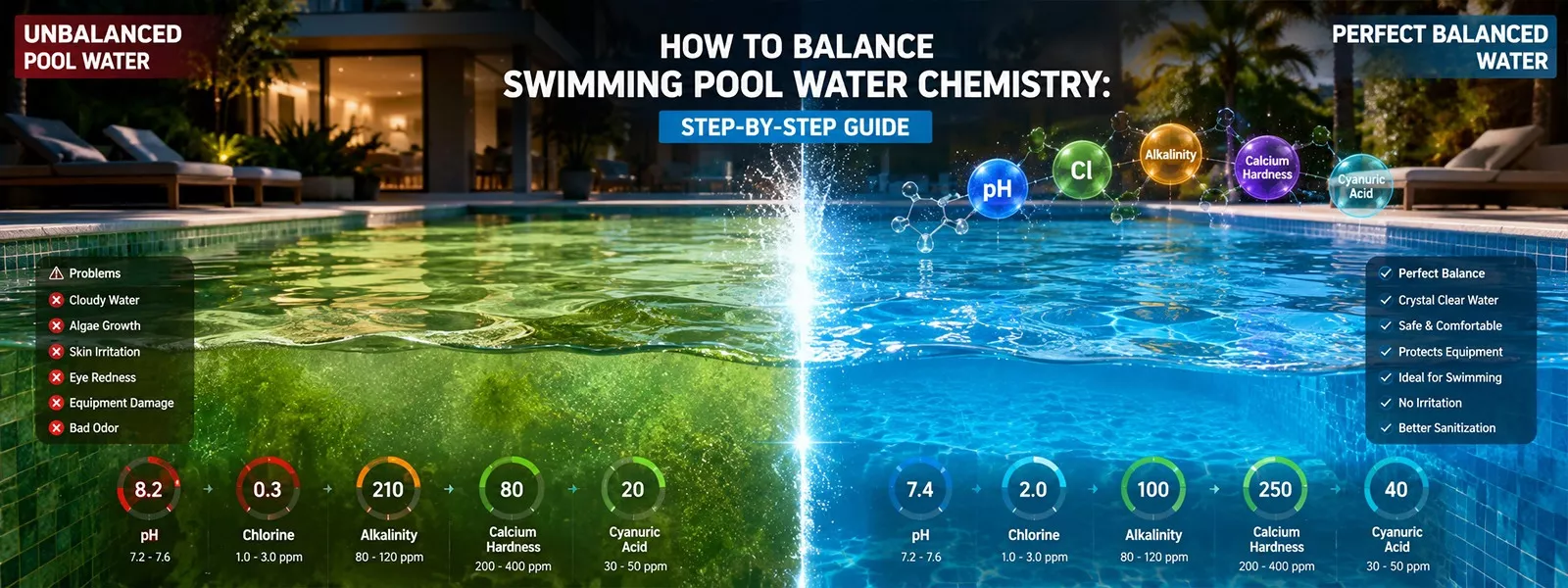
If your pool water looks slightly off — cloudy, greenish, or it stings the eyes — there's a good chance your swimming pool chemicals are out of balance. Most pool problems aren't about the pool itself. They're about water chemistry.
Getting this right doesn't require a chemistry degree. But it does require understanding a few core parameters, knowing which chemicals to use, and adding them in the right order. This guide covers exactly that.
Why Pool Water Chemistry Matters (More Than You Think)?
Poorly balanced pool water does more damage than most pool owners realize. It doesn't just make the water uncomfortable — it corrodes pool equipment, degrades plaster surfaces, and creates an environment where bacteria and algae thrive.
In India especially, outdoor pools face additional challenges: hard water in cities like Delhi, Gurgaon, and Mumbai, intense summer heat that accelerates chlorine loss, and monsoon rains that dilute chemical concentrations rapidly. Seasonal fluctuations mean you can't just set it and forget it.
The goal of balancing pool water is to maintain three conditions simultaneously: safe sanitizer levels, a stable pH, and physical water balance (alkalinity + calcium hardness). When all three are right, the water stays clear, feels comfortable, and protects both swimmers and pool infrastructure.
The Core Swimming Pool Chemicals You Need to Know
Chlorine is the most widely used pool sanitizer in India and globally. It kills bacteria, viruses, and destroys organic contaminants introduced by swimmers (sweat, skin oils, sunscreen). It comes in several forms: granules, tablets (trichloro or dichloro), and liquid sodium hypochlorite.
The free chlorine reading is what matters most. This is the active portion of chlorine in your water. Combined chlorine (chloramines) is what forms when free chlorine reacts with ammonia — it causes the irritating smell and eye redness often blamed on 'too much chlorine,' when it's actually the opposite.
pH Adjusters - Acids and Alkalinity Increasers
pH measures how acidic or basic your water is. Too low and the water becomes corrosive — it'll eat through metal fittings and irritate skin. Too high and chlorine becomes ineffective, and scale starts forming. For lowering pH, sodium bisulfate (dry acid) or muriatic acid is used. For raising it, sodium carbonate (soda ash) works reliably.
Total Alkalinity Balancers
Alkalinity is often described as the 'pH buffer.' Without adequate alkalinity, pH becomes unstable — it can swing sharply up or down after rainfall or heavy pool use. Sodium bicarbonate raises alkalinity without significantly raising pH, which makes it the preferred product for this adjustment.
Calcium Hardness Regulators
Calcium hardness refers to how much dissolved calcium is in the water. Too little and the water becomes 'hungry' — it will pull calcium from pool walls, causing etching and pitting. Too much leads to scale formation on surfaces and inside pipes. Calcium chloride is used to raise hardness levels.
Algaecides and Shock Treatments
Algaecides are preventive chemicals used to inhibit algae growth, especially during monsoon season when spores are more prevalent. Shock treatment (superchlorination) involves adding a heavy dose of chlorine or non-chlorine oxidizer to break down accumulated chloramines and restore water clarity after heavy use or contamination.
Key Parameters and Their Ideal Ranges
This is your reference table for every test you run:
| Parameter | Ideal Range | If Too Low | If Too High |
|---|---|---|---|
| Free Chlorine | 1-3 ppm | Bacteria/algae risk | Eye/skin irritation |
| pH | 7.2 - 7.6 | Corrosive water, equipment damage | Chlorine loses effectiveness |
| Total Alkalinity | 80 - 120 ppm | pH becomes unstable | Cloudy water, scale formation |
| Calcium Hardness | 200 - 400 ppm | Etching and pitting of surfaces | Scaling on tiles and pipes |
| Cyanuric Acid (Stabilizer) | 30 - 50 ppm | Chlorine degrades rapidly in sunlight | Chlorine lock — sanitizer becomes inactive |
| Total Dissolved Solids (TDS) | Below 1500 ppm | Water feels flat | Chemical imbalance, cloudy water |
Step-by-Step: How to Balance Your Pool Water (Correct Order Matters)
Adding chemicals in the wrong sequence is one of the most common mistakes. Some chemicals react with each other if added simultaneously. Follow this order every time.
Step 1 - Test Your Pool Water First
Never add chemicals based on guesswork. Use a reliable test kit or test strips to measure free chlorine, pH, total alkalinity, and calcium hardness. For commercial pools or if you're troubleshooting a persistent problem, a full water analysis from a professional lab gives you more accurate data.
Pro Tip: Test in the morning before the sun has been on the water. UV light burns off chlorine, so afternoon readings often underestimate your true chlorine demand.
Step 2 - Adjust Total Alkalinity
Alkalinity is adjusted first because it directly affects how stable your pH will be. If alkalinity is low, add sodium bicarbonate. If it's too high, add muriatic acid slowly in front of a return jet with the pump running. Wait at least 6 hours before retesting or moving to the next step.
Step 3 - Correct the pH Level
Once alkalinity is in range, pH usually follows close behind. If pH is still off, add sodium carbonate (to raise) or dry acid/muriatic acid (to lower). Add chemicals in small increments — never dump large amounts at once. Always pre-dissolve granular chemicals in a bucket of pool water before adding.
Step 4 - Balance Calcium Hardness
If your hardness reading is below 200 ppm, add calcium chloride to raise it. Dissolve it in a bucket first — calcium chloride generates heat when dissolved and adding it directly to the pool can cause localized damage to surfaces. Hardness adjustments take longer to circulate, so run your pump for 24 hours after adding.
Step 5 - Add Sanitizer (Chlorine)
With pH and alkalinity in range, chlorine will work at maximum efficiency. Add your chosen chlorine form — tablets go in a floating feeder or skimmer basket, granules can be broadcast across the pool, liquid chlorine is poured in near a return outlet. Maintain free chlorine between 1-3 ppm consistently.
Step 6 - Shock the Pool if Needed
If your pool has visible algae, very high combined chlorine, or has been heavily used, shock it. Pool shock raises chlorine temporarily to 10x the normal level, which destroys chloramines and kills stubborn algae. Always shock at dusk or night — sunlight degrades shock treatment before it can do its job. Keep the pump running for 8 hours after shocking it.
Step 7 - Add Algaecide as a Preventive Measure
After shocking, once chlorine levels return to the normal range (1-3 ppm), add an algaecide. Adding algaecide when chlorine is high will neutralize it — so timing matters. A weekly algaecide dose is particularly important in India during the monsoon season.
Common Pool Chemistry Problems in India (and How to Fix Them)
Indian pool owners face some specific challenges that generic Western guides don't address:
| Problem | Likely Cause | Fix |
|---|---|---|
| Green water after monsoon | Algae bloom from spore influx + diluted chlorine | Shock treat + algaecide + retest all parameters |
| Chlorine disappears too quickly | High UV exposure, low cyanuric acid (stabilizer) | Add stabilizer; switch to stabilized chlorine tablets |
| White scale on tiles | High calcium hardness + high pH | Lower pH, reduce calcium; brush scale manually |
| Eye irritation for swimmers | High chloramines (combined chlorine) not excess chlorine | Shock the pool to break chloramine bonds |
| Cloudy water despite correct chlorine | High TDS, low alkalinity, or poor filtration | Check alkalinity, backwash filter, consider partial water replacement |
| Rapid pH drop after rain | Acidic rainwater entering pool, low alkalinity buffer | Raise total alkalinity to the 100-120 ppm range |
How Often Should You Test and Treat Pool Water?
- Free chlorine and pH: Every 2-3 days for residential pools; daily for commercial pools
- Total alkalinity and calcium hardness: Once a week
- Cyanuric acid: Once a month or after heavy rainfall
- TDS: Every 3 months or if the water looks persistently dull
- Full professional water analysis: Once per quarter for large pools
During peak summer months (April-June) and monsoon season (July-September), increase your testing frequency. Heat and rainfall are the two biggest disruptors of pool chemistry in India.
Safety Tips When Handling Pool Chemicals
Indian summers put pools through more stress than a generic maintenance guide accounts for. Water temperatures regularly exceed 30°C, UV radiation is intense, and dust / organic debris enter pools constantly. Here's what changes:
- Always add chemicals to water — never water to chemicals. This prevents dangerous exothermic reactions.
- Store different chemicals separately. Chlorine and algaecide stored together can create toxic fumes.
- Wear gloves and eye protection when handling concentrated acids or chlorine granules.
- Never mix different chlorine products together — different formulations can react violently.
- Keep chemicals in original, airtight containers away from sunlight and moisture.
- Wash hands thoroughly after handling any pool chemical.
About DS Water Technology: With over 15 years of experience in water treatment and pool chemical supply across India, DS Water Technology holds ISO and MSME certifications and is a registered importer-exporter of commercial and residential pool treatment solutions. Our recommendations are grounded in field experience — not just specifications.
FAQ Section
Q1. What are the most essential swimming pool chemicals for a residential pool in India?
The core chemicals every pool owner needs are: a chlorine-based sanitizer (granules, tablets, or liquid), pH reducer (dry acid or muriatic acid), pH increaser (soda ash), sodium bicarbonate for alkalinity, and an algaecide. A good water testing kit is equally essential.
Q2. What is the correct pH level for a swimming pool?
The ideal pH range for pool water is 7.2 to 7.6. Below 7.2, the water becomes corrosive and irritates skin and eyes. Above 7.6, chlorine loses up to 60–70% of its effectiveness, and scale begins to form on pool surfaces.
Q3. How often should I add chlorine to my pool?
For most residential outdoor pools in India, adding chlorine every 2–3 days maintains safe levels. During summer or monsoon seasons, daily checks are recommended as heat and rainwater accelerate chlorine loss.
Q4. Why does my pool water turn green after the monsoon?
Monsoon rain introduces algae spores and dilutes your pool's chemical concentrations rapidly. The drop in sanitizer levels combined with new spore influx creates ideal conditions for algae to bloom. The fix is to shock the pool, add an algaecide, and rebalance all parameters from scratch.
Q5. Is it safe to swim after adding pool chemicals?
It depends on the chemical. After adding chlorine or adjusting pH, wait at least 30 minutes to 1 hour with the pump running. After shocking, wait until chlorine levels return to 1–3 ppm — typically 8–24 hours. Never swim immediately after adding acid.
Q6. What causes eye irritation in a pool if chlorine levels are fine?
Eye irritation is almost always caused by chloramines — combined chlorine that forms when free chlorine reacts with ammonia from sweat, urine, and sunscreen. The solution is shocking the pool to break chloramine bonds, not reducing chlorine.
Q7. What happens if pool pH is too low?
Low pH (below 7.2) makes pool water acidic. This corrodes metal fittings and pool equipment, causes eye and skin irritation, degrades chlorine rapidly, and etches plaster and grouted surfaces over time.
Q8. Can I use saltwater instead of chlorine in my pool in India?
Yes, saltwater pools use a salt chlorinator to generate chlorine from sodium chloride. They produce softer-feeling water and lower ongoing chemical costs. However, the initial system cost is higher, and the equipment requires proper maintenance. Salt can also accelerate corrosion on certain metal components.
Q9. What is cyanuric acid and do I need it?
Cyanuric acid (CYA) is a stabilizer that protects chlorine from UV degradation. In India's high-sun environment, it's particularly valuable — without stabilizer, chlorine can break down in 2–4 hours of direct sunlight. The ideal range is 30–50 ppm.
Q10. How do I raise total alkalinity without changing pH?
Add sodium bicarbonate (baking soda grade pool chemical) while the pump is running. Broadcast it across the pool surface rather than adding it in one spot. It raises alkalinity with a modest effect on pH, making it the preferred product for this adjustment.
Q11. What is pool shock treatment and when should I use it?
Shock treatment involves raising free chlorine to 10 times the combined chlorine level (usually 10–20 ppm) to oxidize chloramines, kill algae, and restore water clarity. Use it after heavy pool use, after a storm, when water turns cloudy or green, or if chloramines are detectable.
Q12. How do I fix white scaling on pool tiles?
White scale is typically calcium carbonate deposit from high calcium hardness and elevated pH. Lower pH first with dry acid, then work on reducing calcium levels. Brush the scale off surfaces while the pool runs. For severe buildup, a professional acid wash may be needed.
Q13. What is TDS and when should I drain the pool?
Total Dissolved Solids (TDS) accumulates over time as chemicals, minerals, and organic matter build up in the water. When TDS exceeds 1,500–2,000 ppm, water quality degrades and becomes harder to balance. Partial or full water replacement is the only way to reduce TDS.
Q14. Are there safer alternatives to chlorine for pool sanitation?
Several alternatives exist: bromine (effective over a wider pH range, gentler on skin), mineral sanitizers (silver/copper-based, reduce chlorine demand), UV systems (kill pathogens without chemical residue), and ozone generators. Most alternatives work best in combination with low-level chlorine rather than completely replacing it.
Q15. How do I know if my pool water is safe without a professional test?
Basic consumer test strips measure free chlorine, pH, alkalinity, and sometimes hardness and stabilizer levels. While not as precise as lab testing, they're sufficient for routine monitoring. Color-matching DPD test kits offer better accuracy. Test in shade and read results within the timeframe specified on the product packaging.
Still have questions about your pool chemistry? Call DS Water Technology — 15 years of water treatment expertise at your service.
Ready to build or
upgrade your pool?
Tell us about your swimming pool project and one of our experts will contact you within 24 hours with the best solution and pricing.
New Delhi - 110086, Delhi, India