126, Mange Ram Park, Rohini, Delhi, India


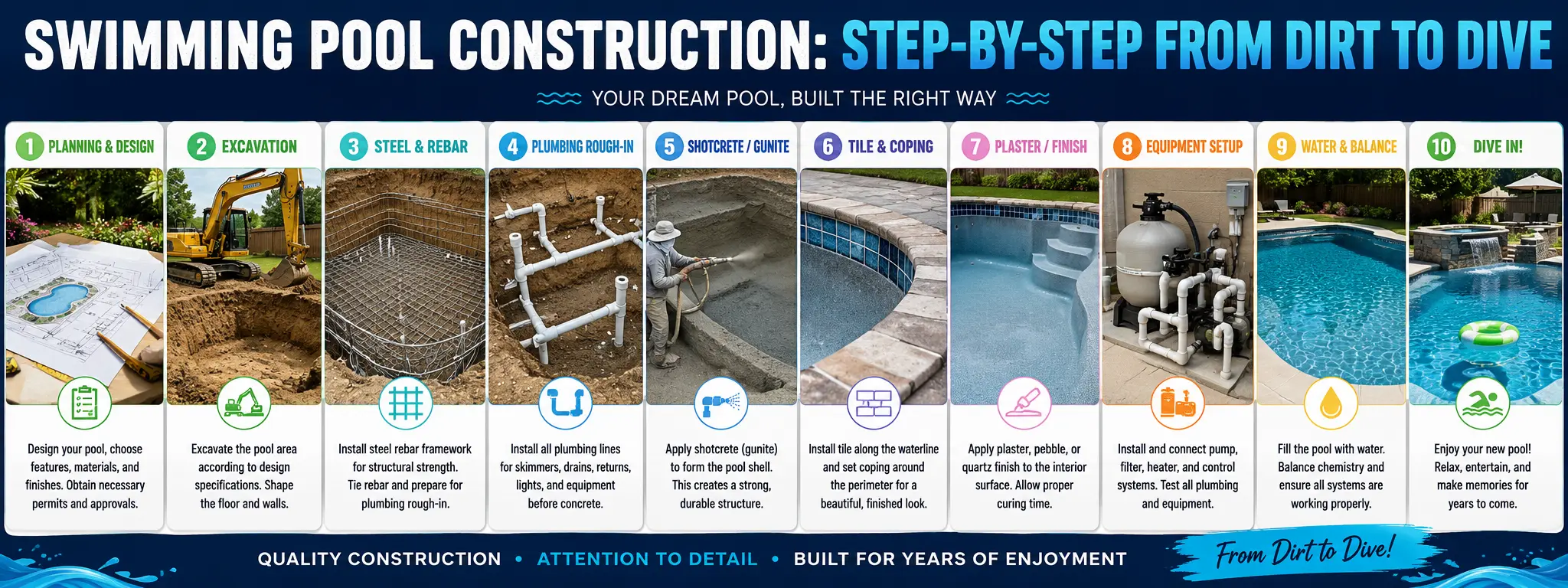
Building a swimming pool is one of the most rewarding home investments you can make - and one of the most complex. This comprehensive guide walks you through every stage, from choosing the right pool type to breaking ground and filling it up for the first swim.
But pool construction mistakes happen far more than people realize. Some surface within a few months. Others stay hidden for years - and when they appear, the repair costs can match half of what you originally spent.
How To Build A Pool - Beginner's Guide
Building a swimming pool is not a weekend DIY project. It involves civil engineering, plumbing, electrical work, and local government permits. But with the right knowledge, you can confidently navigate the process - and make decisions that save you thousands of dollars while avoiding expensive mistakes.
Before a single shovel breaks ground, you need to understand the full scope of the project. A typical inground pool installation takes 8 to 16 weeks from permit approval to the first swim. The process is sequential - one phase must complete before the next can begin - which is why delays compound quickly.
"The most common mistake first-time pool owners make is underestimating the planning phase. Rushing the design stage creates problems that are expensive - sometimes impossible - to fix once construction begins."
This guide covers every phase: choosing the right pool material, designing for your space, understanding local regulations, the construction sequence, and the critical ongoing maintenance commitments that come after installation.
How To Build a Swimming Pool: Guidelines & Considerations
Swimming pool construction is governed by a layered set of requirements - from your local municipality to your Municipal Corporation approvals. Understanding these guidelines before you start prevents costly redesigns and legal complications.
Building Permits & Local Codes
Approval requirements vary across India. Depending on the project location, approvals may be required from municipal corporations, development authorities, panchayats, housing societies, or local governing bodies.
- Setback requirements (distance from property lines, structures, utilities)
- Fencing and barrier requirements - most localities require a 4-5 ft fence around all pools
- Electrical permit for pool lighting, pumps, and bonding/grounding
- Plumbing permit for water supply and drainage systems
- Inspections at each phase of construction before work proceeds
Utility Mapping and Underground Services Check
Before excavation, ensure underground water lines, electrical cables, sewage lines, internet cables, and other utilities are identified through local authorities, builders, or utility providers.
Soil and Site Assessment
A geotechnical assessment (soil test) determines whether your soil can support the pool structure without expensive engineering solutions. Expansive clay soils, high water tables, and rocky ground all require specialized construction approaches. Skipping this step is a leading cause of pool structural failures within 5 years of installation.
- Perc test to determine drainage capacity
- Soil compaction and bearing capacity analysis
- High water table risk assessment
- Slope stability review for hillside installations
Environmental & Drainage Regulations
Pool drainage - both from construction and ongoing backwash - is regulated in most areas. You cannot simply direct pool water into storm drains, waterways, or your neighbor's property. Work with your contractor to design a compliant drainage plan and understand your ongoing water treatment obligations.
Which Is the Best Pool? Fiberglass, Concrete, or Vinyl Liner
The single most consequential decision you'll make is choosing your pool's construction material. Each type has a distinct set of trade-offs in cost, longevity, maintenance burden, and aesthetic flexibility.
Fiberglass
Pre-manufactured shell dropped into an excavated hole. Fastest to install, smoothest surface, and lowest ongoing maintenance costs.
PROS
- +Fast install (3-6 weeks)
- +Non-porous surface
- +Algae-resistant
- +Lower chemical use
- +Comfortable surface
CONS
- - Size/shape limits
- - Difficult to repair
- - Osmotic blisters possible
- - Transportation constraints
Concrete (Gunite)
Sprayed concrete (gunite or shotcrete) over a steel rebar framework. Fully customizable in shape, depth, and finish. The most durable option.
PROS
- +Unlimited shapes
- Extremely durable
- Any depth possible
- Premium finishes
- Highest resale value
CONS
- 3-6 month install
- Porous - algae prone
- High chemical needs
- Resurface every 10-15 yr
Vinyl Liner
Flexible vinyl sheet fitted over a frame of steel, aluminum, or polymer panels. Lowest upfront cost but requires liner replacement every 8-12 years.
PROS
- +Lowest entry price
- +Smooth surface
- +Wide pattern choice
- +Fast installation
CONS
- Liner tears/fades
- Replacement cost ₹2 lakh to ₹8 lakh
- Limited shapes
- Less luxurious feel
Our Verdict: Concrete (RCC) swimming pools remain the most popular choice in India because they offer flexibility in design, durability, and suitability for varying soil and climatic conditions. Fiberglass pools are becoming popular for faster installation, while vinyl liner pools are relatively uncommon in the Indian market.
7 Essential Tips for Planning and Designing Your New Backyard Pool
Good planning prevents the three biggest pool-building regrets: wrong size, wrong placement, and wrong budget. These seven principles - learned from hundreds of pool installations - will guide you to better decisions before construction begins.
Size for How You'll Actually Use It
Most homeowners overestimate how much pool space they need. A 12×24 ft pool suits most families for recreational swimming. Larger pools mean higher costs for heating, chemicals, and maintenance - every time, forever.
Position for Sunlight, Not Just Views
Position the pool to maximize sunlight exposure based on your property's orientation and local climate conditions. A sun-drenched pool is warmer, cheaper to heat, and more pleasant. Don't sacrifice this for a view of the garden shed.
Plan for Tree and Landscape Impact
Nearby trees drop leaves, shed roots that can damage pool walls, and create shading. Keep pools at least 10 feet from large trees. Factor in how your landscape plan evolves over 10-20 years.
Budget 20% More Than You Expect
Hidden costs are universal in pool construction: unexpected rock during excavation, upgraded electrical panels, decking, fencing, landscaping, and landscaping restoration after construction. A contingency budget is not optional.
Design the Equipment Area Thoughtfully
Your pump, filter, heater, and automation equipment will be accessed regularly. Place the equipment pad where it's accessible for maintenance, within code setbacks from property lines, and screened from main view areas.
Build Safety In From Day One
Childproof fencing, self-closing gates, alarms, and pool covers are not afterthoughts - they should be in the original design. Retrofitting safety features costs significantly more than including them from the start.
Interview at Least Three Contractors
Get bids from three licensed pool builders. Ask for references, verify GST registration, company registration, project portfolio, client references, and local approvals, verify insurance certificates, and review their standard contract carefully. Lowest bid rarely means best value.
Build an Inground Swimming Pool
Why Choose Inground?
Unlike above-ground pools, inground pools are constructed as permanent home improvements. A professionally designed swimming pool can improve the luxury appeal and marketability of premium residential properties, resorts, farmhouses, and villas.
Inground pools also support a wider range of safety features and water management systems than above-ground alternatives, making them the preferred choice for families with children.
- Permanent home improvement - adds property value
- Supports all pool features: spa, waterfall, sun shelf
- Works with any pool material type
- Custom depth from 3 ft to 9+ ft dive configurations
- Superior aesthetic integration with landscaping
Inground vs. Above-Ground: Quick Comparison
| Factor | Inground | Above-Ground |
|---|---|---|
| Cost | ₹10 lakh to ₹1 crore+ | ₹80,000 to ₹8 lakh |
| Property Value | ₹+5-8% | Neutral/slight negative |
| Permanence | Permanent | Removable |
| Lifespan | 25-50+ years | 7-15 years |
| Customization | Unlimited | Limited |
| Permits | Always required | Usually required |
Types of Inground Pools
Beyond material choice, inground pools come in many design configurations - each optimized for different uses, lot sizes, and budgets.
| Pool Type | Ideal For | Typical Size | Key Features | Relative Cost |
|---|---|---|---|---|
| Lap Pool | Fitness-focused homeowners | 8×40 ft to 10×50 ft | Long, narrow; often 4 ft depth throughout; may include resistance jets | $$ |
| Plunge Pool | Small lots; relaxation | 6×10 ft to 10×20 ft | Compact; deeper than average; often heated; spa-like experience | $ |
| Infinity / Vanishing Edge | Views; luxury properties | Custom | One edge creates "infinite" water appearance; requires catch basin below | $$$$ |
| Free-Form / Lagoon | Natural aesthetic | Custom | Organic, curved shape; often with waterfalls, grottos, rock features | $$$ |
| Geometric / Rectangular | Modern homes; lap swimming | 12×24 to 20×40 ft | Clean lines; most efficient use of space; pairs well with pool covers | $$ |
| Pool + Spa Combo | Year-round use; entertaining | Pool + 7-8 ft spa | Spa integrated into pool design; shared heating system; spillover feature | $$$ |
| Saltwater Pool | Sensitive skin; eco-conscious | Any size | Salt chlorine generator system; softer water feel; any pool type can convert | ₹1 lakh to ₹3 lakh |
Step-by-Step Construction Process
The pool construction sequence is highly structured - each phase depends on the successful completion of the one before it. Understanding this sequence helps you monitor progress, spot delays, and communicate effectively with your contractor.
Design Finalization & Permit Submission
Your contractor finalizes engineering drawings and submits the permit application package to your local building department. This phase includes the final pool design, equipment specifications, electrical and plumbing layouts, and site plans showing setbacks and drainage.
- Structural engineering drawings completed
- Building permit application submitted
- Utility marking (Call 811) scheduled and completed
- HOA approval obtained if required
- Construction contract signed and deposit paid
Excavation
Heavy equipment excavates the pool shell to the precise dimensions specified in the engineering drawings. Excavated soil is hauled away - typically 50-200 tons for a standard pool. This phase is fast but generates significant disruption to your yard.
- Machinery access path established through yard
- Pool area marked with stakes and string lines
- Excavation to specified depth and shape
- Spoils (excavated soil/rock) hauled from site
- First building inspection - excavation sign-off
Watch for: Unexpected rock excavation, dewatering, or soil stabilization can increase project costs by ₹1 lakh to ₹20 lakh or more.
Steel Reinforcement (Rebar Grid)
For concrete pools, a steel rebar framework is installed throughout the pool floor and walls. This skeleton gives the gunite/shotcrete its tensile strength and prevents cracking. Fiberglass and vinyl pools skip this phase entirely.
- Rebar grid tied at specified spacing (typically 6"-12")
- Plumbing rough-in positioned within rebar framework
- Main drain, return, and skimmer rough plumbing set
- Steel inspection by building department
- Gunite shoot scheduled
Shotcrete / Gunite Application (Concrete Only)
A high-pressure hose shoots a concrete mix (gunite = dry mix + water at nozzle; shotcrete = pre-mixed) over the rebar framework. A skilled nozzleman shapes the pool shell. The shell must cure for 7-28 days - during this time, regular wet-curing (spraying with water) is essential to prevent shrinkage cracking.
- Gunite crew arrives with hose and compressor equipment
- Pool shell built to final shape in one continuous session
- Wet-cure schedule maintained for minimum 7 days
- Initial gunite inspection completed
Plumbing & Electrical Rough-In
Licensed plumbers and electricians complete the pool's mechanical systems. All pipes, conduit, and bonding wire are installed before the deck is poured. The equipment pad - housing pump, filter, heater, and automation - is typically poured at this stage as well.
- Return jets, skimmers, and main drains connected
- Equipment pad poured and equipment mounted
- Pool light conduit and niche set in shell
- Bonding wire installed around all metal components
- Plumbing and electrical inspections completed
Decking & Coping Installation
The coping (the cap stone around the pool edge) and surrounding deck are installed. Decking material choices include concrete (poured or stamped), pavers, natural stone, and composite materials. The deck is one of the most visible elements of your pool - material choice significantly affects aesthetics and cost.
- Coping material selected and installed around pool perimeter
- Deck subgrade prepared and compacted
- Decking poured, set, or laid
- Deck sealer or texture applied as specified
- Fencing and gates installed at this stage
Interior Finish (Plaster, Pebble, or Tile)
The final interior surface is applied to the pool shell. White plaster is standard; pebble finishes (PebbleTec, Wet Edge) offer texture and longevity; full-tile pools represent the premium finish. After application, the pool must be filled immediately to prevent the finish from drying and cracking.
- Pool tile (waterline tile) installed prior to plaster
- Interior finish crew applies plaster or aggregate in one session
- Pool begins filling immediately after plaster application
- Start-up chemical treatment begins as pool fills
- Final building inspection - project completion sign-off
Start-Up, Balancing & Handover
Your contractor - or a pool startup specialist - performs the initial chemical balance of the new pool water. New plaster requires a careful 28-day startup protocol involving specific brushing schedules and chemical additions to prevent staining and surface issues. This is also when you receive training on your pool's equipment and systems.
- Pool water tested and initial chemicals dosed
- New plaster brushed daily for 14 days
- All equipment operated and checked
- Automation system programmed
- Owner walkthrough and equipment training
- Warranty documentation provided
Key Considerations Before Starting
These are the questions most first-time pool buyers wish they'd asked before signing a contract. Think carefully about each one - they affect the long-term enjoyment and cost of your pool.
True Cost of Ownership
A pool's purchase price is just the beginning. Factor in annual maintenance (₹50,000 to ₹3 lakh), water bills, heated pools can significantly increase electricity or fuel expenses, especially during winter months in North India., and eventual resurfacing. Budget accordingly before committing.
Return on Investment
A well-designed inground pool adds 5-8% to your home's value in regions with longer swimming seasons such as Goa, Kerala, Karnataka, Maharashtra, Tamil Nadu, Telangana, and parts of North India during summer. In cooler climates, the ROI is lower. If you plan to sell within 5 years, consult a local realtor before investing in a pool.
Safety and Liability
Pools are legally classified as "attractive nuisances." Your homeowner's insurance must be updated before construction begins. Proper fencing, self-latching gates, alarms, and covers are both legal requirements and moral imperatives - especially with children in or near the home.
Heating and Seasonal Use
Heating dramatically extends your swimming season. Gas heaters warm fastest; heat pumps are most efficient but slow to heat; solar is cheapest to run but weather-dependent. Design your heating solution before construction - retrofitting is expensive.
Ongoing Maintenance Commitment
Pool maintenance is year-round. Water chemistry must be tested and adjusted 2-3 times per week during the swim season. Equipment requires annual service. Filters need backwashing. Pools don't maintain themselves - budget time or money for professional maintenance.
Choosing the Right Contractor
Your contractor choice is the most consequential decision in this process. Verify their license with your state licensing board, check insurance (general liability minimum $1M, workers comp), read independent reviews, and ask for 3-5 recent references you'll actually call.
Timing Your Build
Pool construction demand peaks in spring and early summer. Contractors are busiest and lead times are longest. Building in fall or winter typically yields better contractor availability, often faster permits, and sometimes 10-15% cost savings on labor.
Landscape Integration Plan
The area immediately around your pool will be completely disrupted during construction. Plan your full landscaping - plants, lighting, irrigation, shade structures - as part of the original design, not as an afterthought. This saves significant money and creates a cohesive result.
Ready to build or
upgrade your pool?
Tell us about your swimming pool project and one of our experts will contact you within 24 hours with the best solution and pricing.
New Delhi - 110086, Delhi, India