126, Mange Ram Park, Rohini, Delhi, India


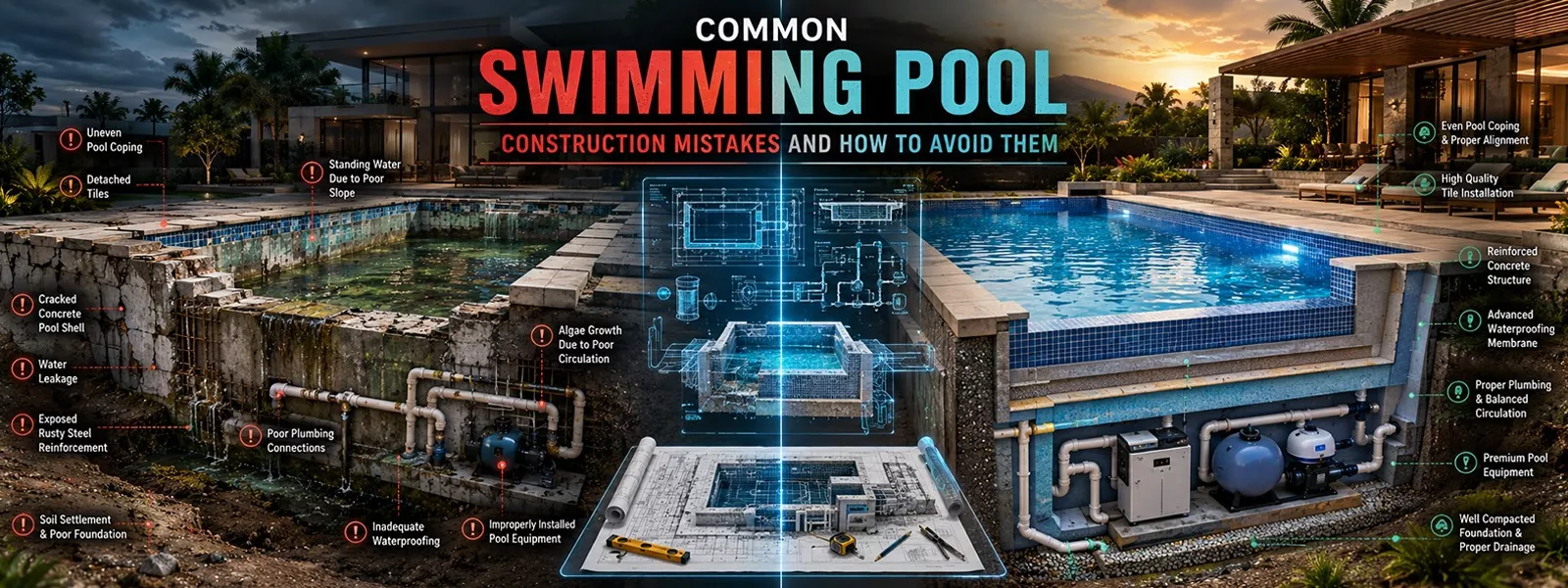
Building a swimming pool is a significant investment. In India, a well-built residential pool can run anywhere from ₹5 lakh to ₹40 lakh or more, depending on size, finish, and equipment. That kind of money deserves a project done right the first time.
But pool construction mistakes happen far more than people realize. Some surface within a few months. Others stay hidden for years — and when they appear, the repair costs can match half of what you originally spent.
At DS Water Technology, with over 15 years of swimming pool construction experience and certifications from ISO and MSME, we have seen firsthand what goes wrong when a pool is rushed, under-engineered, or built by the wrong contractor. This guide walks through the most critical mistakes — and exactly how a qualified swimming pool builder avoids each one.
Why Pool Construction Mistakes Are More Common Than You Think in India?
India's pool construction market has grown rapidly over the last decade. Residential demand has jumped in cities like Pune, Hyderabad, Ahmedabad, and the NCR. With that growth has come an influx of contractors — some experienced, many not.
The result? Clients often choose on price alone, not process. And when corners get cut on a structure that holds thousands of litres of water under constant pressure, the damage compounds fast.
Understanding what these mistakes look like puts you in control of the conversation with any contractor before work begins.
Mistake #1 — Skipping Proper Soil Testing and Site Analysis
This is the most fundamental error in swimming pool construction, and it is more common in India than anywhere else.
Before a single brick is laid or any excavation begins, the soil bearing capacity of your plot must be tested. India has enormous variation in soil types — black cotton soil in Maharashtra and Madhya Pradesh, laterite in Kerala and Karnataka, waterlogged clay in parts of Bengal and Assam. Each type behaves differently under the hydrostatic pressure of a filled pool.
What Happens When Soil Assessment Is Ignored
- Black cotton soil expands when wet and contracts when dry, causing pool shells to shift and crack
- High water tables create upward hydrostatic pressure, which can literally push an empty pool out of the ground
- Soft or unstable subsoil leads to uneven settlement — visible as cracks across the floor or leaning walls
- These are not cosmetic issues. They are structural failures that require full demolition and rebuild
A qualified swimming pool contractor will always conduct a soil investigation report before finalizing the structural design. It is non-negotiable.
Mistake #2 — Poor Waterproofing and Sealing
Water leakage is the most commonly reported complaint after pool construction in India. And in almost every case, it traces back to waterproofing that was either skimped on, applied incorrectly, or used the wrong product for the substrate.
A swimming pool shell is not naturally watertight. Concrete is porous. Without a layered waterproofing system — typically a combination of crystalline waterproofing, SBR-modified plaster, and a quality tile adhesive — the structure will leak. It is a matter of when, not if.
Signs Your Waterproofing Was Done Wrong
- Wet patches on surrounding soil or landscaping within 3–6 months of filling
- Pool water level drops more than 6mm per day without explanation
- Efflorescence (white salt deposits) forming on pool walls
- Tile debonding within the first year
Waterproofing done right uses compatible, tested materials applied in controlled conditions. Humidity, surface preparation, and curing time all affect final performance — factors that only an experienced team manages correctly.
Mistake #3 — Wrong Pool Shell Design or Structural Calculations
Not every contractor who builds pools is a structural engineer. And yet the pool shell must be designed to withstand the load of thousands of litres of water, the lateral pressure of surrounding soil, and in some cases — seasonal movement in expansive clay soils.
Without correct reinforcement bar sizing, concrete grade specification, and wall thickness calculations, a pool shell can develop cracks under stress. In worst-case scenarios, this requires partial or complete demolition.
A legitimate swimming pool builder will provide structural drawings stamped by a qualified civil engineer, especially for pools larger than 6m x 4m or pools on upper floors and terraces.
Mistake #4 — Undersized or Poorly Designed Filtration System
The filtration system is the heart of a swimming pool. A pool without correctly sized filtration is like a house without proper drainage — it works for a while, and then it does not.
In India, many contractors undersize the filter to reduce upfront equipment cost. The visible result within months: perpetually cloudy water, high chlorine demand, algae growth, and a pool that feels uncomfortable to swim in.
Correct filtration design depends on the pool volume, bather load, and climate. A 50,000-litre pool in Chennai — where ambient temperatures push algae growth — has different filtration requirements than the same pool in Shimla.
What an Undersized Filter Actually Costs You
| Issue Caused by Undersized Filtration | Typical Repair / Ongoing Cost |
|---|---|
| Chronic algae and water chemistry imbalance | ₹3,000–₹8,000/month in excess chemicals |
| Early filter media replacement | ₹8,000–₹20,000 every 12–18 months instead of 5 years |
| Pump motor burnout from overwork | ₹15,000–₹35,000 replacement cost |
| Full filtration system upgrade | ₹50,000–₹1,50,000 post-installation |
Mistake #5 — Ignoring Plumbing Layout and Hydraulic Balance
Plumbing mistakes are invisible until they are not. Poor pipe routing, incorrectly sized return jets, and skimmers placed without hydraulic analysis create dead zones — areas of water that do not circulate. Dead zones breed bacteria, algae, and debris accumulation.
Common issues include skimmers placed downwind of prevailing breezes (so debris skips them entirely), return jets aimed incorrectly (creating turbulence rather than circulation), and undersized pipe diameters that strain the pump motor.
A properly hydraulically balanced pool will have clean, consistent circulation reaching every corner. This is tested and verified during commissioning — something only an experienced swimming pool contractor does systematically.
Mistake #6 — Using Low-Quality or Wrong Materials for Indian Climate
India's climate diversity is extreme. What works in Germany or Australia does not automatically work in Rajasthan or Tamil Nadu. UV radiation, hard water, and temperature extremes affect tile adhesives, grout, PVC plumbing, and pool equipment differently than in temperate climates.
Specific failures we see regularly:
- Grout cracking within 6 months due to high-TDS (total dissolved solids) water
- PVC fittings becoming brittle in high UV exposure zones
- Variable speed pump controllers failing due to power fluctuations
- Underwater lights with inadequate IP rating corroding within a monsoon season
Material specifications matter. DS Water Technology sources equipment and materials tested for Indian conditions — a direct result of 15 years of regional experience.
Mistake #7 — Not Factoring Monsoon Season Into the Construction Timeline
This one is unique to India and almost entirely ignored by content from UK or US-based sources.
Concrete curing requires controlled conditions. High humidity during monsoon months affects curing times, increases risk of surface defects, and can compromise waterproofing adhesion. Starting a pool pour in June or July in Mumbai or Kochi without accounting for this is asking for problems.
Equally important: the monsoon raises water tables. If a freshly excavated pool shell sits unprotected before filling, hydrostatic pressure from the rising water table can damage or displace the structure.
The right swimming pool builder plans construction windows to avoid the critical structural phases during peak monsoon — or implements specific protective measures if the timeline cannot shift.
How to Choose the Right Swimming Pool Contractor in India?
Knowing the mistakes is only half the picture. The other half is knowing how to identify a contractor who won't make them.
Questions to Ask Before Signing Any Contract
- Can you provide a structural drawing stamped by a licensed civil engineer?
- What waterproofing system do you use, and which products specifically?
- How do you calculate filtration system size for our pool volume?
- Do you have ISO or other quality certifications?
- Can I speak to three recent clients and visit a completed project?
- What is your warranty on the pool shell and equipment?
- How do you handle the construction timeline around monsoon?
Any contractor who cannot answer these confidently is not ready for your project.
What Good Swimming Pool Construction Looks Like — A Process Checklist
For reference, here is what a correctly executed pool construction process includes at every stage:
| Phase | What a Good Contractor Does |
|---|---|
| Site Assessment | Soil test report, water table check, slope analysis, structural feasibility |
| Design | Structural drawings by engineer, hydraulic design, electrical layout, equipment spec sheet |
| Excavation | Precise depth and dimension, dewatering system if water table is high |
| Shell Construction | Correct rebar grade and spacing, approved concrete mix, controlled pour and curing |
| Waterproofing | Multi-layer system applied to dry substrate, cured before plastering |
| Plumbing & Filtration | Correctly sized pipes and equipment, leak-tested before backfill |
| Finishing | Quality tiles with certified adhesive, grout sealing, equipment commissioning |
| Commissioning | Water chemistry balance, circulation test, filtration efficiency test |
| Handover | Operations manual, chemical guide, maintenance schedule, warranty documentation |
FAQ Section
Q1: What is the most common swimming pool construction mistake in India?
The most common mistake is inadequate waterproofing. Many contractors use a single-layer cement plaster without a proper crystalline or polymer-modified waterproofing system. This leads to slow leaks that are expensive to detect and repair after tiles are laid.
Q2: How much does it cost to fix a swimming pool construction mistake?
Repair costs depend on the type of failure. A minor waterproofing repair might cost ₹30,000–₹80,000. Structural cracks requiring shell repair can cost ₹1,50,000–₹5,00,000. Full rebuilds in cases of complete structural failure can match or exceed the original construction cost.
Q3: How long does swimming pool construction take in India?
A standard residential pool of 8m x 4m typically takes 45–90 days, depending on soil conditions, design complexity, and weather. Pools built during monsoon season may take longer due to curing restrictions and site access issues.
Q4: What certifications should a swimming pool contractor in India have?
Look for contractors with ISO 9001 quality certification, MSME registration, and experience certificates from completed projects. ISO-certified contractors follow documented quality management processes, which directly reduces construction errors.
Q5: Can a swimming pool be built on black cotton soil in India?
Yes, but it requires specific engineering — typically a raft foundation or pile foundation to distribute load and resist soil movement. Contractors without experience in expansive soil types should not be used for pools on black cotton soil.
Q6: What is the minimum recommended filtration turnover rate for a residential pool in India?
The standard recommendation is a full water turnover every 6–8 hours for residential pools, every 4 hours for pools with higher bather loads. In warmer climates (Chennai, Hyderabad, Goa), tighter turnover is advisable to control algae growth.
Q7: Is it cheaper to repair a pool or rebuild it?
It depends on the type and extent of damage. Surface and waterproofing repairs are typically cost-effective. Structural failures — cracked shells, foundation movement — usually require at least partial rebuild, and full rebuild may be cheaper than repeated patchwork repairs.
Q8: How do I know if my pool contractor is qualified?
Ask for completed project references you can visit, structural drawings from a licensed engineer, and certifications (ISO, MSME). A qualified contractor will also provide a detailed scope of work document and written warranty terms before starting.
Q9: What is the ideal time of year to build a swimming pool in India?
October to March is the optimal construction window for most of India. This avoids the monsoon season, allows proper concrete curing in controlled humidity, and reduces site disruption. Pre-construction planning can begin earlier in the year.
Q10: How deep should a residential swimming pool be in India?
Most residential pools are 1.2m–1.5m at the shallow end and 1.5m–1.8m at the deep end. Pools intended for diving require a minimum of 2.5m depth in the deep zone, which also requires additional structural engineering.
Q11: Why does pool water turn green soon after construction?
Early algae growth is usually caused by an undersized or poorly commissioned filtration system, incorrect initial water chemistry balancing, or inadequate circulation design. It signals a systemic issue, not just a chemical one.
Q12: What is the warranty on a swimming pool in India?
A reputable contractor offers at minimum 1 year on equipment and 3–5 years on the pool shell structure. DS Water Technology provides structured warranty coverage with documented handover and maintenance protocols.
Q13: Can swimming pools be built on terraces or rooftops in India?
Yes, but this requires significantly more engineering — the building slab must be evaluated for load capacity, and the pool shell needs a specialized lightweight structural design. Waterproofing requirements are also more stringent to protect the structure below.
Q14: What is the swimming pool construction cost per square foot in India?
Pool construction costs in India range from approximately ₹2,500 to ₹6,000 per square foot of water surface area, depending on pool type, finish, equipment quality, and location. This does not include civil work for pump rooms or surrounds.
Q15: How do I maintain a swimming pool after construction?
Basic pool maintenance includes daily skimming and water level check, twice-weekly chemical testing and dosing, weekly backwashing of the filter, and monthly inspection of all fittings and equipment. DS Water Technology provides full maintenance contracts for post-construction care.
Ready to build or
upgrade your pool?
Tell us about your swimming pool project and one of our experts will contact you within 24 hours with the best solution and pricing.
New Delhi - 110086, Delhi, India