126, Mange Ram Park, Rohini, Delhi, India


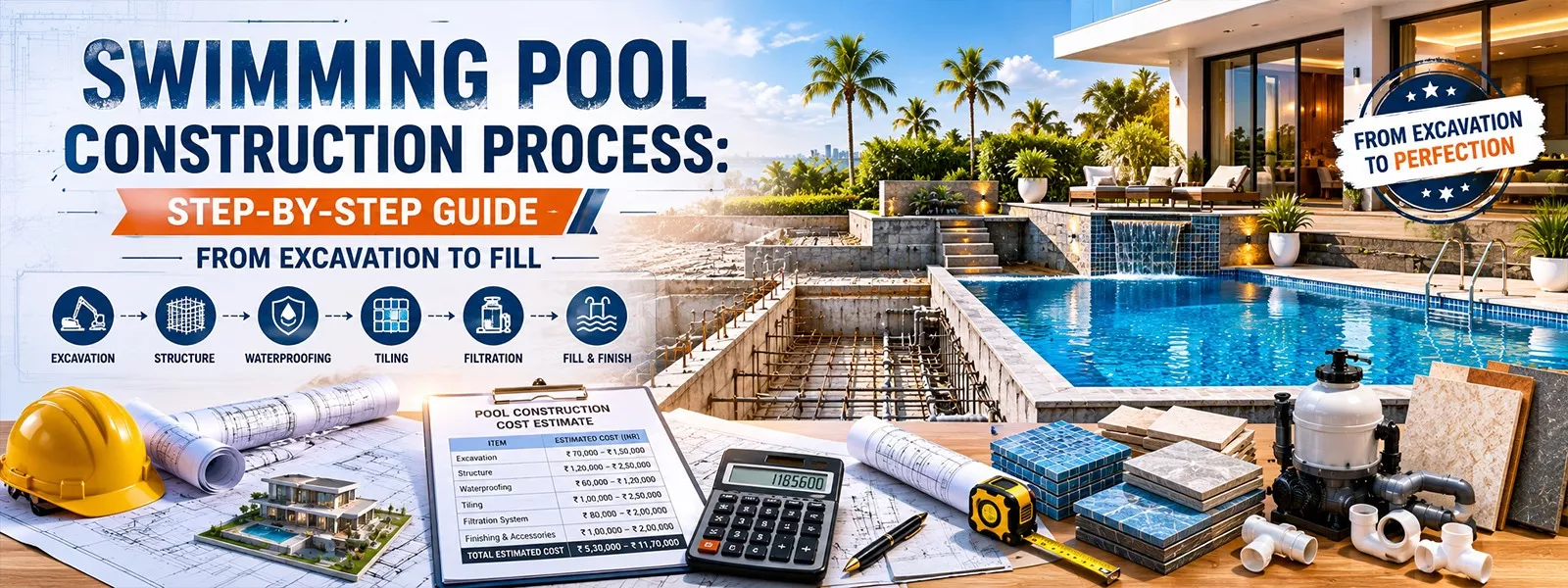
Planning a swimming pool is exciting — until you realise how little information exists that actually applies to India. Most guides online are written for UK or US conditions, use materials unavailable here, and completely ignore the soil challenges, monsoon seasons, and permit requirements that define swimming pool construction in India.
This guide is different. It covers every phase — from the soil test your contractor should be doing before a single machine enters your plot, to the day water fills your finished pool. Whether you're building a 4×8 metre backyard pool in Pune or a commercial resort pool in Goa, the process is the same. The details change. That's what we'll walk through.
DS Water Technology has been involved in pool water systems across India for 15 years. What follows is what we've actually seen work — and what we've seen fail.
Before Construction Begins — What Most People Skip
The biggest mistakes in pool construction happen before excavation starts. Skipping the groundwork phase — literally — is the fastest way to end up with a cracked pool or a rejected permit.
Soil Testing and Site Assessment
Not all ground is the same. Black cotton soil — common in Maharashtra, Madhya Pradesh, and parts of Karnataka — expands significantly when wet. A pool built directly into it without proper engineering will crack within a few monsoon seasons. Coastal plots in Kerala or Tamil Nadu often have a high water table, which complicates excavation and dewatering. Rocky terrain in parts of Rajasthan drives up excavation costs considerably.
A basic geotechnical (soil bearing) test costs relatively little but informs every structural decision that follows. Any contractor who wants to start without one is cutting a corner you'll pay for later.
Key things evaluated:
- Soil bearing capacity — can it support a full pool (often 100+ tonnes when filled)?
- Water table depth — critical for coastal, low-lying, and river-adjacent plots
- Soil type — expansive soils need special reinforcement and drainage planning
- Access for excavation equipment — is there clear vehicle access to the site?
Legal Permits and Approvals in India
This step gets ignored in almost every pool construction guide you'll find online — because most are written for other countries. In India, depending on your location, you may need:
- Approval from the local municipal corporation or gram panchayat
- No-Objection Certificate from your housing society or RWA
- Compliance with setback rules under local building bylaws
- For commercial/resort pools — additional state tourism or FSSAI-related clearances
Starting construction without these can result in demolition orders. Get clearances first, even if it delays the start by a few weeks.
Choosing the Right Pool Shape and Size
For most residential projects in India, rectangular pools are the most practical. They use space efficiently, are simpler to construct, and easier to maintain. Freeform or kidney shapes are common in resorts and villa projects where aesthetics take priority.
Standard residential dimensions: 4m × 8m to 5m × 10m, with a shallow end of 1.0-1.2m and deep end of 1.6-1.8m. Larger doesn't always mean better — an oversized pool becomes expensive to maintain.
Step 1 — Excavation
Excavation involves digging the pool shell to the designed depth and footprint, with additional allowance for the concrete wall thickness (typically 150-200mm). On hard rock sites, hydraulic breakers or controlled blasting may be required — this significantly increases both cost and timeline.
The excavated area must be cleaned, levelled, and compacted. Soft zones are filled with gravel and well-compacted before any structural work begins. If the water table is high, temporary dewatering pumps keep the pit dry during construction.
Step 2 — Steel Reinforcement (RCC Framework)
This is the pool's structural backbone. TMT steel bars (typically Fe 500 grade) are tied in a double-layer mesh grid — commonly 150mm × 150mm spacing for walls and floor. Additional reinforcement goes at wall-floor junctions, step edges, and corners, which are the highest-stress points.
A concrete cover of at least 40mm must be maintained over all steel. In pools, the steel is under constant exposure to moisture — inadequate cover leads to corrosion and structural failure within years.
Step 3 — Concrete Application
Two methods are common in India:
| Method | Ideal Range | Best Suited For | Common In |
|---|---|---|---|
| Conventional RCC with formwork | Concrete poured into timber/steel formwork | Rectangular pools, standard designs | Tier-2/3 cities, budget projects |
| Shotcrete (Gunite) | Concrete pneumatically shot at high velocity onto steel frame | Curved shapes, large pools, premium projects | Metro cities, resorts, luxury residential |
Either method uses M30 grade concrete with waterproofing admixtures. A mandatory curing period of 7-10 days follows before plumbing work begins.
Step 4 — Plumbing and Filtration Installation
Plumbing is installed before the interior finish is applied — getting this sequencing wrong is an expensive mistake. The circulation system includes:
- Main drain at the pool floor
- Skimmers at the waterline to collect surface debris
- Return jets to push treated water back into the pool
- Pipework connecting to the equipment room — pump, filter, and optional heating or UV system
Pump and filter sizing must match the pool volume. A pool filter that's too small won't complete a full water turnover in 6-8 hours, leading to persistent water quality issues. The equipment room needs ventilation and waterproofing — two things often cut from budgets.
Step 5 — Waterproofing
Waterproofing is the difference between a pool that holds water for decades and one that starts seeping within the first monsoon. Several systems are used in India:
- SBR (Styrene-Butadiene Rubber) waterproofing coating — most common for residential pools
- Crystalline waterproofing admixtures (e.g., Xypex) — added directly to the concrete mix
- Epoxy-based coatings — used as a secondary layer in premium builds
The waterproofing layer must be applied to the full shell before any interior finish work starts. Expansion joints must be properly sealed — they are the most common entry point for leaks.
Step 6 — Interior Finishing
The finish is what you see, touch, and swim against. Options commonly used in India:
| Finish | Durability | Maintenance | Best For |
|---|---|---|---|
| White cement marble plaster | 8-12 years | Low-moderate | Budget to mid-range residential |
| Ceramic / mosaic tiles | 15-20 years | Moderate | Residential, mid-range commercial |
| Glass tiles | 20+ years | Low | Luxury residential, resorts |
| Vinyl liner | 8-10 years | Low (until damage) | Above-ground or budget projects |
Tile grout lines and plaster surface quality are critical. Rough or unsealed surfaces harbour algae. Shoddy grouting is one of the top causes of long-term pool maintenance problems.
Step 7 — Pool Deck and Surroundings
A well-built pool deck isn't decorative — it's functional. It needs to:
- Slope slightly away from the pool to drain rainwater and prevent flooding (monsoon-critical)
- Use anti-skid tiles or stone to prevent slips
- Have proper drainage channels around the perimeter
- Include safety handrails, ladder anchors , and llighting fixtures
Deck and landscaping design should be finalised before any civil work begins around it. Retrofitting drainage after the fact is expensive.
Step 8 — Final Inspection, Filling, and Handover
Before filling, the contractor should conduct a thorough inspection: checking for surface cracks, verifying all plumbing connections, testing the filtration system dry-run, and confirming all electrical work is properly isolated and certified.
The pool is then filled — typically using municipal supply or tested bore water. Once filled, a basic water test confirms the starting conditions. The filtration system runs continuously for 24-48 hours before the pool is considered ready for use.
At handover, the contractor should provide: equipment manuals, spare parts for fittings, a maintenance schedule, and a basic orientation on the filtration system. If they don't offer this, ask for it.
Construction Methods Compared — Which Is Right for You?
Use this table as your baseline. These are the target ranges recommended for Indian pool conditions (not US/European defaults, which don't account for our climate).
| Method | Cost | Durability | Construction Time | Customisation | Best For |
|---|---|---|---|---|---|
| RCC (conventional) | Moderate | 25-30 years | 8-14 weeks | Limited shapes | Standard rectangular pools |
| Shotcrete / Gunite | Moderate-high | 25-30 years | 8-12 weeks | High | Custom shapes, large pools |
| Fibreglass shell | Higher upfront | 20-25 years | 3-6 weeks | Pre-set shapes only | Fast installation, low maintenance |
| Vinyl liner (above-ground) | Low | 8-12 years | 2-4 weeks | Moderate | Budget, temporary, above-ground |
For permanent in-ground pools in India, RCC and shotcrete are the dominant choices. Fibreglass is growing in popularity for residential projects where speed matters, though size options are limited by what manufacturers produce.
Not sure which construction method is right for your site? Ask our team →
Swimming Pool Construction Cost in India
| Pool Type & Finish | Approx. Size | Estimated Cost (INR) |
|---|---|---|
| Basic RCC, plaster finish | 4m × 8m | ₹8 - 15 lakhs |
| Mid-range RCC, ceramic tiles | 5m × 10m | ₹15 - 25 lakhs |
| Premium shotcrete, glass tiles | 6m × 12m | ₹25 - 45 lakhs |
| Fibreglass (installed) | Standard shell | ₹12 - 22 lakhs |
| Commercial / resort pool | Custom | ₹50 lakhs and above |
These are realistic starting figures — not marketing numbers. Final costs depend on soil conditions, location (labour costs vary significantly across India), equipment specifications, and interior finish quality. Always get 3 itemised quotes before proceeding.
How Long Does Pool Construction Take in India?
| Phase | Typical Duration |
|---|---|
| Site assessment, design finalisation, permits | 2-4 weeks |
| Excavation | 3-7 days |
| Steel reinforcement | 4-7 days |
| Concrete / shotcrete + curing | 10-18 days |
| Plumbing and filtration installation | 5-8 days |
| Waterproofing | 3-5 days |
| Interior finishing (plaster / tiles) | 7-15 days |
| Decking and surroundings | 5-10 days |
| Filling, testing, handover | 3-5 days |
| Total (under normal conditions) | 10-16 weeks |
The main delays in India: permit clearances (can add 2-4 weeks), monsoon rain (avoid excavating June-September in most regions), material procurement delays, and contractor scheduling. Build these buffers into your timeline from the start.
Mistakes to Avoid During Pool Construction in India
- Starting without a soil test — the single most expensive shortcut
- Not obtaining permits before breaking ground — can result in stop-work orders or demolition notices
- Choosing a contractor based only on price — the cheapest quote usually reflects skipped steps
- Under-sizing the pump and filter — leads to permanent water quality problems
- Skipping waterproofing on expansion joints — first place leaks develop
- No deck drainage plan — water pools around the edge during monsoon, causing structural damage
- Poor equipment room ventilation — damages pump and filter motors over time
- No written handover documentation —leaves you without maintenance guidance
How to Choose the Right Pool Construction Contractor?
In India, swimming pool construction is largely an unregulated market. Anyone can call themselves a pool contractor. Here's how to separate the capable from the casual:
- Ask to visit at least two completed projects — in person, not just photos
- Request an itemised quote, not a lump-sum — if they refuse, walk away
- Verify they have civil engineering credentials or work — with a qualified structural engineer
- Check that the quote explicitly includes filtration, plumbing, waterproofing, and finishing — — not just the shell
- Ask what waterproofing system they use and why — a blank stare is a red flag
- Confirm their after-sales support — who do you call when something goes wrong?
DS Water Technology works with verified pool construction professionals across India and provides full water system design and equipment supply for new builds. Our 15-year track record and ISO-certified processes mean you're working with a team that has seen — and solved — every common pool construction problem.
record and ISO-certified processes mean you're working with a team that has seen — and solved — every common pool construction problem.
FAQ Section
Q1: How long does swimming pool construction take in India?
A standard residential pool takes 10-16 weeks from soil assessment to handover under normal conditions. Permit delays, monsoon interruptions, and material availability can extend this. Build a 4-6 week buffer into your project plan.
Q2: What is the cost of swimming pool construction in India?
A basic residential pool (4m × 8m, plaster finish) starts at around ₹8-15 lakhs. Mid-range tiled pools run ₹15-25 lakhs. Premium and commercial pools start at ₹25-50 lakhs and scale up from there. Always get 3 itemised quotes — lump-sum quotes hide cut corners.
Q3: Which construction method is best for a swimming pool in India — RCC or shotcrete?
Both are excellent. RCC with formwork is more accessible in smaller cities and suits standard rectangular pools. Shotcrete is better for custom shapes, larger pools, or projects where fast construction matters. For most residential pools, conventional RCC is reliable and cost-effective.
Q4: Do I need a permit to build a swimming pool in India?
Yes, in most urban and peri-urban areas you do. You will typically need approval from the local municipal body, a housing society NOC if applicable, and compliance with setback regulations. Commercial pools may require additional state-level clearances. Always secure permits before starting work.
Q5: Can a swimming pool be built on black cotton soil?
Yes, but it requires special structural engineering. Black cotton soil expands significantly with moisture and can exert lateral pressure on pool walls. A structural engineer must design appropriate reinforcement, drainage, and possibly pressure-relief systems. Don't let a contractor skip this assessment on black cotton soil sites.
Q6: What is the minimum size for a home swimming pool in India?
A functional lap-swim pool starts at 3m × 6m. Most residential pools are 4m × 8m to 5m × 10m. Smaller than 3m × 6m functions more as a plunge pool. Size also affects filtration cost — don't build larger than you'll realistically use and maintain.
Q7: What is shotcrete and how is it different from normal concrete pouring?
Shotcrete (or gunite) is concrete pneumatically sprayed at high velocity directly onto the steel reinforcement frame. It bonds extremely well, needs no formwork for curved surfaces, and is widely used for custom-shaped or large pools. It achieves higher compressive strength than many poured concrete methods.
Q8: How deep should a residential swimming pool be in India?
Standard residential pools use a 1.0-1.2m shallow end and 1.6-1.8m deep end. If the pool is primarily for lap swimming, a uniform 1.4m depth works well. Diving boards require a minimum 2.5m deep section and are rarely installed in residential pools in India.
Q9: Can I build a swimming pool during monsoon season in India?
Excavation and concrete work during heavy monsoon is strongly inadvisable — site flooding, weak concrete curing, and structural issues are real risks. The ideal construction window is October to May across most of India. If your project spans the monsoon, plan for finishing work (tiling, decking) during those months rather than structural phases.
Q10: What type of interior finish is best for an Indian swimming pool?
For budget to mid-range residential pools, white cement marble plaster is the standard. Ceramic or mosaic tiles offer longer life and better aesthetics. Glass tiles are used in premium and resort pools. Vinyl liners are rare for in-ground pools in India due to durability issues in the climate.
Q11: How do I prevent my swimming pool from cracking?
The key factors: proper soil testing before construction, full-strength RCC with adequate steel coverage, waterproofing admixtures in the concrete mix, correctly placed and sealed expansion joints, proper curing time, and a deck design that keeps rainwater away from the pool edge. Cracks from expansive soil are the most common structural failure in Indian pools.
Q12: What filtration system do I need for a swimming pool in India?
A sand filter with a centrifugal pump is standard for most residential pools. The pump and filter must be sized to turn over the full pool volume in 6-8 hours. For larger commercial pools, multi-port valve systems or cartridge filters may be more practical. The equipment room should be ventilated and accessible for maintenance.
Q13: How do I check if my pool contractor is reliable?
Visit their completed projects in person. Ask for an itemised quote (not a lump sum). Verify they specify the waterproofing system, concrete grade, and filtration equipment. Ask who handles post-construction problems. A contractor who can't answer clearly on any of these points is a significant risk.
Q14: What is the maintenance cost of a swimming pool in India per month?
For a standard residential pool, regular maintenance including filtration electricity, periodic professional servicing, and consumables runs approximately ₹2,000-5,000 per month. Larger pools and commercial pools scale proportionally. Deferred maintenance always costs more than consistent upkeep.
Q15: What documentation should I receive at pool handover?
You should receive: equipment operation manuals, warranty documents for all installed equipment, a recommended maintenance schedule, contact details for service support, and a brief orientation on the filtration system. If your contractor doesn't provide this, request it explicitly — it determines how well you can look after your pool long-term.
Important Keywords & Tags for swimming pool contractor in Delhi
Popular Search Terms: People searching for swimming pool contractor in Delhi also look for these related keywords and services.
Ready to build or
upgrade your pool?
Tell us about your swimming pool project and one of our experts will contact you within 24 hours with the best solution and pricing.
New Delhi - 110086, Delhi, India