126, Mange Ram Park, Rohini, Delhi, India


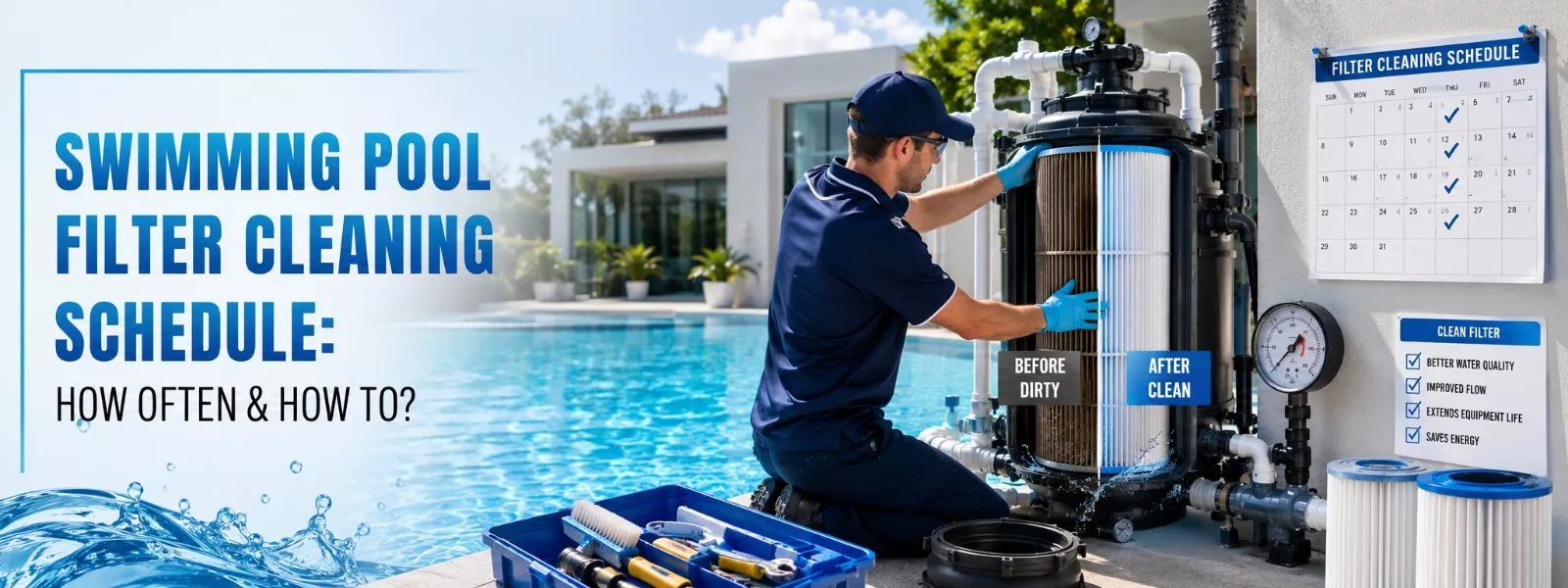
Your pool water looks fine — but your filter is silently struggling.
Most pool owners clean their swimming pool filter only when something goes wrong. By then, you've already paid the price: cloudy water, strained pump motors, rising chemical costs, and sometimes a full filter replacement that could have waited another three years.
At DS Water Technology, we've serviced and supplied pool filtration systems across India for over 15 years. In that time, the most common issue we see isn't equipment failure — it's neglected maintenance. This guide gives you a practical, filter-type-specific cleaning schedule so you stay ahead of the problem.
Why Your Pool Filter Needs a Proper Cleaning Schedule?
A swimming pool filtration system does more than catch leaves. It removes bacteria, fine particles, algae spores, sunscreen residue, hair, and the invisible organic load that builds up every time someone swims.
When that filter gets clogged, flow rate drops. Your pump works harder. Pressure builds. Chemicals don't circulate properly. And water that looks clear at 10 AM can turn green by evening.
What Happens When You Skip Filter Maintenance?
Here's what poor filter maintenance actually costs:
- Increased chemical consumption — clogged filters reduce chlorine distribution, so you add more and still don't get results
- Pump damage — restricted flow overheats the motor and wears out seals faster
- Higher electricity bills — a struggling pump pulls more current
- Algae outbreaks — the number one complaint from pool owners who "do everything right" but skip filter cleaning
- Full filter replacement —sand media that should last 5 - 7 years can fail in 2 - 3 if never properly backwashed or deep cleaned
How Indian Water Conditions Affect Filter Frequency?
India presents challenges most international maintenance guides ignore.
Municipal water in many Indian cities carries high TDS (Total Dissolved Solids), elevated iron content, and seasonal turbidity spikes — especially during monsoon when source water quality drops sharply. Borewell water, used by many residential societies, often has hardness levels that cause scale to form on filter media, reducing its effectiveness over time.
The practical result: your filter works harder than the same filter would in Europe or North America. A backwash schedule designed for London is too conservative for Delhi or Chennai.
Types of Swimming Pool Filters and Their Cleaning Needs
Not all pool filters clean the same way — and not all need the same attention.
1. Sand Filters — Most Common in India
Sand filters push water through a bed of specially graded silica sand. Particles get trapped in the sand bed and are flushed out during backwashing. They're durable, cost-effective, and ideal for Indian pool sizes ranging from small residential pools (30,000 - 60,000 litres) to large club pools (3 - 10 lakh litres).
Sand needs replacement roughly every 5 - 7 years under normal conditions, though in high-bather-load pools or areas with poor source water, this can shorten to 3 - 4 years.
2. Cartridge Filters — Growing in Premium Segments
Cartridge filters use a pleated polyester element to trap particles. They offer finer filtration than standard sand (down to 10 - 15 microns vs 20 - 40 microns for sand) and don't require backwashing — you simply remove and rinse the cartridge.
Popular in villa pools and hotel spas where water clarity standards are higher and backwash water disposal is inconvenient.
3. Diatomaceous Earth (DE) Filters
DE filters use fossilized diatom powder coated on a grid to achieve sub-10-micron filtration — the finest available. They're common in competition pools and high-end resort properties. Maintenance is more involved and DE powder must be handled carefully.
4. Multimedia / Pressure Filters for Commercial Pools
Large commercial pools often use multimedia pressure filters with layers of anthracite, sand, and gravel. These are the workhorses of hotel pools, water parks, and institutional pools. Maintenance requires professional handling and is typically part of an annual service contract.
How Often Should You Clean Each Type of Pool Filter?
Here's a quick reference table. Use it as a starting point — actual frequency depends on bather load, source water quality, and pool size.
| Filter Type | Backwash / Rinse | Deep Clean | Media Replacement |
|---|---|---|---|
| Sand Filter | Every 4 - 6 weeks | Every 6 - 12 months | Every 5 - 7 years |
| Cartridge Filter | Every 2 - 4 weeks | Every 3 - 6 months | Every 2 - 3 years |
| DE Filter | Every 4 - 8 weeks | Annual grid cleaning | Add DE after each backwash |
| Multimedia Filter | As per pressure differential | Every 6 - 12 months | Every 7 - 10 years |
A note on pressure: Your filter's pressure gauge is the most reliable cleaning trigger. If baseline pressure when clean is 10 PSI and it reads 18 - 20 PSI, clean it — regardless of what the calendar says.
Step-by-Step Guide: How to Clean a Swimming Pool Sand Filter
Since sand filters are by far the most common type used in Indian pools, here's a detailed process.
When to Backwash vs When to Deep Clean?
Backwash = routine maintenance (monthly or pressure-triggered) Deep clean = semi-annual chemical treatment to break down oils and scale
Backwash Process:
- Turn off the pool pump completely
- Set the multiport valve to BACKWASH position
- Turn the pump back on and run for 2 - 3 minutes until the sight glass runs clear
- Turn off the pump again
- Set the valve to RINSE and run for 30 - 60 seconds
- Return the valve to FILTER position
- Restart the pump and note the new pressure reading — this is your clean baseline
Never skip the Rinse step. Moving from Backwash to Filter without rinsing can send a cloud of fine sand particles into your pool.
What to Check After Every Backwash?
- Confirm pressure has dropped back toward baseline
- Check that the sight glass is clear during the next pump cycle
- Inspect the multiport valve O-ring seal for any signs of cracking (common in Indian summers)
- Note the date — don't rely on memory for your next cycle
Warning Signs Your Pool Filter Needs Immediate Attention
Don't wait for the monthly schedule if you notice any of these:
- Pressure 8 - 10 PSI above normal — filter is choked; backwash immediately
- Cloudy water despite correct chemical levels — filter isn't capturing fine particles
- Algae returning within days of treatment — filtration is inadequate
- Water returning to pool through the backwash line during normal operation — internal valve or lateral failure
- Sand or fine grit appearing on the pool floor — broken laterals inside the filter tank
- Pump running hot or tripping the breaker — severely restricted flow
Any of the last three items on this list means get a professional involved. These aren't cleaning issues — they're equipment failures.
Pool Filter Maintenance Schedule by Season
Indian pool maintenance follows a fairly predictable seasonal rhythm. Most pool operators in India know this instinctively, but having it written down helps.
Pre-Summer Prep (March - April)
This is the most important maintenance window. Pool usage is about to spike. Do this before the heat arrives:
- Full backwash and rinse cycle
- Inspect and clean the strainer basket
- Check multiport valve O-rings and seals
- If last sand replacement was more than 5 years ago, test media performance — slow clearing time after backwash is a signal
- Test baseline pressure and record it
Monsoon Maintenance (June - September)
Monsoon is hard on pools. Rainwater dilutes chemicals, organic load from dust and debris increases, and source water turbidity spikes. Backwash more frequently — every 2 - 3 weeks rather than monthly during peak monsoon.
If the pool is covered during heavy rain, remove standing water from the cover before it seeps in. An overwhelmed filter combined with diluted chlorine is a recipe for a green pool.
Post-Monsoon Reopening (October - November)
Many pools are partially neglected during the monsoon. Before the winter season begins:
- Full inspection of filter internals (hire a technician if it's a sand filter over 4 years old)
- Shock treat the pool water and run filtration continuously for 24 - 48 hours
- Clean or replace cartridge elements if applicable
- Check pump seals and motor performance
How Pool Size and Usage Frequency Affect Cleaning Intervals?
A pool's turnover rate — how many times the total water volume passes through the filter in 24 hours — directly affects how quickly the filter gets dirty.
For residential pools with low bather load (a family of 4), one full turnover per 8 hours is standard. A hotel pool with 50 swimmers per day may need 2 - 3 turnovers to maintain water quality.
Higher bather load = more frequent backwashing. No formula replaces watching your pressure gauge.
Rough adjustments by usage
| Usage Level | Standard Schedule | Recommended Adjustment |
|---|---|---|
| Occasional (1 - 2x/week) | Monthly backwash | Can extend to 6 - 8 weeks |
| Regular (daily family use) | Monthly backwash | Stay on monthly schedule |
| High (hotel, club, society pool) | Monthly backwash | Every 2 - 3 weeks |
| Very high (water park, public pool) | Monthly backwash | Weekly, pressure-monitored |
Common Pool Filter Maintenance Mistakes to Avoid
These are the patterns we see repeatedly after 15 years of pool service across India:
1. Backwashing Too Often
Some pool owners backwash every week thinking it helps. Counterintuitively, a small amount of accumulated debris improves sand filter efficiency by creating a filtering layer. Backwash when pressure rises, not by habit.
2. Skipping the Rinse Cycle
Already mentioned — but it bears repeating because it's the most common single mistake.
3. Running the Pump Too Few Hours
Many owners run the pump only 4 - 5 hours to save electricity. If your pool needs 8 hours for a full turnover, cutting to 5 means water is recirculating before it's fully filtered. You pay more in chemicals than you save in electricity.
4. Ignoring the Pressure Gauge
The gauge exists for a reason. Check it weekly. Write down the baseline.
5. Adding Chemicals Directly in Front of Return Jets
Concentrated chemicals can damage cartridge elements or coat sand media before they dilute. Always add chemicals with the filter running and away from return fittings.
6. Delaying Sand Replacement
Old, channelled sand has voids that water flows through without being filtered. If your pool water takes forever to clear after a backwash, the sand may be exhausted regardless of schedule.
When to Replace vs When to Clean Your Pool Filter?
Cleaning extends filter life. But at some point, cleaning stops working.
Replace the Sand Media When:
- Pressure doesn't drop significantly after backwashing
- Pool water consistently stays cloudy despite correct chemistry
- Visible channelling, clumping, or oily residue in the sand
- It's been more than 7 years since the last replacement
Replace the Cartridge Element When:
- Folds in the pleated element show visible tears or cracks
- An acid soak doesn't restore flow
- Pressure spikes return within days of cleaning
- It's been more than 2 - 3 years since the last replacement
Replace the Filter Tank Itself When:
- Visible corrosion on metal tanks
- Cracking or deformation of fibreglass tanks
- Repeated lateral failures inside a sand filter
- A technician finds the internal distribution system is compromised
For high-quality replacement options suited to Indian pool sizes and water conditions, explore our range of swimming pool filters and swimming pool filtration systems — available for residential, commercial, and institutional applications.
DS Water Technology — ISO Certified Pool Filtration Systems for Residential & Commercial Pools. Get a quote today.
FAQ Section
Q1. How often should I backwash my swimming pool sand filter?
As a general rule, every 4 - 6 weeks. But the most reliable trigger is your pressure gauge — backwash when pressure rises 8 - 10 PSI above your clean baseline, regardless of the calendar.
Q2. Can I clean a pool filter too often?
Yes, for sand filters. Backwashing too frequently removes the fine layer of debris that actually improves filtration. Let pressure guide you, not a rigid daily schedule.
Q3. How long should a pool filter backwash take?
Typically 2 - 3 minutes, until the sight glass runs clear. Followed by a 30 - 60 second Rinse cycle before returning to Filter mode.
Q4. Why is my pool water cloudy even after cleaning the filter?
Possible causes: exhausted sand media that needs replacement, a broken lateral inside the tank, incorrect water chemistry (high pH reduces chlorine effectiveness), or insufficient pump run time for adequate pool turnover.
Q5. How often should a cartridge pool filter be replaced?
The filter element (cartridge) typically lasts 2 - 3 years with proper cleaning every 2 - 4 weeks. The housing itself can last much longer with routine maintenance.
Q6. Does monsoon rain affect how often I need to clean my pool filter?
Yes, significantly. Rainwater dilutes chemicals and brings in organic debris. During peak monsoon in India, increase backwash frequency to every 2 - 3 weeks and monitor pressure more closely.
Q7. What happens if pool filter pressure is too high?
High pressure means restricted flow. The pump strains, water circulation suffers, and chemical distribution becomes ineffective. Backwash immediately. If pressure doesn't drop, inspect for channelled sand, broken internals, or a failed multiport valve.
Q8. How do I know when to replace swimming pool filter sand?
Replace the sand if: pressure doesn't return to baseline after backwashing, pool water stays cloudy with correct chemistry, or the media is over 5 - 7 years old. Visible clumping or channelling in the sand is also a clear sign.
Q9. What is the difference between backwashing and deep cleaning a pool filter?
Backwashing is a routine hydraulic flush that removes trapped particles from sand media. Deep cleaning involves a chemical treatment (typically a filter cleaning solution) that breaks down oils, sunscreen, algae residues, and scale that backwashing alone cannot remove. Do a deep clean every 6 - 12 months.
Q10. How many hours a day should I run my pool filter?
Enough to achieve at least one complete water turnover. For most residential pools in India (40,000 - 80,000 litres), this means 8 - 10 hours per day. High-use pools (hotels, clubs) may need 16 - 24 hours.
Q11. Do pool filters work differently in hard water areas?
Yes. Hard water (high calcium and magnesium content) causes scale to form on sand media and cartridge elements, reducing their effectiveness over time. In hard water areas, add a regular acid wash to your maintenance routine and consider a multimedia filter with scale-resistant media.
Q12. What is the best pool filter for an Indian residential pool?
Sand filters remain the most practical choice for most Indian residential pools — they're durable, easy to maintain, and handle variable source water quality well. Cartridge filters are suitable for smaller pools where high water clarity is a priority. The right choice depends on pool size, usage, and water source.
Q13. Can I run my pool without the filter for a few days?
Not recommended. Even a day or two without filtration in a busy pool allows bacteria and algae to establish. If the pump or filter is down for repairs, maintain chemical levels and run a manual vacuum. Bring the filter back online as quickly as possible.
Q14. How does bather load affect filter cleaning frequency?
Every swimmer introduces organic matter — sweat, sunscreen, oils, and bacteria — that the filter must process. A hotel pool with 40 - 50 daily swimmers will need filter attention 2 - 3 times more frequently than a family pool used a few times a week.
Q15. What certifications should I look for in a pool filter supplier?
Look for ISO-certified manufacturers or importers who follow established quality standards. In India, MSME registration and import-export certification indicate a legitimate, accountable supplier. DS Water Technology holds ISO certification, MSME registration, and importer-exporter certification — giving customers confidence in product quality and supply chain reliability.
Ready to build or
upgrade your pool?
Tell us about your swimming pool project and one of our experts will contact you within 24 hours with the best solution and pricing.
New Delhi - 110086, Delhi, India