126, Mange Ram Park, Rohini, Delhi, India


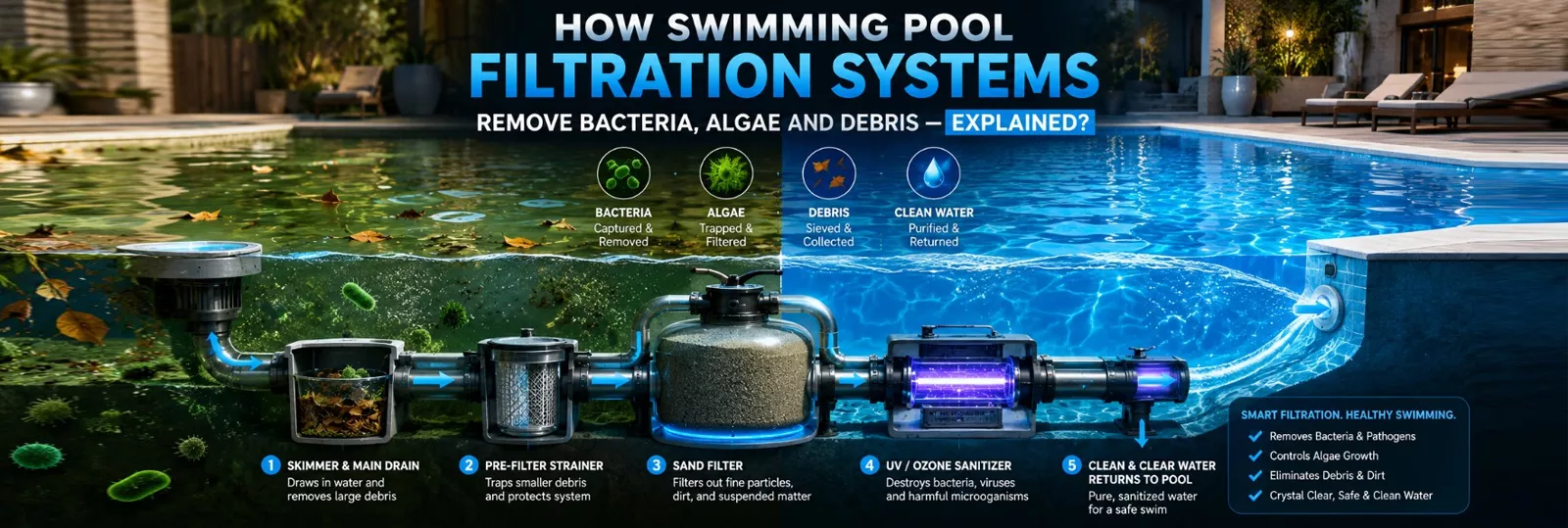
Pool water does not stay clean on its own. Every swimmer, every gust of wind, every monsoon shower adds something to the water — dust, sweat, dead skin, insects, bird droppings, and invisible microorganisms. A properly designed swimming pool filtration system is the first and most important line of defense against all of this.
In this guide, we explain exactly how pool filtration works at a scientific level — which contaminants get removed, how each filter type handles different particle sizes, and why filtration alone is only part of the equation. If you are evaluating swimming pool filters for a new build, an upgrade, or a troubleshooting situation, this will give you a practical, honest understanding.
What Does a Pool Filtration System Actually Do?
The core job of a pool filtration system is to circulate all the water through a filter medium — repeatedly — so that suspended particles are physically trapped and removed. This includes:
- Fine dust and sand particles brought in by wind (especially relevant in northern and coastal India)
- Organic debris: leaves, insects, pollen, algae fragments
- Body-borne contaminants: sweat, sunscreen residues, skin cells
- Biological matter: bacteria, algae spores, protozoan cysts like Giardia
The filtration system does not work alone. It operates in a circuit: the pool pump draws water from the pool through skimmers and main drains, forces it through the filter, and returns clean water through return inlets. The speed and efficiency of this circuit determines how quickly the pool water cycles through.
This is described as the turnover rate — the time taken to filter the entire pool volume once. For residential pools in India, a turnover time of 4-6 hours is standard. Commercial pools often require a faster rate of 2-4 hours.
The Main Types of Swimming Pool Filters
There are three types of filters used in swimming pools worldwide. Each uses a different filtration medium and achieves a different level of water clarity.
1. Sand Filters
Sand filters are the most widely used type in India, both for residential pools and mid-sized commercial pools. They use a bed of specially graded silica sand (typically #20 mesh) to trap particles as water passes through.
- Filtration range: 20-40 microns
- Backwashing required: every 1-2 weeks, or when pressure gauge rises by 8-10 psi above clean baseline
- Sand media lifespan: 5-7 years before replacement
- Best for: medium to large pools, pools with heavy debris load, installations where low maintenance is preferred
Sand filters work well in Indian conditions — they handle higher sediment loads from dust and organic matter that are common in tropical climates. The backwash process reverses the water flow to flush trapped debris out to waste.
2. Cartridge Filters
Cartridge filters use a pleated polyester filter element to trap particles. The pleated design creates a large surface area in a compact housing, which means finer filtration without the need for backwashing.
- Filtration range: 10-15 microns (finer than sand)
- Cleaning: remove cartridge and rinse with water — no backwash needed
- Cartridge replacement: every 1-3 years depending on pool usage
- Best for: smaller pools, pools where water conservation matters (no backwash waste), areas with water supply constraints
Cartridge filters are increasingly popular for residential pools in urban India, partly because they save water — something relevant in cities with water supply restrictions.
3. Diatomaceous Earth (DE) Filters
DE filters use a coating of diatomaceous earth powder — the fossilized skeletal remains of microscopic algae — on a series of grids or fingers inside the filter housing. This is the most precise form of pool filtration available.
- Filtration range: 2-5 microns (removes almost all visible particles and many bacteria-sized particles)
- Cleaning: partial backwash plus DE recharge
- Best for: high-clarity requirements (e.g., competition pools, luxury hotels, hospitals with therapy pools)
DE filters are less common in standard Indian residential pools but are specified for premium commercial applications where crystal-clear water is non-negotiable.
How Each Filter Type Removes Bacteria, Algae and Debris?
Mechanical Filtration — The Physical Process
All three filter types rely on a process called mechanical filtration: water is forced through a medium with pores smaller than the particles being removed. Anything larger than the pore size gets physically trapped.
Here is what that means in practice:
| Contaminant / Particle | Approx. Size | Sand Filter | Cartridge Filter | DE Filter |
|---|---|---|---|---|
| Sand and Grit | 100-200 microns | Yes | Yes | Yes |
| Pollen | 10-100 microns | Partially | Yes | Yes |
| Algae Cells | 3-20 microns | Partially | Yes | Yes |
| E. coli Bacteria | 2-3 microns | Rarely | Partially | Yes (most) |
| Giardia Cysts | 8-12 microns | Partially | Yes | Yes |
| Cryptosporidium | 4-6 microns | Rarely | Partially | Yes |
This table illustrates an important point: sand filters do not reliably remove bacteria. They reduce the overall bacterial load by removing particles that bacteria cling to, but they are not a standalone biological treatment. This is why pool filtration must work alongside chemical disinfection.
Why Filtration Alone Is Not Enough — The Filtration vs. Sanitation Distinction?
Many pool owners assume that if the water is filtered, it is safe. This is a dangerous misconception.
Filtration removes physical particles and reduces the biological load. Sanitation kills dissolved microorganisms that pass through the filter. The two processes are complementary, not interchangeable.
- Filtration handles: visible debris, suspended particles, algae blooms (once the filter is fine enough), most protozoan cysts
- Sanitation handles: dissolved bacteria, viruses, residual algae, oxidation of organic matter
Chlorine (or its alternatives — bromine, salt chlorinators, UV disinfection) provides the sanitation layer. Without it, even a perfectly functioning DE filter cannot guarantee safe pool water.
Pool Filtration System Flow: Step-by-Step
Here is how a complete pool filtration circuit works from start to finish:
- Water enters the circulation system through skimmer baskets (surface debris) and main drains (bottom debris).
- The pool pump creates suction that draws water through a pre-filter or hair-and-lint strainer basket, removing large debris.
- The pump pressurises the water and pushes it into the filter housing.
- Water passes through the filter medium — sand bed, cartridge element, or DE-coated grids — and particles are physically trapped.
- Filtered water exits the filter and may pass through a heater, UV system, or chemical dosing point before returning.
- Clean water re-enters the pool through return inlets (eyeball fittings or slot diffusers), creating circulation that helps distribute chemicals evenly.
- The cycle repeats continuously until the entire pool volume has passed through the filter — the turnover rate.
Filter Comparison: Sand vs Cartridge vs DE
| Feature | Sand Filter | Cartridge Filter | DE Filter |
|---|---|---|---|
| Filtration (Microns) | 20-40 | 10-15 | 2-5 |
| Bacteria Removal | Limited | Moderate | High |
| Algae Removal | Partial | Good | Excellent |
| Water Use (Cleaning) | High (backwash) | Very low | Moderate |
| Maintenance Effort | Low | Medium | Medium-high |
| Media Lifespan | 5-7 years | 1-3 years | Ongoing recharge |
| Best for India | Medium-large pools | Compact residential | Premium / luxury |
| Relative Cost | Lower | Medium | Higher |
How to Know If Your Pool Filter Is Working Correctly?
Signs of a Failing or Blocked Pool Filter
A filtration system that is not working properly will give you visible and measurable signals. Watch for:
- Cloudy or hazy water despite regular chemical dosing — one of the clearest signs the filter is bypassing particles
- Green or yellow water — algae bloom that the filter is no longer controlling
- Pressure gauge reading significantly above the baseline clean pressure (usually 8-10 psi above clean = time to backwash or clean)
- Reduced return flow from the pool inlets — indicates blockage or pump issue
- Short filter cycles — filter needs cleaning more frequently than normal, which can indicate media degradation
- Visible debris returning to the pool through return inlets — sand in a sand filter, for example, indicates a cracked lateral
If your pool consistently shows these signs, the issue is usually one of three things: media saturation, incorrect filter sizing for the pool volume, or insufficient daily run time. A water treatment specialist can diagnose which applies.
Pool Filter Maintenance in India — What You Need to Know
India's climate creates specific maintenance challenges that generic pool care guides don't address:
- High dust load in dry seasons (especially in Delhi NCR, Rajasthan, Gujarat) clogs sand filters faster than in temperate climates. Plan to backwash more frequently.
- Monsoon runoff introduces organic matter and algae spores at elevated levels. Consider a shock chlorination routine at the start of monsoon season, and check filter pressure more frequently.
- High temperatures (35°C+) accelerate algae growth and bacterial multiplication, placing greater demand on both - chemical systems.
- Hard water in many Indian cities increases calcium and mineral scaling on filter media and pipework. Regular acid washing of filter media extends its effective life.
| Maintenance Task | Recommended Frequency (India) |
|---|---|
| Backwash Sand Filter | Every 7-10 days in peak season; 2 weeks in off-season |
| Clean Cartridge Filter | Every 4-6 weeks; after heavy rain or high bather load |
| DE Filter Recharge | After every backwash (top up DE powder) |
| Inspect Pump Strainer Basket | Weekly |
| Test and Record Filter Pressure | Daily (operational pools) |
| Full Sand Media Replacement | Every 5 years |
| Professional System Inspection | Annually |
How DS Water Technology Designs Pool Filtration Systems?
DS Water Technology has been designing and supplying water treatment and pool filtration systems across India for over 15 years. We work with residential developers, hotel groups, sports complexes and municipal facilities.
Our approach to pool filtration system design is based on three principles:
- Correct sizing — we calculate the required flow rate based on pool volume, expected bather load and desired turnover time. Undersized systems are a common cause of persistent water quality problems.
- System integration — filtration does not work in isolation. We design the complete circuit: pump selection, pipe sizing, chemical dosing integration, and where required, UV or ozone disinfection.
- Local conditions — for pools in high-dust or high-humidity regions, we factor in higher contamination loads and specify filter media and maintenance schedules accordingly.
We hold ISO certification and are registered as an MSME and licensed importer-exporter of pool equipment, which means we can source and supply a full range of filter types — from standard sand filter units to high-performance DE systems for luxury properties.
If you are planning a new pool or looking to upgrade an existing filtration setup, our technical team can advise on the right swimming pool filtration system for your specific requirements. Talk to our swimming pool equipment specialists — 15 years of experience, ISO certified.
FAQ Section
Q1: What does a swimming pool filtration system remove?
A pool filtration system removes suspended particles, debris, algae cells, and some bacteria from pool water. It physically traps particles based on the filter medium's pore size — ranging from 40 microns for sand to as fine as 2 microns for diatomaceous earth filters.
Q2: Does a pool filter remove bacteria completely?
No. Pool filters reduce bacterial load by removing particles that bacteria attach to, but they do not eliminate dissolved bacteria reliably — especially sand filters. Chemical disinfection (chlorine, bromine, or UV treatment) is required to kill bacteria and make pool water truly safe.
Q3: What is the difference between a sand filter and a cartridge filter for a swimming pool?
A sand filter uses a bed of silica sand and filters particles down to 20-40 microns. It requires backwashing to clean. A cartridge filter uses a pleated polyester element, filters down to 10-15 microns, and is cleaned by removing and rinsing the cartridge. Cartridge filters are finer but require more frequent manual cleaning.
Q4: How long should I run my pool filtration system each day?
Enough to achieve at least one full water turnover. For a standard residential pool, this typically means 6-8 hours per day in Indian summer conditions. In cooler months or for rarely used pools, 4-6 hours may be sufficient. Reduce run time only after checking actual water clarity and chemical stability.
Q5: How do I know if my pool filter needs backwashing?
Check the filter's pressure gauge. When the reading climbs 8-10 psi above the clean baseline (usually shown on the gauge after installation), it is time to backwash. Also watch for cloudy water or noticeably reduced return flow from the pool inlets.
Q6: Can algae grow despite running a pool filtration system?
Yes. Filtration helps remove algae particles but cannot prevent algae growth on its own. Algae blooms occur when pool chemistry is imbalanced — typically low chlorine levels, high pH, or phosphate presence. Filtration and proper chemical management must work together.
Q7: What is the turnover rate in a swimming pool filtration system?
The turnover rate is the time taken for the total pool water volume to pass through the filtration system once. For residential pools, 4-6 hours is standard. Commercial pools often require 2-4 hours. It is calculated as: Pool Volume (litres) ÷ Flow Rate (litres/hour) = Turnover Time (hours).
Q8: Which pool filter type is best for Indian conditions?
Sand filters are most commonly used in India due to their durability, low maintenance, and ability to handle the high dust and organic load typical in Indian climates. For luxury or high-clarity applications, DE filters are preferred. Cartridge filters suit compact urban pools where water conservation is important.
Q9: How often should pool filter sand be replaced in India?
Typically every 5-7 years under normal conditions. In high-usage commercial pools or areas with heavy sediment load (like parts of Rajasthan or NCR), sand may need replacement every 3-5 years. Signs that replacement is needed include shorter filter cycles and persistent water cloudiness after chemical treatment.
Q10: Is a pool filtration system the same as a water purifier?
No. A pool filtration system is designed for high-volume, continuous circulation of water. It removes suspended particles and some pathogens but is not designed to produce drinking water. A domestic water purifier uses different technology (reverse osmosis, activated carbon) for a different purpose and scale.
Q11: Can I run my pool without a filtration system?
Not safely. Without filtration, organic matter and bacteria accumulate rapidly. Even with heavy chemical dosing, the water will turn cloudy and unsafe within days in warm climates. A functional filtration system is non-negotiable for any pool intended for swimming.
Q12: What causes white powder or sand to come out of my pool return jets?
In a sand filter, this usually means a cracked or broken lateral — the slotted plastic arms at the bottom of the filter tank that hold the sand in place. The sand bypasses the lateral and returns to the pool. This requires opening the filter, inspecting the laterals, and replacing any cracked ones.
Q13: What is a multiport valve on a swimming pool filter?
A multiport valve is fitted on top of or on the side of a sand filter. It allows you to switch between filter mode, backwash mode, rinse, waste, recirculate, and closed positions. It is the control point for all maintenance operations on the filter.
Q14: Does pool water pH affect filtration?
Indirectly, yes. Incorrect pH (above 7.8) causes calcium scaling on filter media and pipe walls, which reduces flow and filtration efficiency over time. Maintaining pH between 7.2 and 7.6 protects both the filtration system and the pool structure.
Q15: How do I choose the right filtration system for my pool size?
The primary factor is the pool volume and required turnover time. Match the filter's flow rate to the pump capacity and the target turnover. A supplier like DS Water Technology can calculate this for you based on pool dimensions, expected usage, and local water quality conditions.
Ready to build or
upgrade your pool?
Tell us about your swimming pool project and one of our experts will contact you within 24 hours with the best solution and pricing.
New Delhi - 110086, Delhi, India