126, Mange Ram Park, Rohini, Delhi, India


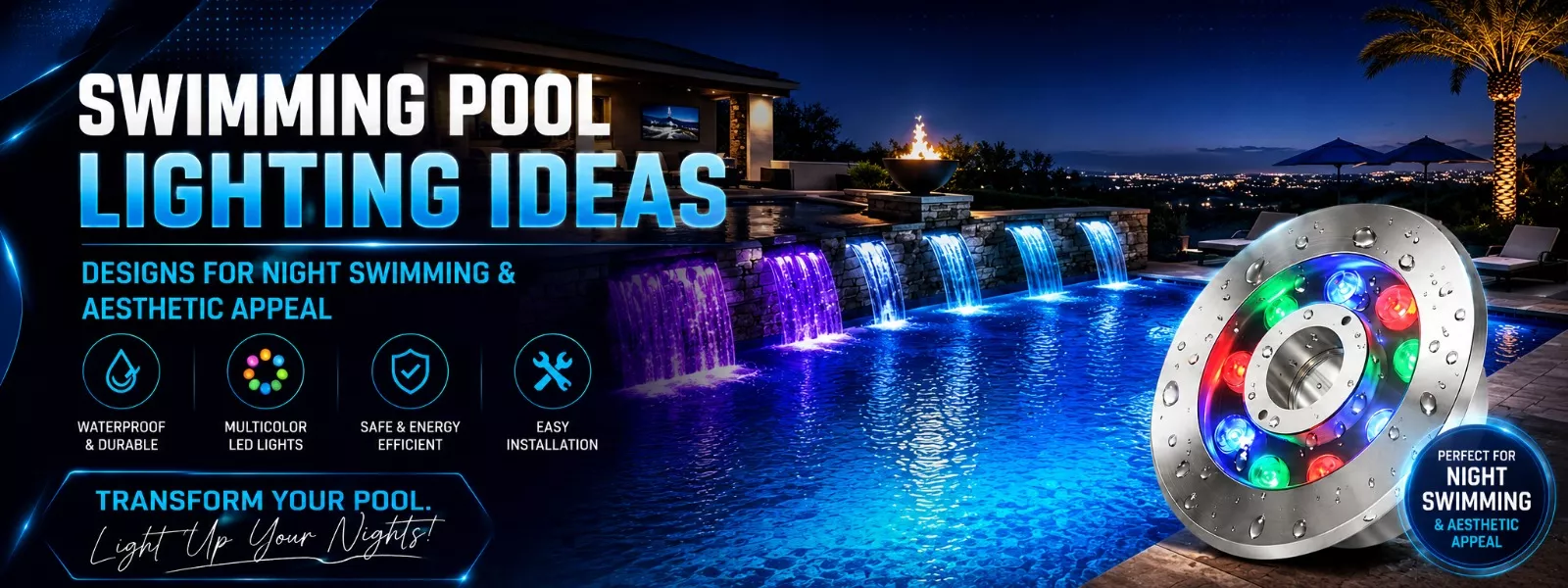
There is something about a lit pool at night that makes a house feel like a retreat. The water glows. The garden looks deeper. The whole space feels intentional.
If you are planning or upgrading a swimming pool in India — whether it is a private villa pool, a rooftop pool, or a resort-style backyard — the right swimming pool light can make or break the experience after sundown.
This guide covers everything you need to know: the types of pool lights available, design ideas that work specifically for Indian homes, how to place them, and what to look for before you buy.
DS Water Technology has been supplying and installing pool equipment across India for over 15 years. The insights here come from real project experience, not a product catalogue.
Why Pool Lighting Is Not Just About Visibility?
Most people think of pool lights as a safety feature — you install them so people can see where they are swimming after dark. That is true, but it is only part of the picture.
Lighting fundamentally changes the visual character of a pool. The colour temperature of the light affects how the water appears. The position of the lights determines whether you get even illumination or dramatic contrast. The type of fixture affects energy costs over years of use.
In Indian residential projects, well-designed pool lighting also extends the usable hours of the pool — particularly relevant in cities like Bengaluru, Pune, and Hyderabad where evenings are the only comfortable time to swim during summer months.
Beyond function, lighting is now a key part of pool aesthetics. Social media has made the glowing blue pool a visual language of its own. People expect it. Done well, it elevates the entire outdoor space.
Types of Swimming Pool Lights You Should Know
Before you look at design ideas, it helps to understand the technology behind the fixtures. Each type has specific use cases, costs, and lifespans.
LED Pool Lights
LED underwater lights are the current standard for most residential and commercial pools in India. They consume significantly less electricity than older halogen fixtures — typically 10 to 30 watts compared to 100 to 300 watts for halogen — while delivering the same or better brightness.
Modern LED pool lights are available in single-colour (white, blue) and RGB colour-changing variants. RGB lights use red, green, and blue diodes that blend digitally to produce a full colour spectrum, often controlled via remote or smartphone app.
A quality LED pool light lasts between 25,000 and 50,000 hours under normal conditions. For a pool used 3-4 hours per day, that is well over a decade before replacement is needed.
- Best for: Most residential pools, including rooftop and villa poolse
- Average power: 10-50 watts per fixture
- Lifespan: 25,000-50,000 hours
- IP rating required: Minimum IP68 for full underwater submersion
Fiber Optic Pool Lights
Fiber optic lighting works differently from LED. A single light source (called an illuminator) sits outside the pool — typically in a technical room or nearby cabinet — and transmits light through optical fibers that terminate inside the pool wall or floor.
The key advantage is that no electrical components are in the water at all. The fibers carry only light, not electricity. This makes them inherently safe and nearly maintenance-free underwater.
They are particularly popular in luxury pool projects where a starfield effect on the pool floor is desired, or where consistent low-intensity ambient lighting is the goal. They are not as bright as LED and are not suited for pools where functional underwater visibility is the primary requirement.
- Best for: Best for: Luxury accent lighting, spa pools, indoor pools
- Electrical component: Located outside pool (illuminator box)
- Maintenance: Replace illuminator bulb every few years; fibers are maintenance-free
- Typical cost: Higher initial cost than LED; lower running cost
Halogen and Incandescent — Why You Should Avoid Them?
If your pool was built more than ten years ago, it may have halogen or incandescent underwater fixtures. These are worth replacing.
Halogen lights run hot — even underwater, they generate heat that stresses the fixture seal over time. They consume four to ten times more electricity than equivalent LED fixtures. Replacement bulbs need to be changed frequently. And they are progressively harder to source in India as the market shifts to LED.
If you are doing any pool renovation, budget for switching to LED. The electricity savings alone typically recover the switching cost within two to three years in Indian conditions.
Solar-Powered Pool Lights
Solar-powered floating and surface pool lights have become affordable and are worth considering for accent use — around pool decks, garden edges, or for floating decorative purposes during events.
For underwater lighting, solar options are not yet reliable enough for permanent installation. The battery capacity and submersion requirements make wired LED the better choice for primary pool lighting.
- Best for: Deck edges, garden borders, temporary accent lighting
- Not recommended for: Primary underwater illumination
Swimming Pool Lighting Design Ideas for Indian Homes
Good design is about matching the lighting to the pool's purpose, the architecture of the home, and the lifestyle of the family using it. Here are five approaches that work well in the Indian context.
The Single-Colour Glow — Classic and Timeless
A single-colour LED setup — typically white or a cool blue — gives the pool a clean, resort-like appearance. It is easy to control, does not distract from the surrounding landscape, and suits pools that are used more for swimming than entertainment.
For white light, a colour temperature of 5000K to 6500K produces the classic glowing blue effect in pool water due to how the water absorbs and scatters the light. A warmer white (3000K-4000K) gives the pool a more inviting, intimate tone — good for smaller plunge pools or spa pools.
This setup works well with minimalist architecture — flat-panel homes, contemporary villas, or homes where the pool is part of a broader landscape design.
RGB Colour-Changing Lights — For Entertainment Spaces
If the pool is part of an entertainment area — adjacent to a lounge, party space, or outdoor bar — RGB lights give you control over the mood. A slow cycle through cool blues and greens reads as calm and ambient. Red and amber tones shift the space toward warmth. High-saturation single colours can create dramatic effects for events.
Modern RGB LED pool lights come with remote controls or app integration. Some models synchronise with music, which is a popular feature in resort and hospitality projects. For residential use, a simple remote or timer controller is sufficient.
Tip from the field: For Indian families who use their pool for weekend gatherings, a pool with RGB lights controllable from a mobile app has become a popular request in projects DS Water Technology handles.
Underwater Wall Lights — The Clean Architectural Look
Wall-mounted underwater lights (also called niche lights or recessed pool lights) are installed flush with the pool wall. When done correctly, they disappear into the tile during the day and only reveal themselves at night as a glow from the wall rather than a visible fixture.
This approach is popular in contemporary design where visual cleanliness matters. The light appears to come from the water itself rather than from a visible source.
Placement matters here. Lights placed too high on the wall create glare at the water surface. Lights placed at 300-600 mm below the water surface on the long walls produce the most even illumination with minimal glare.
Perimeter and Deck Lighting — Extending the Ambience
The pool itself does not need to carry the entire lighting load. Perimeter lighting — around the coping, along garden paths, under deck planking, or in landscaping — extends the lit zone and softens the transition between pool and garden.
In-ground deck lights set into the paving around the pool edge are a popular choice. They are low-profile, directional, and create a border effect that frames the water. Paired with underwater lights, the result is layered and far more interesting than a single underwater fixture alone.
For Indian homes with larger gardens or poolside seating areas, pole lights or wall-mounted lights at mid-height around the perimeter also provide functional light for the surrounding zone without washing out the pool's glow.
Floating Pool Lights — For Events and Occasional Use
Floating lights are battery or solar powered and sit at the water surface. They are not meant for permanent installation but serve a clear purpose: creating visual interest during events, festivals, or parties.
Some float as spheres. Others are flat discs that change colour slowly. For Diwali, summer parties, or housewarming events, they add a practical decorative layer without any electrical installation work.
Store them when not in use. They are not designed for continuous exposure to pool chemicals.
How to Choose the Right Swimming Pool Light?
Choosing the right light is a combination of technical requirements and design preferences. Here is a straightforward way to think through it:
- Define the primary use — Is the pool mainly for swimming, or equally for visual enjoyment and entertainment? Functional pools need higher lumen output. Aesthetic-focused pools can use lower intensity, more design-forward fixtures.
- Assess the pool size — A pool under 10 metres typically needs two to four fixtures. Larger pools or irregular shapes need a lighting plan to ensure even coverage and avoid dark corners.
- Choose the technology —LED for practicality and energy savings. Fiber optic for luxury accent or indoor pools. Avoid halogen unless replacing a legacy system where the niche size is non-standard.
- Check the IP rating — For underwater installation, IP68 is the minimum. Do not compromise on this, especially in Indian conditions where voltage fluctuations and monsoon humidity add stress to fixtures.
- Decide on colour capability — If you want flexibility, go with RGB. If you prefer simplicity and lower cost, a high-quality white LED is reliable and cost-effective.
- Consider the control system — Basic on/off switch, remote control, or smart app integration? Choose based on actual use, not maximum features.
Swimming Pool Light Placement — A Practical Guide
Placement is one of the most under-discussed aspects of pool lighting. Even good fixtures will disappoint if placed incorrectly.
- For rectangular pools: Place lights on the longer walls, facing the shorter wall. This distributes light evenly across the pool floor and reduces glare for swimmers.
- Depth of placement: For a pool with a depth of 1.2-1.5 metres, place fixtures 300-500 mm below the water surface. Deeper than 600 mm and the light spread narrows. Shallower than 200 mm and you risk glare and surface scatter.
- Spacing: For a standard residential pool (8m x 4m), two fixtures on the longer walls spaced evenly typically provide adequate coverage. Wider pools or pools over 12 metres need additional fixtures.
- Avoid placing lights at the deep end if there is a significant depth change — the angle creates uneven illumination and draws attention to the slope rather than the water.
- Steps and shallow areas: A separate low-wattage fixture near pool steps improves safety visibility without creating a hot spot in the overall lighting scheme.
If you are building a new pool, have the niche positions set during the shotcrete or concrete pour stage. Retrofitting light niches into an existing pool is expensive and structurally disruptive.
LED Pool Lights vs Fiber Optic vs Halogen — Comparison
| Feature | LED Pool Lights | Fiber Optic | Halogen |
|---|---|---|---|
| Power Consumption | 10-50W per fixture | 15-75W (illuminator only) | 100-300W per fixture |
| Lifespan | 25,000-50,000 hrs | Fiber: maintenance-free; Illuminator: 2,000-5,000 hrs | 1,000-2,000 hrs |
| Heat Generation | Low | None in water | High |
| IP Rating Available | IP68 | Not applicable (no electrical in water) | IP68 (but heat risk) |
| Colour Options | White & RGB | White, amber, colour wheels | White only (mostly) |
| Installation Cost | Moderate | Higher | Lower (legacy) |
| Running Cost (India) | Low | Low-Moderate | High |
| Recommended For | Most pools | Luxury / indoor / spa | Replacement only |
Energy Efficiency and Cost — What Indian Homeowners Should Know
In India, electricity costs vary by state and slab. Assuming a tariff of ₹6-₹9 per unit (kWh), the difference between halogen and LED becomes significant over time.
A single 300-watt halogen fixture running 4 hours per day uses 1.2 kWh per day. At ₹8/kWh, that is ₹9.60 per day per fixture. A 30-watt LED replacement uses 0.12 kWh — ₹0.96 per day. Over 12 months, that is a saving of roughly ₹3,150 per fixture annually.
For a pool with four fixtures, switching from halogen to LED saves approximately ₹12,000-₹15,000 per year on electricity alone, before accounting for reduced replacement bulb costs.
LED lights also operate without generating significant heat, which reduces stress on the fixture seal and the water chemistry in heated pools.
IP Rating Explained — Why It Matters for Underwater Pool Lights
IP stands for Ingress Protection. The rating is given in the format IP followed by two digits. The first digit rates dust protection (0-6). The second rates water resistance (0-9K).
For underwater swimming pool lights, IP68 is the minimum requirement. This means the fixture is rated for continuous submersion beyond 1 metre of water depth. IP67 is rated for submersion up to 1 metre for 30 minutes — not adequate for pool use.
In India, where voltage fluctuations during monsoon season are common, a properly rated IP68 fixture with a surge-protected circuit is the right approach. Saving money on a lower-rated fixture typically results in premature failure and much higher replacement costs.
Common Mistakes to Avoid When Installing Pool Lights
These are errors seen repeatedly in residential pool lighting projects:
- Installing lights without a proper niche — A niche is the recessed housing in the pool wall that holds the light. Without it, you have no way to service the fixture without draining the pool. Every pool light installation should include a proper wet niche.
- Choosing fixtures based on price alone — The cheapest option is almost never IP68-rated with quality sealing. Fixtures that fail underwater create both safety and warranty headaches.
- Ignoring colour temperature — Warm white underwater looks muddy in a tile-lined pool. Cool white (5000K+) produces the crisp, resort-style glow most homeowners are expecting.
- Overcrowding or undercrowding fixtures — Too many fixtures and the pool looks clinical. Too few and you have dark patches. Get a basic lighting plan before ordering fixtures.
- Not planning for access — Fiber optic illuminators need to be in a dry, accessible location. LED fixtures need to be accessible from the pool edge or steps for occasional service. This should be factored into the pool design stage, not added later.
DS Water Technology — 15 Years of Pool Solutions in India
DS Water Technology has been working in the swimming pool equipment space since 2009. The company supplies, installs, and supports pool lighting, filtration systems, water treatment equipment, and pool automation across India.
With ISO certification, MSME registration, and an active Importer-Exporter Certificate (IEC), DS Water Technology sources quality pool lighting fixtures that meet international IP standards — backed by local technical support.
If you are building a new pool or upgrading an existing one, the team can advise on fixture selection, placement, and integration with your pool control system. Contact the team for a consultation.
Looking for the right swimming pool lights for your project? Browse the DS Water Technology pool lighting range for IP68-certified LED and fiber optic options suited for Indian residential and commercial pools.
FAQ Section
Q1. How many lights does a swimming pool need?
A standard residential pool (8m x 4m) typically needs two to four underwater lights depending on the pool shape and desired brightness. Larger or irregular pools need a lighting plan. As a rough guide , one fixture covers approximately 15-20 square metres of pool surface area at standard depth.
Q2. What is the best type of light for a swimming pool?
LED pool lights are the best choice for most residential pools in India. They are energy-efficient, long-lasting, available in colour-changing variants, and carry the IP68 rating needed for underwater use. Fiber optic is the better choice for luxury accent lighting in spa or indoor pools.
Q3. What IP rating is required for pool lights?
IP68 is the minimum required rating for any fixture that will be permanently submerged in a swimming pool. This rating certifies the fixture for continuous underwater use beyond 1 metre of depth. Fixtures rated IP67 or lower are not suitable for pool use.
Q4. How long do LED pool lights last?
Quality LED pool lights have a rated lifespan of 25,000 to 50,000 hours. At 4 hours of use per day, this equates to 17-34 years of operational life under normal conditions.
Q5. Can I change the colour of my pool lights?
Yes, if your fixtures are RGB (colour-changing) LED lights. RGB lights allow you to select from a full spectrum of colours and often include pre-programmed colour cycle modes. These are controllable via remote, wall panel, or smartphone app depending on the control system installed.
Q6. Are pool lights safe to use?
Yes, when properly installed to code. All underwater pool lights operate at low voltage (typically 12V AC or DC) via a transformer. The transformer is installed outside the pool in a dry area. IP68-rated fixtures with intact seals pose no electrical hazard in the pool water.
Q7. How much does pool lighting cost in India?
Costs vary widely based on the type and number of fixtures. A basic LED pool light fixture for a residential pool ranges from ₹3,000 to ₹15,000 per unit depending on quality, brand, and colour capability. Installation, cabling, transformer, and control system are additional. Fiber optic systems cost more due to the illuminator box.
Q8. What colour pool light is best for night swimming?
White light at 5000K-6500K gives the best visibility for night swimming while producing the characteristic blue glow most people associate with pool aesthetics. If ambience is the priority over visibility, a soft blue LED or slow RGB cycle works well.
Q9. Can pool lights be installed in an existing pool?
Yes, but it depends on whether the pool has existing niches. If the pool was built with wet niches in the walls, replacing or installing lights is straightforward. If there are no niches, retrofitting is possible but involves cutting into the pool structure — a more complex and costly job.
Q10. Do pool lights need maintenance?
LED underwater pool lights require minimal maintenance. The main check is ensuring the fixture seal remains intact and no water has entered the housing. Fiber optic systems need the illuminator bulb replaced every few thousand hours. Clean the fixture face periodically as algae or calcium deposits can reduce output.
Q11. What is a wet niche in pool lighting?
A wet niche is a recessed housing installed in the pool wall during construction. It holds the light fixture and allows the fixture to be removed for servicing while the pool is full of water. The niche itself remains filled with water — hence 'wet niche.' Without a properly installed niche, servicing pool lights requires draining the pool.
Q12. Are fiber optic pool lights better than LED?
For accent and luxury applications — particularly indoor pools, spa pools, or starfield effects — fiber optic is the better choice. For most residential outdoor pools, LED is more practical: brighter, more energy-efficient, and easier to install. The two serve different use cases rather than one being universally superior.
Q13. Can I use solar-powered lights in my swimming pool?
Solar-powered lights are suitable for deck and garden areas around the pool, and as floating accent lights. For permanent underwater lighting, wired LED remains the only reliable option due to battery capacity and submersion requirements.
Q14. What voltage do pool lights operate on?
Most underwater pool lights in India operate at 12V AC or 12V DC via a step-down transformer. The transformer connects to the mains supply (230V in India) and steps it down to the safe low voltage for the pool circuit. Some modern LED fixtures operate at 24V DC.
Q15. How do I control multiple pool lights together?
Multiple pool lights can be controlled together through a single switch, a remote control panel, or an app-based pool automation system. In more sophisticated setups, pool lighting integrates with home automation systems (like KNX or Zigbee-based systems) for full scene control including dimming, colour, and scheduling.
Ready to build or
upgrade your pool?
Tell us about your swimming pool project and one of our experts will contact you within 24 hours with the best solution and pricing.
New Delhi - 110086, Delhi, India