126, Mange Ram Park, Rohini, Delhi, India


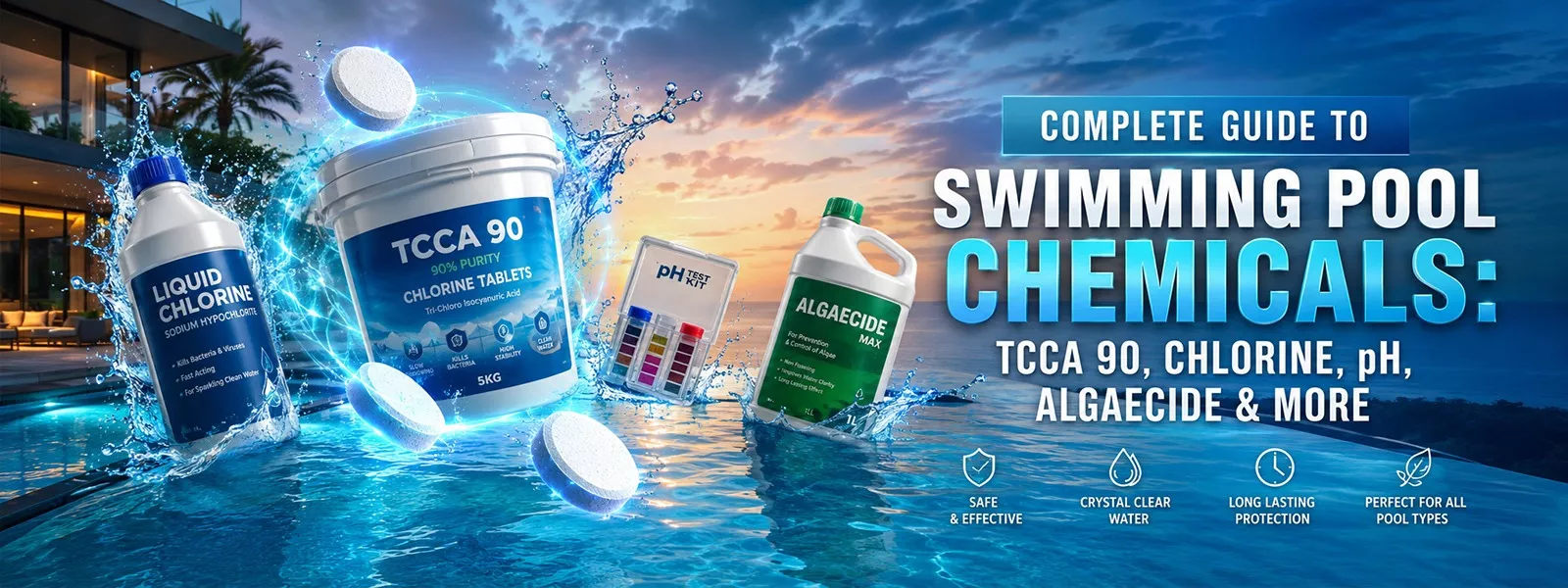
A swimming pool without the right chemicals is just a large container of stagnant water. Within days, it turns green, breeds bacteria, and becomes a health hazard. If you own a pool — or manage one at a hotel, housing society, or sports club — getting your swimming pool chemicals right is not optional.
This guide covers everything you need to know: what each chemical does, how much to use, and how to keep your pool safe all year round. We'll focus on the realities of pool maintenance in India, where hard water, high temperatures, and dust create challenges that generic guides rarely address.
Why Swimming Pool Chemicals Matter?
Untreated pool water is a breeding ground for bacteria like E. coli, algae blooms, and even Legionella in stagnant systems. The right chemical balance keeps water safe for swimmers, protects pool surfaces, and makes the water look inviting rather than murky.
Three parameters define whether your pool is healthy or not:
- Sanitiser levels — typically free chlorine between 1-3 ppm
- PH — ideally between 7.2 and 7.6
- Alkalinity — total alkalinity between 80-120 ppm
Let these drift, and no amount of expensive equipment will save you from green walls and eye-burning water.
The Core Swimming Pool Chemicals Explained
1. Chlorine — The Primary Sanitiser
Chlorine is the workhorse of pool sanitation. It kills bacteria, viruses, and breaks down organic contaminants. When chlorine reacts with ammonia from sweat and urine, it forms chloramines — the compound that causes the 'chlorine smell' people associate with poorly maintained pools. That smell actually means the pool needs more chlorine, not less.
Chlorine comes in several forms. In India, the two most common are TCCA 90 (granules or tablets) and Sodium Dichloroisocyanurate (SDIC / NaDCC). Liquid sodium hypochlorite is used in larger or commercial systems.
2. pH Adjusters — pH Up and pH Down
pH measures how acidic or alkaline your pool water is. The sweet spot is 7.2-7.6. Below 7.0, the water becomes corrosive — it irritates eyes, damages equipment, and eats away at pool surfaces. Above 7.8, chlorine becomes far less effective, meaning you're wasting chemicals.
- pH Increaser (pH Up): Sodium carbonate (soda ash) — raises pH when water is too acidic
- pH Decreaser (pH Down): Sodium bisulphate or muriatic acid — lowers pH when water is too alkaline
Indian tap water and borewell water often have a naturally high pH. Test before you dose.
3. Algaecide — Prevention Before Cure
Algaecide is a preventive chemical. A small weekly dose stops algae before it takes hold. If your pool already looks green, you'll need a shock treatment with chlorine first, then algaecide to prevent regrowth.
Common types include quaternary ammonium compounds (quats) for mild cases and copper-based algaecides for stubborn or mustard algae. Use copper algaecide carefully with vinyl liners as it can stain.
4. Chlorine Stabiliser (Cyanuric Acid / CYA)
In outdoor pools, direct UV from the sun degrades free chlorine rapidly — sometimes destroying 50-90% within two hours of exposure. CYA acts as a UV shield, slowing this breakdown. Maintain CYA between 30-50 ppm for outdoor pools. TCCA 90 already contains CYA as part of its chemistry, so it self-stabilises as you dose.
5. Clarifiers and Flocculants
Clarifiers gather tiny suspended particles into clumps large enough for your filter to catch. Flocculants do the same but more aggressively — particles sink to the bottom and must be vacuumed out. Use clarifiers for routine water clarity and flocculants for post-storm or heavy-use cleanup.
TCCA 90: India's Most Popular Pool Sanitiser
If you ask any pool professional in India what they primarily use, the answer is almost always TCCA 90 — Trichloroisocyanuric Acid with 90% available chlorine. It's stable, convenient, cost-effective, and works well in Indian conditions.
TCCA 90 Granules vs Tablets — What's the Difference?
| Feature | TCCA 90 Granules | TCCA 90 Tablets (200g) |
|---|---|---|
| Dissolution Speed | Fast — dissolves in minutes | Slow — dissolves over 5-7 days |
| Best For | Shock treatments, quick dose correction | Continuous feeder / skimmer dosing |
| Handling | Easier to measure precise quantities | Less mess, easier for weekly use |
| Storage | Keep dry, sealed container | Keep dry, sealed container |
| Dosing Method | Pre-dissolve in water, then add to pool | Float in skimmer or chemical feeder |
Standard dosage: 1-3 grams of TCCA 90 granules per 1,000 litres of pool water for routine maintenance. For shock treatment, increase to 5-7 grams per 1,000 litres. Always pre-dissolve granules in a bucket of water before adding to the pool — never add directly to a running pool with swimmers.
Understanding pH in Pool Water
pH is the single most misunderstood parameter in pool chemistry. Get this right and most other problems become easier to manage.
| pH Level | What It Means | Action Required |
|---|---|---|
| Below 7.0 | Corrosive — damages pool surfaces and equipment | Add pH Increaser (soda ash) |
| 7.0-7.2 | Slightly low — acceptable but monitor closely | Add small dose of pH Increaser |
| 7.2-7.6 | Ideal range — chlorine works efficiently | Maintain this range |
| 7.6-7.8 | Slightly high — chlorine effectiveness drops | Add small dose of pH Decreaser |
| Above 7.8 | Alkaline — scale formation, cloudy water | Add pH Decreaser (sodium bisulphate) |
Test pH at least twice a week during summer. In India's high-temperature months (April-June), evaporation and swimmer load can shift pH faster than expected.
Algaecide: Your Defence Against Green Water
Green or cloudy water is the most common pool complaint in India, especially during the monsoon and post-summer season when organic load in the environment is high. Algae enter the pool through rain, wind, or contaminated swimwear.
A preventive weekly dose of algaecide — typically 50-100 ml per 100,000 litres — costs almost nothing compared to the time and chemicals needed to clear a full algae bloom. Think of it as insurance.
If you're already dealing with green water: shock the pool with a high chlorine dose first, wait 24 hours, then add algaecide once chlorine levels drop below 3 ppm. Adding algaecide to heavily chlorinated water wastes the product.
How to Use Pool Chemicals Safely?
Pool chemicals are effective precisely because they're reactive. That same reactivity makes improper handling dangerous. A few non-negotiables:
- Never mix chemicals together directly — even different chlorine products can react violently
- Always add chemicals to water, not water to chemicals
- Pre-dissolve granular chemicals in a separate bucket before adding to the pool
- Wear gloves and eye protection when handling concentrated chemicals
- Store chemicals in a cool, dry, ventilated space — away from each other
- Do not allow swimmers in the pool for at least 30 minutes after adding any chemical
If you're managing a commercial or hotel pool, MSDS (Material Safety Data Sheets) should be available for every chemical on-site. DS Water Technology provides full product documentation as standard practice.
Maintaining Pool Chemistry in India's Hot Climate
Indian summers put pools through more stress than a generic maintenance guide accounts for. Water temperatures regularly exceed 30°C, UV radiation is intense, and dust / organic debris enter pools constantly. Here's what changes:
- Chlorine demand increases significantly — expect to dose 20-30% more in peak summer
- pH tends to rise faster due to CO2 outgassing from warm water — test more frequently
- Evaporation concentrates dissolved minerals — watch TDS (Total Dissolved Solids) and consider partial drain-and-refill when TDS exceeds 1,500 ppm
- Hard borewell water (common in many Indian cities) raises calcium hardness — may require a sequestering agent to prevent scale
For hotels and societies running pools through the full year, a monthly chemical audit is advisable. DS Water Technology's team, with 15 years of experience in water treatment across India, can assess your specific water conditions and recommend a custom dosing schedule.
Quick Comparison: TCCA 90 vs SDIC vs Liquid Chlorine
| Criterion | TCCA 90 | SDIC (NaDCC) | Liquid Hypochlorite |
|---|---|---|---|
| Available Chlorine | ~90% | ~55-60% | ~10-15% |
| Form | Granules / Tablets | Granules / Tablets | Liquid |
| Stability | Excellent (includes CYA) | Good | Poor — degrades quickly |
| Best Use | Outdoor pools, routine & shock | Indoor pools, sensitive surfaces | Large commercial systems |
| Storage | Long shelf life, dry storage | Long shelf life, dry storage | Short shelf life, cool dark storage |
| pH Impact | Slightly lowers pH | Slightly lowers pH | Raises pH significantly |
| Cost (India) | Economical, widely available | Slightly higher cost | Low per-litre but high volume needed |
When to Test Your Pool Water?
Regular testing is the difference between proactive management and expensive corrective treatments. As a minimum:
- Free chlorine and pH: Every 2 days (daily in summer or heavy use periods)
- Total alkalinity: Weekly
- Calcium hardness: Monthly
- Cyanuric acid (CYA): Monthly for outdoor pools
- Total dissolved solids (TDS): Monthly
Use a good-quality test kit or digital tester. Colour-based test strips give a quick indication but are less accurate for making precise dosing decisions. For commercial pools, a certified water test report is required under many state health guidelines in India.
Managing pool chemistry correctly isn't complicated — it just requires consistency and the right products. If you're unsure about your pool's specific needs, DS Water Technology has been helping pool owners, hotels, and housing societies across India get their water chemistry right for over 15 years. ISO certified and registered with MSME, we supply a full range of swimming pool chemicals including TCCA 90, pH adjusters, algaecides, and more.
Need help with a green pool? Talk to our experts →
FAQ Section
Q1: What chemicals are needed for a swimming pool?
The essential swimming pool chemicals are: a sanitiser (usually chlorine in the form of TCCA 90 or SDIC), a pH adjuster (pH Up/Down), and an algaecide. Most pools also benefit from a stabiliser (CYA) and a clarifier. The exact combination depends on your water source, pool size, and usage levels.
Q2: What is TCCA 90 and why is it used in swimming pools?
TCCA 90 (Trichloroisocyanuric Acid) is a chlorine-based sanitiser with approximately 90% available chlorine content. It's popular in India because it's highly effective, stable in storage, and comes with built-in UV stabiliser (cyanuric acid), making it suitable for outdoor pools. It's available as granules or tablets.
Q3: How much chlorine should I put in my pool?
For routine maintenance, add 1–3 grams of TCCA 90 granules per 1,000 litres of pool water. Target a free chlorine level of 1–3 ppm. For shock treatment after heavy use or contamination, dose 5–7 grams per 1,000 litres. Always test before and after dosing.
Q4: What is the ideal pH for a swimming pool?
The ideal pH for a swimming pool is between 7.2 and 7.6. At this range, chlorine works most efficiently and the water is comfortable for swimmers. Below 7.0, water becomes corrosive. Above 7.8, chlorine effectiveness drops significantly and scale can form on pool surfaces.
Q5: Why is my pool water green?
Green pool water is caused by algae growth, usually resulting from low chlorine levels, high pH, or poor circulation. To clear a green pool: shock treat with a high dose of chlorine, run the filter continuously, then add algaecide once the chlorine settles below 3 ppm. Brush pool walls before shocking to improve chemical penetration.
Q6: How often should I add chemicals to my swimming pool?
As a general guide: add chlorine every 1–3 days depending on usage and temperature; check and adjust pH twice a week; add algaecide once a week as a preventive dose. In Indian summer months, increase frequency as heat accelerates chemical consumption.
Q7: Can I mix pool chemicals together?
No. Never mix pool chemicals directly together. Mixing different types of chlorine, or mixing chlorine with other chemicals, can cause violent reactions, fire, or toxic gas release. Always add chemicals to water (not the other way around), and add each chemical separately, waiting between additions.
Q8: What is the difference between TCCA 90 granules and tablets?
TCCA 90 granules dissolve quickly and are ideal for shock treatments or rapid dosing adjustments. Tablets dissolve slowly over 5–7 days and are suited for continuous feeding via a skimmer or chemical feeder. Granules give more control; tablets are more convenient for routine maintenance.
Q9: Is TCCA 90 safe for swimming pools?
Yes, when used correctly. TCCA 90 is one of the most widely used pool sanitisers globally. Pre-dissolve granules in a bucket of water before adding to the pool. Do not allow swimming for at least 30 minutes after dosing. Store away from heat, moisture, and other chemicals. Follow dosage guidelines and use PPE during handling.
Q10: Why does my pool have a strong chlorine smell?
Counterintuitively, a strong chlorine smell usually means the pool needs more chlorine, not less. The smell comes from chloramines — compounds formed when chlorine reacts with organic matter (sweat, body oils, urine). A shock dose of chlorine breaks down chloramines through breakpoint chlorination, eliminating the smell.
Q11: What chemicals do I need for a new pool first fill?
For a first fill, you'll need to: (1) Establish base alkalinity with sodium bicarbonate, (2) Adjust pH with pH Up or Down to 7.2–7.6, (3) Add calcium hardness increaser if using soft water, (4) Add chlorine to establish a 1–3 ppm free chlorine reading, (5) Add stabiliser (CYA) for outdoor pools, (6) Add algaecide as a preventive baseline dose.
Q12: Where can I buy swimming pool chemicals in India?
Swimming pool chemicals including TCCA 90, pH adjusters, and algaecides are available from specialist water treatment chemical suppliers. DS Water Technology supplies a full range of pool chemicals across India, with 15 years of experience, ISO certification, and MSME registration. We cater to residential pools, hotels, housing societies, and commercial aquatic facilities.
Ready to build or
upgrade your pool?
Tell us about your swimming pool project and one of our experts will contact you within 24 hours with the best solution and pricing.
New Delhi - 110086, Delhi, India