126, Mange Ram Park, Rohini, Delhi, India


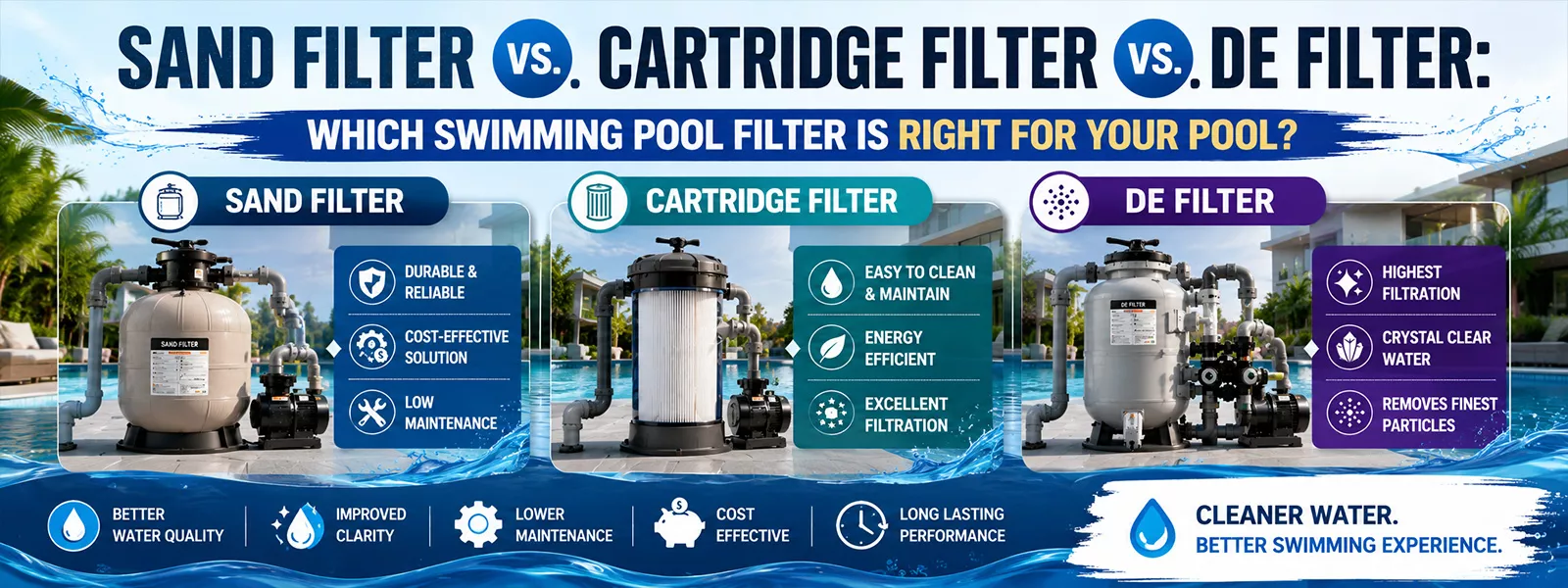
Choosing the wrong swimming pool filter doesn't just cost you money at the time of purchase — it costs you in water wastage, chemical usage, and hours of avoidable maintenance every season. It's one of those decisions that looks simple until you're standing in front of three different products with no real guide to help you decide.
This article breaks down all three major swimming pool filtration system types clearly — what each one does, how they compare on practical factors that matter in Indian conditions, and which situation each one suits best. No fluff. No hard sell. Just the information you need to make the right call.
Sand filters are the most common choice for Indian pools — affordable, low maintenance, and reliable. Cartridge filters are better for smaller pools where water conservation matters. DE filters offer the finest filtration but require more upkeep and are best suited for high-end residential or club pools. The right choice depends on your pool size, water quality, budget, and how much time you're willing to spend on maintenance.
Why the Right Swimming Pool Filtration System Matters More Than You Think?
A pool without proper filtration is essentially a large tank of water that slowly becomes unsuitable for swimming. Even with regular chlorination, without mechanical filtration you'll deal with cloudy water, algae build-up, clogged pool returns, and escalating chemical costs.
The filter is the engine of your pool's water hygiene. It removes particulate matter — dust, dead skin cells, insects, pollen, debris — ,a that chemicals alone can't handle. In Indian conditions specifically, where outdoor pools contend with high ambient dust, monsoon runoff, and often hard water, getting filtration right is even more critical.
What a Pool Filter Actually Does
Your pool pump pulls water from the pool and pushes it through the filter, where particles are trapped in the filter media. Clean water returns to the pool through the return jets. This cycle — called the turnover — should complete every 6 to 8 hours for residential pools and every 4 to 6 hours for commercial ones.
The filter and pump work as a pair. A filter with insufficient flow rate for your pool's pump will build pressure and fail prematurely. If you're also in the process of selecting your pool equipment, it's worth reading about swimming pool pumps alongside this guide.
The Three Main Types of Swimming Pool Filters — A Quick Overview
Sand Filters
Sand filters use a bed of silica sand (typically 0.45-0.55 mm grain size) inside a fibreglass or ABS tank. Water passes through the sand bed downward, and particles as small as 20-40 microns get trapped between the sand grains. When the filter pressure builds up (usually around 10 psi above baseline), you backwash it — reversing the flow to flush trapped debris to waste.
- Filtration: 20-40 microns
- Backwash frequency: Every 1-2 weeks (higher in monsoon or high-use periods)
- Sand replacement: Every 5-7 years
- Most widely available in India
Cartridge Filters
Cartridge filters use a pleated polyester filter element housed inside a canister. Water flows through the element from outside to inside, and the pleats trap particles down to 10-15 microns. There is no backwashing — you remove and hose down the cartridge every 2-6 weeks depending on pool load.
- Filtration: 10-15 microns (finer than sand)
- No backwash required — saves water
- Cartridge replacement: Every 2-3 years
- Good for smaller pools and rooftop pools where drainage is difficult
Diatomaceous Earth (DE) Filters
DE filters are the most efficient of the three. They use diatomaceous earth — a fine powder made from fossilised algae — coated onto filter grids inside the tank. This powder can filter particles as small as 2-5 microns, capturing even some bacteria.
- Filtration: 2-5 microns (finest available)
- Requires periodic DE powder addition after backwashing
- Higher initial cost and more complex maintenance
- Best suited for high-end pools where crystal clarity is the priority
DS Water Technology — 15 Years of Pool Filtration Expertise
Need help selecting the right filter for your pool? Our team has installed and serviced pool filtration systems across India for over 15 years — from rooftop residential pools to large commercial complexes. Explore our swimming pool filters →
Sand Filter vs. Cartridge Filter vs. DE Filter: Detailed Comparison
| Parameter | Sand Filter | Cartridge Filter | DE Filter |
|---|---|---|---|
| Maintenance frequency | Backwash every 1-2 weeks | Clean every 2-6 weeks | Backwash + recharge DE regularly |
| Water usage | High (wastes ~400-600L per backwash) | Very low (rinse only) | Moderate (backwash required) |
| Initial cost | Low-Medium | Medium | High |
| Running cost | Low (sand lasts 5-7 yrs) | Medium (cartridges replace every 2-3 yrs) | Medium-High (DE powder recurring cost) |
| Water clarity | Good | Very Good | Excellent |
| Best for | Large pools, high-bather loads, commercial use | Small-medium pools, water-scarce areas | Premium residential, health-focused pools |
| Availability in India | Widely available | Widely available | Limited; specialist suppliers |
Filtration Efficiency
If you're swimming in water that looks clear but isn't perfectly sparkling, it's likely because your filter can't capture fine particles. Sand filters at 20-40 microns are fine for most pools. Cartridge at 10-15 microns gets noticeably cleaner water. DE at 2-5 microns is in a different league — water looks almost surgical-grade clear.
However, the difference between sand and cartridge is often barely visible to the naked eye for a well-maintained pool. The visible clarity gap only becomes obvious when pool load is high or when the pool is near trees, a road, or a construction site.
Maintenance Requirements
Sand filters are the easiest to maintain day-to-day. Backwashing takes about 2-3 minutes once you know the process. The multiport valve makes it straightforward. Cartridge filters need the element physically removed and hosed down — not difficult, but more hands-on. DE filters require adding new DE powder after every backwash, which some pool owners find fussy.
One thing worth noting for Indian pools: during summer, if bather load increases significantly or dust storms are frequent in your region, backwash intervals shorten. Plan your maintenance schedule around seasonal load — not just a fixed calendar date.
Running Cost and Longevity
Over a 10-year period, sand filters typically have the lowest total cost. The sand media costs relatively little to replace, and the tank itself lasts 10-15 years with reasonable care. Cartridge filters have moderate ongoing costs — the cartridge elements are the recurring expense. DE filters have the highest ongoing cost because DE powder needs restocking, and the filter grids require careful cleaning to avoid channeling.
Water Usage (Backwashing)
In water-stressed cities — Chennai, Bengaluru, Hyderabad — this is an underappreciated factor. A typical sand filter backwash uses 400-600 litres per cycle. If you're backwashing twice a month, that's 800-1,200 litres wasted monthly. Cartridge filters, by contrast, require only a hose rinse — saving significant water over time. If water costs or scarcity is a concern in your area, cartridge filtration makes a genuine practical difference.
Which Pool Filter Is Best for Indian Conditions?
Residential Pools
For a standard home pool in the 30,000 to 80,000-litre range, a sand filter is the most practical and cost-effective option. They're easier to service, spare parts are readily available, and the operational knowledge is widespread — your pool technician will know them inside out.
If your pool is smaller (under 30,000 litres) or located in an apartment building where drainage for backwash isn't convenient, a cartridge filter is the better fit.
Commercial and Club Pools
For pools at hotels, sports clubs, and apartment complexes with high swimmer loads, sand filters remain the industry standard in India. High flow rates, easy backwashing, and durability under heavy use make them the practical choice. Size the filter for at least 1.2x the calculated flow rate to account for peak load periods.
Pools in High-Dust or Hard-Water Zones
Rajasthan, Gujarat, and parts of Maharashtra see high ambient dust — this clogs filter media faster and shortens backwash intervals significantly. In these conditions, upsizing your sand filter capacity by 20-30% is a better strategy than switching filter type. For hard water areas, the filter type matters less than having correct chemical dosing alongside it — proper pool water treatment prevents scale build-up inside the filter itself.
How to Size Your Pool Filter Correctly
The most common mistake is selecting a filter based on price alone, not on the pool's actual water volume and required flow rate. Here's a quick way to check sizing:
- Calculate pool volume in litres (length × width × average depth × 1000 for metres)
- Divide by 6 to get the minimum required flow rate in litres/hour for a 6-hour turnover
- Select a filter rated at or above this flow rate — always round up, never down
Example: A pool of 50,000 litres needs a minimum flow rate of ~8,333 litres/hour. A filter rated at 10,000 litres/hour gives you safe headroom.
Common Mistake
Undersizing the filter to save money. An undersized filter runs at high pressure, wears out faster, and gives you cloudy water despite running 24/7. This is the most frequent issue our team sees on pool renovation calls.
Common Mistakes to Avoid When Choosing a Pool Filter
- Buying based on price alone - without checking flow rate compatibility with your pump
- Ignoring media replacement schedules — sand that isn't changed every 5-7 years develops channelling, where water bypasses the media entirely
- Using DE filters without understanding the recharging process — skipping DE powder addition after backwash essentially turns it into a sand filter without the sand
- Not accounting for seasonal load changes — Indian pools in summer or festival seasons need more frequent maintenance cycles
- Selecting a filter designed for temperate climates — some imported filters are not built for India's summer temperatures and UV exposure on the tank casing
Not Sure Which Filter Suits Your Pool?
DS Water Technology - ISO certified, MSME registered, 15 years in the industry — supplies and installs swimming pool filtration systems for residential and commercial pools across India.
Get in touch for a recommendation →
FAQ Section
Q1. Which swimming pool filter is best for home pools in India?
Sand filters are the most practical choice for most Indian home pools — they're cost-effective, easy to maintain, and widely serviced. For smaller pools or areas where drainage is limited, cartridge filters are a better option since they don't require backwashing.
Q2. What is the difference between a sand filter and a cartridge filter for a pool?
Sand filters use a bed of silica sand to trap particles and are cleaned by backwashing (reversing water flow to waste). Cartridge filters use a pleated polyester element and are cleaned by removing and hosing the cartridge. Cartridge filters save more water but need manual cleaning more often.
Q3. How often should I backwash my swimming pool sand filter?
Backwash when the pressure gauge reads 8-10 psi above the clean baseline — usually every 1 to 2 weeks. During monsoon, high-use periods, or in dusty areas, this may increase to once a week. Don't backwash on a fixed schedule; use the pressure gauge as your guide.
Q4. What is a DE filter and is it available in India?
A DE (diatomaceous earth) filter uses a fine fossil-based powder coated on filter grids to achieve 2–5 micron filtration — the finest of any pool filter type. DE filters are available in India through specialist pool equipment suppliers, though they're less common than sand or cartridge filters.
Q5. How do I choose the right size swimming pool filter?
Calculate your pool volume in litres, then divide by 6 to get the minimum flow rate needed (litres per hour) for a 6-hour water turnover. Choose a filter rated at or above this figure. Always round up — an oversized filter is far better than an undersized one.
Q6. Can I use a cartridge filter for a large pool?
Yes, but only if the cartridge filter is rated for the pool's flow requirements. Large cartridge filters exist for commercial use, but the cartridge elements foul faster in high-bather pools and need more frequent cleaning. For pools above 100,000 litres with heavy use, sand filters are typically more practical.
Q7. How long does sand in a pool filter last?
Pool filter sand lasts 5 to 7 years under normal conditions. After this, the grains wear smooth and lose their angular shape, reducing filtration efficiency. If you notice persistently cloudy water despite correct chemical balance, old filter sand is often the culprit.
Q8. What type of pool filter requires the least maintenance?
Sand filters require the least active maintenance — backwashing is quick and the sand media lasts years. Cartridge filters need more hands-on cleaning (cartridge removal and hosing). DE filters require the most maintenance, including DE powder recharging after every backwash.
Q9. Does a better pool filter reduce chemical usage?
Yes, to a degree. Better filtration removes more particulates, which means fewer chlorine-consuming contaminants in the water. This reduces chlorine consumption. However, filtration and chemical treatment are complementary systems — one cannot fully replace the other.
Q10. Can I switch from a sand filter to a cartridge filter on my existing pool?
Yes, in most cases. You'll need to ensure the new filter's flow rate matches your existing pump. The plumbing connections are typically standard (63mm or 50mm), but confirm compatibility before purchasing. Some installations may need minor plumbing adjustments.
Q11. What happens if I run a pool without a filter?
Without filtration, debris and particulate matter accumulate rapidly. Even with chlorination, the water turns cloudy and green within days. Contaminants also consume chlorine faster, requiring significantly higher chemical doses just to maintain basic sanitation. A functioning filtration system is non-negotiable for any pool.
Q12. Is a sand filter or cartridge filter better for rooftop pools?
Cartridge filters are generally better for rooftop pools. They don't require backwashing — which means no need for a drain or waste line at height — and they're typically more compact. Sand filters can work on rooftops but require careful plumbing for the backwash discharge.
Ready to build or
upgrade your pool?
Tell us about your swimming pool project and one of our experts will contact you within 24 hours with the best solution and pricing.
New Delhi - 110086, Delhi, India