126, Mange Ram Park, Rohini, Delhi, India


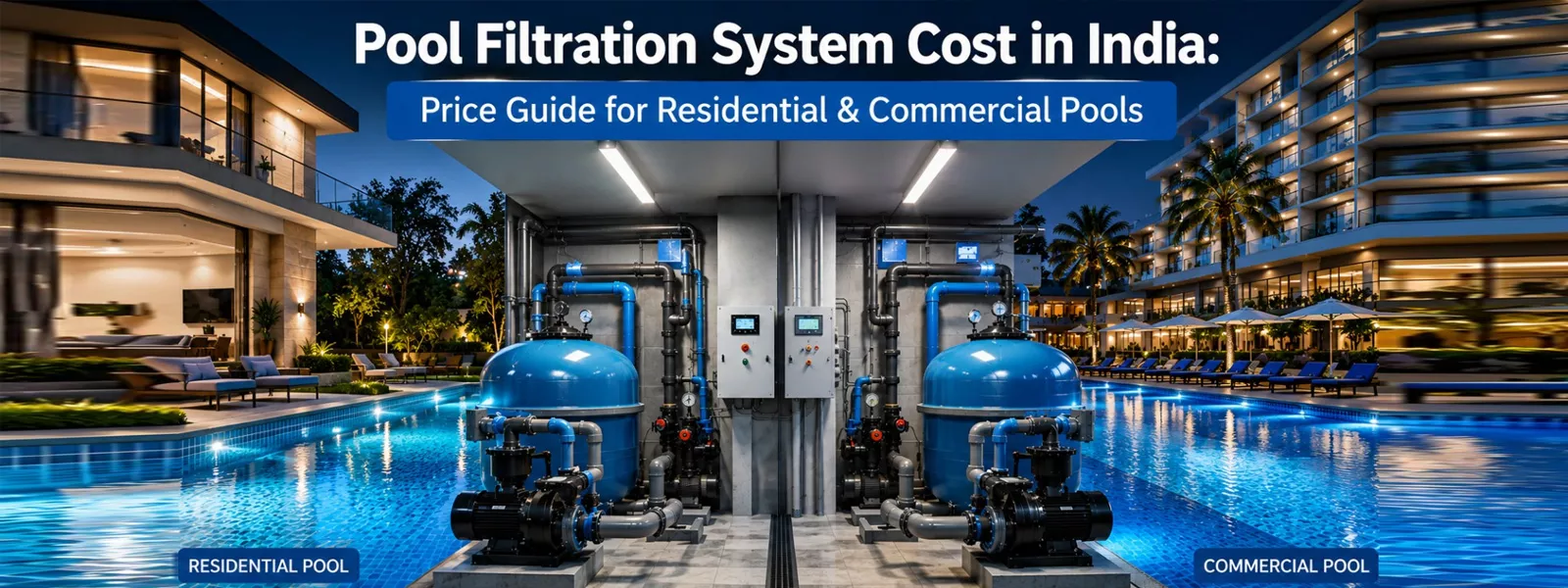
If you've been quoted wildly different prices for swimming pool filters — one supplier says ₹25,000, another says ₹1.8 lakh — there's a reason for that. Pool filtration system cost in India depends heavily on filter type, pool size, water quality, and whether it's a home pool or a large commercial one.
This guide breaks it all down with actual price ranges, not vague estimates. Whether you're planning a new pool or replacing an old filtration setup, you'll find what you need to make a clear, informed decision.
DS Water Technology has been supplying and installing swimming pool filtration systems across India for 15 years. The pricing data in this guide reflects real project costs from residential and commercial installations — not manufacturer list prices.
Why Filtration System Cost Varies So Much? — The Honest Answer
There's no fixed price for a swimming pool filtration system. The variation isn't random — it follows a clear logic. Here are the three biggest factors:
Pool Volume and Turnover Rate
Every pool requires its water to be filtered completely within a set time. For residential pools, the standard is 4-6 hours. For commercial pools used by many swimmers, it's often 2-4 hours.
A larger pool or a faster required turnover rate means you need a higher-capacity filter with a greater flow rate. That directly pushes the price up.
Example: A 50,000-litre residential pool needs a filter capable of handling roughly 12,500 litres per hour minimum. A 2-lakh-litre hotel pool might need 50,000+ litres per hour capacity.
Filter Type and Media
Sand, cartridge, diatomaceous earth (DE), glass media — each filter technology has a different price point, different performance level, and different maintenance requirement.
Residential vs Commercial Application
Commercial pool filtration systems are engineered for continuous operation, heavier bather loads, and stricter water quality standards. They use industrial-grade FRP tanks, larger multiport valves, and automated backwash controls.
The cost gap between residential and commercial systems is significant — often 5x or more.
Types of Swimming Pool Filters and Their Price Ranges in India
Sand Filter Cost
Sand filters are the most common swimming pool filtration option in India. They use silica sand as the filter media, trapping particles as water passes through.
- Filtration accuracy: 20-40 microns
- Media life: 3-5 years before replacement needed
- Maintenance: Backwash every 1-2 weeks depending on bather load
- Best suited for: Residential pools, mid-size club pools
Price range in India:
| Pool Size | Filter Capacity | Approx. Price (Equipment Only) |
|---|---|---|
| Up to 50,000 litres | 10-12 m³/hr | ₹8,000 - ₹18,000 |
| 50,000 - 1.5 lakh litres | 16-24 m³/hr | ₹18,000 - ₹45,000 |
| 1.5 lakh - 3 lakh litres | 32-48 m³/hr | ₹45,000 - ₹90,000 |
| Commercial (3L+ litres) | 60+ m³/hr | ₹90,000 - ₹2,50,000+ |
Cartridge Filter Cost
Cartridge filters use a pleated polyester filter element, typically rated at 10-15 microns. They don't require backwashing — you remove and rinse the cartridge element instead.
- Filtration accuracy: 10-15 microns (finer than sand)
- Media life: 1-2 years per cartridge element
- Maintenance: Cartridge rinse every 2-4 weeks; replacement annually
- Best suited for: Small residential pools, rooftop pools, pools with limited drainage
Price range in India:
| Pool Size | Filter Type | Approx. Price (Equipment Only) |
|---|---|---|
| Up to 30,000 litres | Small cartridge filter | ₹6,000 - ₹14,000 |
| 30,000 - 80,000 litres | Medium cartridge filter | ₹14,000 - ₹35,000 |
| Cartridge replacement | Per element | ₹800 - ₹3,500 |
Diatomaceous Earth (DE) Filter Cost
DE filters provide the finest filtration of any standard pool filter — down to 3-5 microns. They use diatomaceous earth powder coated on filter grids as the filtering medium.
- Filtration accuracy: 3-5 microns (best clarity)
- Media: DE powder needs replenishment after each backwash
- Best suited for: High-end residential pools, hotels, hospitals requiring very clear water
Price range: ₹35,000 - ₹1,50,000+ depending on capacity. DE powder costs ₹150-300 per kg; most pools use 2-5 kg per season.
Glass Media Filter Cost
Glass media filters use recycled glass granules instead of sand. Glass filters to approximately 10 microns, lasts significantly longer than sand, and resists bacteria growth better.
- Filtration accuracy: ~10 microns
- Media life: 8-10 years
- Maintenance: Less frequent backwashing than sand
Price range: Glass media filters are priced similarly to mid-range sand filters (₹20,000 - ₹1,20,000 depending on capacity), but glass media itself costs more: approximately ₹3,500-6,000 per 25 kg bag vs ₹400-800 for silica sand.
Swimming Pool Filtration System Cost Comparison Table
| Filter Type | Filtration Accuracy | Equipment Cost (Residential) | Annual Maintenance Cost | Media Lifespan | Best For |
|---|---|---|---|---|---|
| Sand Filter | 20-40 microns | ₹8,000 - ₹90,000 | ₹3,000 - ₹8,000 | 3-5 years | Most residential pools |
| Cartridge Filter | 10-15 microns | ₹6,000 - ₹35,000 | ₹4,000 - ₹10,000 | 1-2 years | Small/rooftop pools |
| DE Filter | 3-5 microns | ₹35,000 - ₹1,50,000 | ₹6,000 - ₹15,000 | Grids last 5+ years | Luxury/hotel pools |
| Glass Media | ~10 microns | ₹20,000 - ₹1,20,000 | ₹2,500 - ₹6,000 | 8-10 years | Low-maintenance focus |
Not sure which filter type suits your pool? Talk to our team →
What's Included in the Price — and What Isn't?
This matters because most price quotes you see online cover only the filter tank and media. A complete swimming pool filtration system includes more components — and the total cost can be significantly higher than the filter unit alone.
Typically Included in Filter Price
- FRP or stainless steel filter tank
- Multiport valve (MPV)
- Filter media (sand, glass, or cartridge element)
- Pressure gauge
Typically NOT Included — Purchase Separately
- Pool pump and motor — adds ₹6,000 - ₹40,000+ depending on HP
- Pre-filter / hair and lint strainer
- Pipework, fittings, and valves
- Chemical dosing system (chlorinator, pH controller)
- Installation and commissioning charges
Installation Cost in India
Installation cost for a residential pool filtration system typically ranges from ₹5,000 - ₹20,000 depending on complexity, pipe runs, and location. Commercial installations< vary widely: ₹25,000 - ₹1,50,000+.
For a typical 60,000-litre residential pool, expect total project cost (filter + pump + installation + first chemical fill) to land between ₹45,000 - ₹90,000 for a sand filtration setup.
Annual Maintenance Cost
Maintenance is where many pool owners get surprised. Plan for:
- Sand replacement (every 3-5 years): ₹2,000 - ₹8,000
- Backwash water loss (monthly): Minor but ongoing
- Multiport valve service: ₹500 - ₹2,000 per year
- Pool chemicals: ₹8,000 - ₹30,000 per year depending on pool size and usage
- Annual AMC (if contracted): ₹6,000 - ₹25,000
Rule of thumb: Annual maintenance for a residential pool filtration system in India typically runs 10-20% of the initial equipment cost per year.
Commercial Pool Filtration System Cost in India
Commercial pool filtration systems — for hotels, resorts, clubs, schools, and apartment complexes — operate under different parameters than home pools.
Key differences from residential systems:
- Higher flow rate requirements: 40-200+ m³/hr
- Automated backwash controllers
- Redundant filtration (multiple filter banks)
- Integration with UV disinfection or ozone systems
- Stricter water quality compliance
| Pool Type | Volume (Approx.) | Filtration System Cost (Equipment) | Installation |
|---|---|---|---|
| Apartment complex | 1-3 lakh litres | ₹1,50,000 - ₹4,00,000 | ₹30,000 - ₹80,000 |
| Hotel / Resort (small) | 3-8 lakh litres | ₹4,00,000 - ₹10,00,000 | ₹75,000 - ₹2,00,000 |
| Olympic/club pool | 20+ lakh litres | ₹15,00,000+ | Project-based |
DS Water Technology specialises in commercial pool filtration plant design, supply, and installation across India. We carry ISO certification and 15 years of project experience across hotel, resort, and institutional pools.
5 Mistakes That Make Your Pool Filtration Cost Higher
These are real scenarios from projects we've seen — worth knowing before you budget.
- Undersizing the filter. A filter that's too small runs continuously, wears faster, and never quite clears the water. You end up replacing it sooner and spending more on chemicals. Always size to turnover rate, not just pool volume.
- Buying the filter without the pump. Filter and pump need to be matched in flow rate. Mismatched systems reduce filtration efficiency and strain both components.
- Skipping the pre-filter.Hair, leaves, and debris should be caught before they reach the main filter. Without a strainer basket, media clogs faster and requires more frequent backwashing.
- Ignoring local water quality. India has extreme TDS variation across regions. High-TDS water (common in Rajasthan, parts of Maharashtra and Gujarat) may require glass media over sand, or additional treatment — which affects your cost calculation.
- Not planning for maintenance access. A filter installed in a corner that can't be accessed for backwashing or media replacement will cost more over time. Plan the plant room before buying equipment.
How to Choose the Right Swimming Pool Filter?
Narrow it down with three questions:
- What is your pool volume and required turnover rate?
- What is your local water quality (TDS, hardness, iron content)?
- What is your maintenance preference — frequent backwashing or periodic cartridge cleaning?
For most standard residential pools in India (up to 1 lakh litres), a correctly-sized sand filter handles the job well and is cost-effective to maintain. If water clarity is the priority — hotel lobbies, infinity pools, glass-walled pools — DE or glass media delivers visibly better results.
Why DS Water Technology?
DS Water Technology has been supplying and commissioning swimming pool filtration systems across India since 2010. Our team works across residential pools, hotel and resort projects, club pools, and institutional facilities.
- 15 years in the field — not just product supply, but system design
- ISO certified operations, MSME registered
- Importer-exporter certified — access to international-grade filtration equipment
- Projects across residential, hospitality, and institutional sectors
- Post-installation support and AMC contracts available
If you're evaluating filtration options for a new pool or replacing an existing system, our technical team can review your pool parameters and suggest the right configuration — without pushing the most expensive option.
FAQ Section
Q1. What is the average cost of a swimming pool filtration system in India?
For a standard residential pool (up to 80,000 litres), a complete sand filtration system including filter, pump, and basic installation costs between ₹35,000 - ₹90,000. Commercial systems start at ₹1.5 lakh and scale significantly based on pool size.
Q2. Which type of pool filter is best for Indian conditions?
Sand filters are the most practical and cost-effective for most Indian residential pools. In regions with high TDS water (above 1000 ppm), glass media filters or a pre-filtration stage may be worth considering. For luxury pools or hotel projects where water clarity is paramount, DE filters provide the best result.
Q3. How long does a swimming pool filter last?
The filter tank (FRP or SS) typically lasts 10-15 years with proper care. The filter media — sand, glass, or DE grids — has a shorter replacement cycle: 3-5 years for sand, 8-10 years for glass. Cartridge elements need replacement every 1-2 years.
Q4. What size pool filter do I need for a 50,000-litre pool?
For a 50,000-litre residential pool with a 6-hour turnover target, you need a filter capable of handling approximately 8,500-10,000 litres per hour. Look for a filter rated at 10-12 m³/hr minimum. Match the pump to the same flow rate.
Q5. Is installation included in the filter price?
Generally, no. Most suppliers quote equipment-only prices. Installation — which includes pipework, valve connections, electrical wiring for the pump, and commissioning — is typically quoted separately and ranges from ₹5,000 - ₹20,000 for residential pools.
Q6. How often does a pool sand filter need to be replaced?
The sand media typically needs replacement every 3-5 years. You'll notice the signal when backwashing no longer clears the water properly, or when the pressure differential between inlet and outlet remains high even after backwashing. The tank itself can last much longer.
Q7. What is backwashing and does it cost extra?
Backwashing is a cleaning process where water is run backwards through the filter to flush trapped debris out to waste. It's done using the multiport valve (MPV) which is included with most filter systems. Backwashing itself doesn't cost extra, but it uses water — typically 500-2,000 litres per backwash cycle, which should factor into your ongoing costs.
Q8. Can I use a sand filter for a saltwater swimming pool?
Yes. Sand filtration works with saltwater chlorination systems. Salt itself doesn't damage the filter media. However, make sure the filter tank material is compatible — SS (stainless steel) tanks are more appropriate than standard FRP for saltwater pools in coastal areas.
Q9. What is the difference between FRP and SS filter tanks?
FRP (fiberglass reinforced plastic) tanks are lighter, corrosion-resistant, and the most common choice for most Indian pools. SS (stainless steel) tanks are used where aesthetic finish matters (visible plant rooms) or in marine/coastal environments where salt air accelerates corrosion on FRP fittings.
Q10. Do I need a separate chemical system along with the filter?
Yes. A filter removes physical particles. It does not kill bacteria or algae. You still need chlorine or alternative disinfection (salt chlorinator, UV, or ozone system) running alongside filtration. Budget separately for chemicals or a dosing system.
Q11. What are the annual maintenance costs for a pool filtration system?
For a standard residential sand filtration setup: ₹3,000-8,000 per year for media and valve servicing, plus ₹8,000-25,000 for pool chemicals. If you opt for an AMC (annual maintenance contract) with a service company, expect ₹6,000-20,000 annually for filtration plant servicing.
Q12. Is there a government or BIS standard for pool filtration in India?
India follows IS 3412 for public swimming pools covering water quality parameters. Commercial pools under municipal or tourism authority regulation are subject to periodic water quality checks. While standards don't mandate specific filter types, they set water clarity and bacterial count thresholds your filtration system must meet.
Ready to build or
upgrade your pool?
Tell us about your swimming pool project and one of our experts will contact you within 24 hours with the best solution and pricing.
New Delhi - 110086, Delhi, India