126, Mange Ram Park, Rohini, Delhi, India


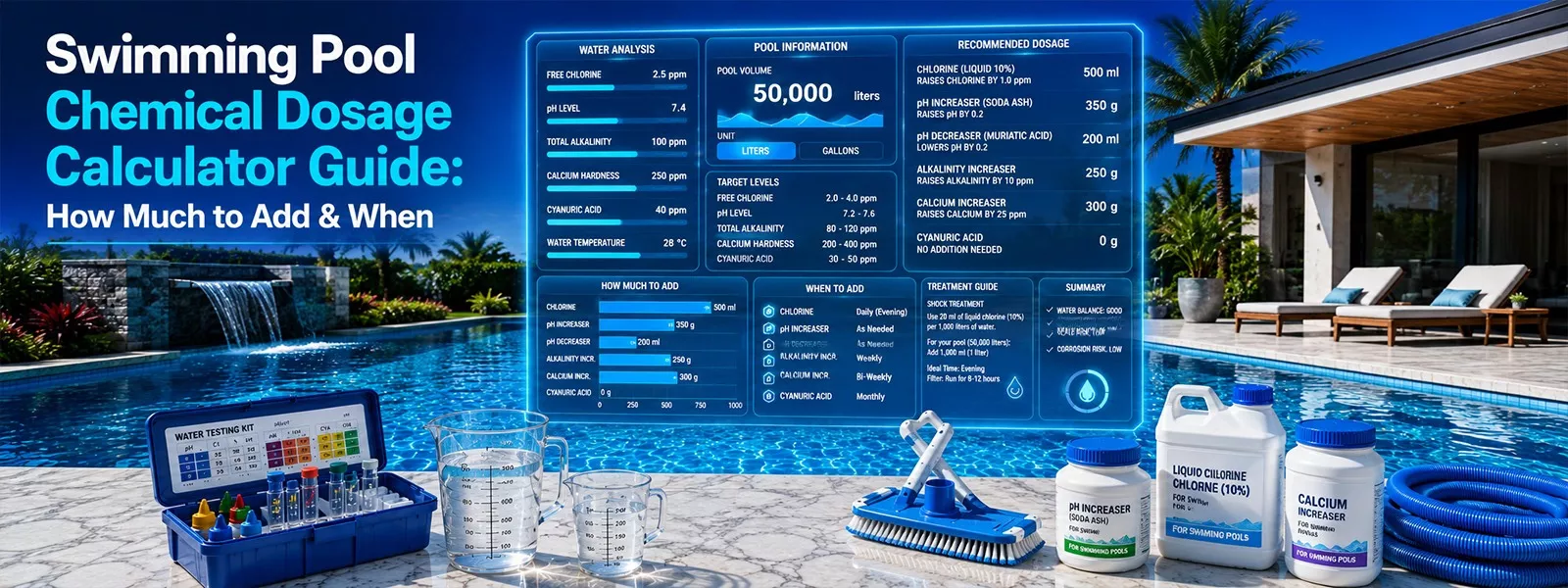
If you've ever stood next to your pool with a bag of chlorine wondering 'how much is too much?' — you're not alone. Getting the dosage right with swimming pool chemicals is one of the most common challenges pool owners face, especially in India where climate conditions change the equation significantly.
This guide gives you a practical, no-fluff reference for every major pool chemical: what it does, how much to add, and when to add it. We've included a dosage table you can bookmark and come back to, plus India-specific advice that most generic pool guides simply ignore.
Why Getting Pool Chemical Dosage Right Actually Matters
Under-treating a pool is the obvious problem — green water, skin irritation, bacterial growth. But over-treating is just as costly and just as common.
Too much chlorine bleaches swimwear and causes eye irritation. Excessive pH correction creates scale buildup on walls and equipment. Over-use of algaecide can create foam problems and leave residue that affects water clarity.
Beyond the water quality issue, incorrect dosing wastes money. A 50,000-litre pool over-dosed with chlorine for a month can consume 30-40% more chemical than needed. Multiply that over a year, and the cost adds up fast.
How the Indian Climate Changes the Calculation
India's climate creates conditions that most Western pool guides don't account for:
- Summer heat (40°C+): UV radiation and high temperatures destroy free chlorine 2-3x faster than in temperate climates. Outdoor pools in cities like Delhi, Ahmedabad, or Nagpur may need daily chlorine top-ups in May-June.
- Monsoon season: Heavy rain dilutes pool water, lowers pH and alkalinity, and introduces organic matter that feeds algae. Post-rain treatments are non-negotiable.
- Hard water: Many Indian cities have calcium-heavy municipal water. This affects calcium hardness levels and increases scaling risk on pool surfaces and equipment.
- High bather load: Clubs, hotels, and apartment complexes often have pools with heavy usage, which burns through sanitiser faster.
Rule of thumb: In Indian summer conditions, check your pool's free chlorine level daily. In winter, every 2-3 days is generally adequate.
Core Swimming Pool Chemicals: What Each One Does
Before you can dose correctly, you need to understand what each chemical actually does. Here's a straight-to-the-point breakdown:
Chlorine — The Primary Sanitiser
Chlorine is the backbone of pool sanitation. It kills bacteria, viruses, and organic contaminants. In Indian pools, you'll typically find it as:
- Calcium hypochlorite granules (65-70% available chlorine) — most common in India
- Sodium hypochlorite liquid (10-12% concentration) — used in larger commercial pools
- Trichlor tablets (90% available chlorine)— slower dissolving, often used in floaters
Internal link opportunity: Link to product page for 'swimming pool chlorine tablets and granules' here.
pH Increaser and pH Decreaser
pH controls how effective chlorine is and how comfortable the water feels. At pH above 7.8, chlorine loses most of its sanitising power — it's still present but largely inactive.
- pH Increaser: Sodium carbonate (soda ash) — raises pH
- pH Decreaser: Sodium bisulphate (dry acid) or muriatic acid — lowers pH
Target range: pH 7.2 - 7.6. Test this every time you test chlorine.
Alkalinity Increaser (Sodium Bicarbonate)
Total alkalinity (TA) is the buffer that keeps pH stable. Low TA means pH swings wildly with every rainfall or chemical addition — a very common problem during Indian monsoon season.
Target range: 80 - 120 ppm. If TA drops below 60 ppm, pH will become erratic and difficult to manage.
Calcium Hardness
Calcium hardness (CH) is particularly relevant in India. Municipal water in cities like Mumbai, Chennai, and Bengaluru tends to be moderately hard, but Delhi and parts of Rajasthan have very hard water with calcium levels that can push pool CH dangerously high over time.
- Too low (below 150 ppm): Corrosive water that etches plaster surfaces and damages metal fittings
- Too high (above 400 ppm): Scale deposits on walls, tiles, and pump internals
Target range: 200 - 400 ppm.
Algaecide
Algaecide is a preventive and curative treatment for algae. It should be used as a weekly maintenance addition to stay ahead of algae growth — not just when you already see green water.
Quaternary ammonium-based algaecides are the most common. Copper-based variants are also effective but require careful dosing to avoid staining.
Internal link opportunity: Link to algaecide product page with anchor 'algaecide for swimming pools'.
Pool Shock (Super-Chlorination)
Pool shock is a heavy-dose chlorine treatment that burns off chloramines (the combined chlorine responsible for the 'pool smell' and eye irritation) and kills algae.
When to shock:
- After heavy rain or flooding
- After an unusually high bather load (pool party, event)
- When combined chlorine exceeds 0.5 ppm
- When algae is visible or suspected
- At the start of every new season
Shock dose: typically 10x the combined chlorine reading, or a standard 10 ppm breakpoint super-chlorination.
Clarifiers and Flocculants
Clarifiers (polyaluminium chloride or PAC) bind tiny suspended particles that pass through the filter, making water visually clear. Flocculants do the same but cause particles to clump and sink so they can be vacuumed out. Use clarifiers for routine maintenance; flocculants when water is seriously cloudy.
Ideal Water Chemistry Parameters: Quick Reference for Indian Pools
Use this table as your baseline. These are the target ranges recommended for Indian pool conditions (not US/European defaults, which don't account for our climate).
| Parameter | Ideal Range | Action if Low | Action if High |
|---|---|---|---|
| Free Chlorine | 1.0 - 3.0 ppm | Add chlorine granules/tabs | Allow to dissipate; reduce dosing |
| pH | 7.2 - 7.6 | Add pH Increaser (soda ash) | Add pH Decreaser (dry acid) |
| Total Alkalinity | 80 - 120 ppm | Add alkalinity increaser | Aerate + add pH decreaser |
| Calcium Hardness | 200 - 400 ppm | Add calcium hardness increaser | Partial drain + refill |
| Cyanuric Acid (stabiliser) | 30 - 50 ppm (outdoor only) | Add stabiliser | Partial drain + refill |
| TDS (Total Dissolved Solids) | Below 2000 ppm | N/A | Partial drain + refill |
These ranges are for standard residential and commercial pools. Therapy pools, children's pools, and indoor pools may have slightly different targets. Always verify with a water test before making adjustments.
Swimming Pool Chemical Dosage Calculator: Reference Table by Pool Size
Step 1: Calculate Your Pool Volume
If you don't know your pool's volume in litres, use this formula:
Pool Volume (litres) = Length (m) × Width (m) × Average Depth (m) × 1,000
For irregular shapes, calculate each section separately and add them together. For circular pools: Volume = 3.14 × radius² × depth × 1,000.
Step 2: Use This Dosage Reference Table
The table below shows approximate chemical doses to raise each parameter by 10 ppm in pools of different sizes. Adjust for current readings and target levels.
| Chemical (raises by 10 ppm) | 25,000 L pool | 50,000 L pool | 100,000 L pool | Notes |
|---|---|---|---|---|
| Chlorine granules (65% cal-hypo) | ~38 g | ~75 g | ~150 g | Add in evening; pre-dissolve first |
| pH Increaser (soda ash) | ~25 g | ~50 g | ~100 g | Add near return jet |
| pH Decreaser (dry acid) | ~15 g | ~30 g | ~60 g | Add slowly; retest after 2 hrs |
| Alkalinity Increaser (bicarb) | ~190 g | ~380 g | ~760 g | Broadcast over water surface |
| Calcium Hardness Increaser | ~25 g | ~50 g | ~100 g | Pre-dissolve; add slowly |
| Algaecide (quat ammonium) | ~50 mL | ~100 mL | ~200 mL | Weekly maintenance dose |
| Pool Shock (shock dose) | ~250 g | ~500 g | ~1,000 g | Evening application; run pump |
IMPORTANT: These are approximate doses for raising parameters from a baseline. Always test water first, calculate the gap to your target, and dose accordingly . Never add multiple chemicals simultaneously.
Internal link opportunity: Link to product page (swimming pool chemicals) with anchor text 'swimming pool chemicals' in the paragraph above.
How Often to Add Pool Chemicals: A Practical Weekly Schedule?
Consistency beats heroics. A regular dosing schedule prevents problems rather than reacting to them. Here's a framework for Indian pool conditions:
Daily (During Summer or High Use)
- Test free chlorine and pH using a test kit or test strips
- Add chlorine if free chlorine is below 1.0 ppm
- Correct pH if outside the 7.2-7.6 range
- Run the filtration system for a minimum of 8 hours
Weekly
- Test total alkalinity and calcium hardness
- Add weekly maintenance dose of algaecide
- Backwash or clean the filter
- Inspect pool surfaces for early signs of algae (green patches, slippery walls)
- Shock treat if combined chlorine is over 0.5 ppm or after heavy usage
Monthly and Seasonal
- Test cyanuric acid (stabiliser) levels for outdoor pools
- Test TDS — if above 2,000 ppm, plan a partial drain and refill
- Check and clean pool equipment: pump, skimmer, nozzles
- Before monsoon: alkalinity and calcium hardness adjustment, plus pre-emptive shock
- After monsoon: full water test, re-balance all parameters, heavy shock dose
Pro tip from 15 years in pool treatment: Keep a simple log of your test readings and doses. It helps you spot patterns — like a consistent weekly pH drop — which often signals a root cause (CO2 from algae, acid rain, over-aeration) that can be fixed permanently.
Monsoon and Summer Pool Treatment: India-Specific Advice
Summer Treatment (April to June)
The combination of intense UV and heat is brutal on free chlorine. In May in Delhi or Jaipur, an outdoor pool without a stabiliser (cyanuric acid) can lose its entire chlorine dose within 2-3 hours of sunlight exposure.
- Use a stabilised chlorine product or add cyanuric acid separately (target 30-50 ppm)
- Dose chlorine in the evening to minimise solar degradation overnight
- Expect to dose 30-50% more chlorine than in cooler months
- Check the pool at least once before it opens each morning
Monsoon Treatment (July to September)
Rainwater is slightly acidic and introduces organic matter, pollen, and environmental contaminants into the pool. After every significant rainfall:
- Test pH and alkalinity — both typically drop after rain
- Run filtration continuously for 24 hours after heavy rain
- Add a maintenance shock dose (not full shock unless algae is visible)
- Check for early algae signs on walls and floor
- Increase algaecide to 1.5x the normal maintenance dose during monsoon months
Common Chemical Dosage Mistakes to Avoid
| Mistake | What Goes Wrong | The Fix |
|---|---|---|
| Adding chemicals without testing first | Dosing blindly leads to over/under-treatment | Always test before dosing |
| Adding multiple chemicals at once | Chemical reactions reduce effectiveness or create hazards | Wait 30-60 minutes between additions |
| Dosing at noon in summer | Sunlight destroys chlorine before it can work | Dose in the evening |
| Using expired chemicals | Degraded active content means ineffective treatment | Check manufacturing date; use within 12 months |
| Ignoring alkalinity | pH becomes impossible to stabilise | Correct TA before adjusting pH |
| Storing chemicals in heat | Chemicals degrade and can become unstable above 35°C | Store in cool, dry, shaded area |
| Skipping pre-dissolving | Granules can bleach pool floor or surfaces | Pre-dissolve in a bucket before adding |
About the Expert Behind This Guide
DS Water Technology has been providing swimming pool water treatment solutions across India for 15 years. With ISO certification, MSME registration, and an active Importer-Exporter certificate, we supply pool chemicals and treatment systems to residential complexes, hotels, clubs, and public pools.
The dosage guidance in this article is based on real-world experience treating thousands of pools across different Indian climatic zones — from the arid North to the humid coastal South. We've seen what works, and more importantly, what doesn't.
Need professional advice on pool chemical dosing? Our team is just a call away.
FAQ Section
Q1: How much chlorine do I add to a 50,000-litre swimming pool?
To raise free chlorine by 1 ppm in a 50,000-litre pool, add approximately 75 grams of 65% calcium hypochlorite granules. For a standard start-up or after a shock event, you may add 500 grams to achieve a 10 ppm shock dose. Always test the existing chlorine level first before dosing.
Q2: How often should I add chemicals to my swimming pool?
In Indian summer conditions, test and dose chlorine and pH daily. During cooler months or for indoor pools, every 2–3 days is sufficient. Alkalinity and calcium hardness should be checked weekly, and a full water balance check should be done monthly.
Q3: What is the correct pH level for a swimming pool in India?
The ideal pH range for swimming pools in India is 7.2 to 7.6. At this range, chlorine is highly effective, water is comfortable for swimmers, and the risk of scale formation and corrosion is minimised. pH tends to drift upward in Indian pools due to hard water and high bather load.
Q4: Can I use regular bleach (sodium hypochlorite) for my pool?
Yes, sodium hypochlorite (liquid chlorine at 10–12% concentration) can be used to sanitise swimming pools. It's commonly used in larger commercial pools in India. However, it has a shorter shelf life and adds to the pH, so regular pH testing is essential. Calcium hypochlorite granules are more practical for most residential and mid-sized commercial pools.
Q5: Why does my pool water turn green even after adding chlorine?
Green water is almost always caused by algae. This usually happens when chlorine levels drop too low (below 1 ppm), pH is too high (reducing chlorine's effectiveness), or the pool goes untreated for several days. Perform a heavy shock treatment (10 ppm), run the filtration continuously, and apply algaecide. Scrub visible algae from walls and vacuum the dead algae after 24 hours.
Q6: What chemicals do I need to open a swimming pool at the start of summer?
Before opening the pool for summer use in India: (1) Test all parameters — chlorine, pH, alkalinity, calcium hardness. (2) Balance alkalinity to 80–120 ppm. (3) Adjust pH to 7.2–7.6. (4) Shock treat with a 10 ppm chlorine dose. (5) Add a maintenance dose of algaecide. (6) Run filtration for 24 hours and re-test before allowing swimmers.
Q7: How do I reduce calcium hardness in my pool?
The only reliable way to reduce calcium hardness is a partial drain-and-refill using lower-hardness water. There is no chemical that safely removes calcium from pool water in a practical sense. If your source water is also very hard (common in Delhi, Jaipur, and parts of Maharashtra), consider investing in a water softener for the fill water line.
Q8: Is it safe to swim after adding chemicals to the pool?
After adding chlorine, wait until the free chlorine level drops to 3 ppm or below before swimming — typically 30 minutes to 4 hours depending on the dose and pump run time. After adding shock, wait until levels return to below 3 ppm, which may take 8–12 hours. After pH or alkalinity corrections, a 30-minute wait with the pump running is generally sufficient.
Q9: How do I treat my pool during the monsoon season?
After every significant rainfall: test pH and alkalinity (both usually drop), run filtration for 24 continuous hours, add a maintenance shock dose, and increase algaecide to 1.5x the normal weekly rate. If rain is persistent, daily testing is advisable. Keep the pool covered when not in use during heavy monsoon periods.
Q10: What does pool shock do and when should I use it?
Pool shock is super-chlorination — adding a high dose of chlorine (typically enough to reach 10 ppm) to burn off chloramines, kill algae, and reset the pool's sanitation. Use it after heavy rain, after a pool party or high-bather event, whenever combined chlorine exceeds 0.5 ppm, when water clarity degrades, or at the start of every season.
Q11: How do I know if I have a chlorine demand problem?
Chlorine demand occurs when the pool consumes chlorine faster than you add it — levels refuse to hold above 1 ppm despite regular dosing. This typically signals a heavy organic load (algae, debris, bird droppings), very high TDS, or high levels of chloramines. The solution is a heavy breakpoint chlorination shock, followed by superb filtration, and then a re-evaluation of your regular dosing schedule.
Q12: Can I mix different pool chemicals together before adding them to the pool?
No. Never pre-mix different pool chemicals, even in water. Chlorine granules and pH adjusters, if mixed together, can cause violent reactions including fire or release of toxic gas. Always add chemicals separately to the pool, wait 30–60 minutes between additions, and add chemicals to water — never water to concentrated chemicals.
Ready to build or
upgrade your pool?
Tell us about your swimming pool project and one of our experts will contact you within 24 hours with the best solution and pricing.
New Delhi - 110086, Delhi, India