126, Mange Ram Park, Rohini, Delhi, India


DS Water Technology is a swimming pool contractor, builder, and construction company based in Rohini, Delhi, serving residential and commercial clients across Delhi NCR since 2011. Founded by Dharmendra Singh, the company has completed 500+ pool construction projects, offering end-to-end swimming pool construction — from site assessment and structural design to waterproofing, filtration, and handover — under fixed-price, fully documented contracts.
Most pool projects in India do not fail because of bad design. They fail because the wrong person was put in charge of building it.
A swimming pool is a reinforced concrete structure with an engineered water circulation system, waterproofed surfaces, and sized mechanical equipment. It will cost anywhere from ₹8 lakhs for a small residential pool to several crores for a large commercial facility. That investment is determined almost entirely by one decision — who you hire as your swimming pool contractor.
What Does a Swimming Pool Contractor Actually Do?
The term contractor is not interchangeable with labourer, supervisor, or builder — though people use these words loosely. In a legal and operational sense, the swimming pool contractor is the single point of accountability for the entire project.
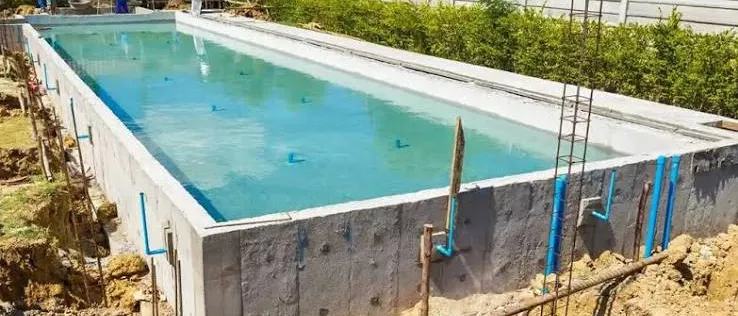
Their responsibilities cover four distinct areas:
When all of this sits with one accountable party, your job is to review progress and make decisions. When it does not, you end up managing six vendors with no one responsible for the result.
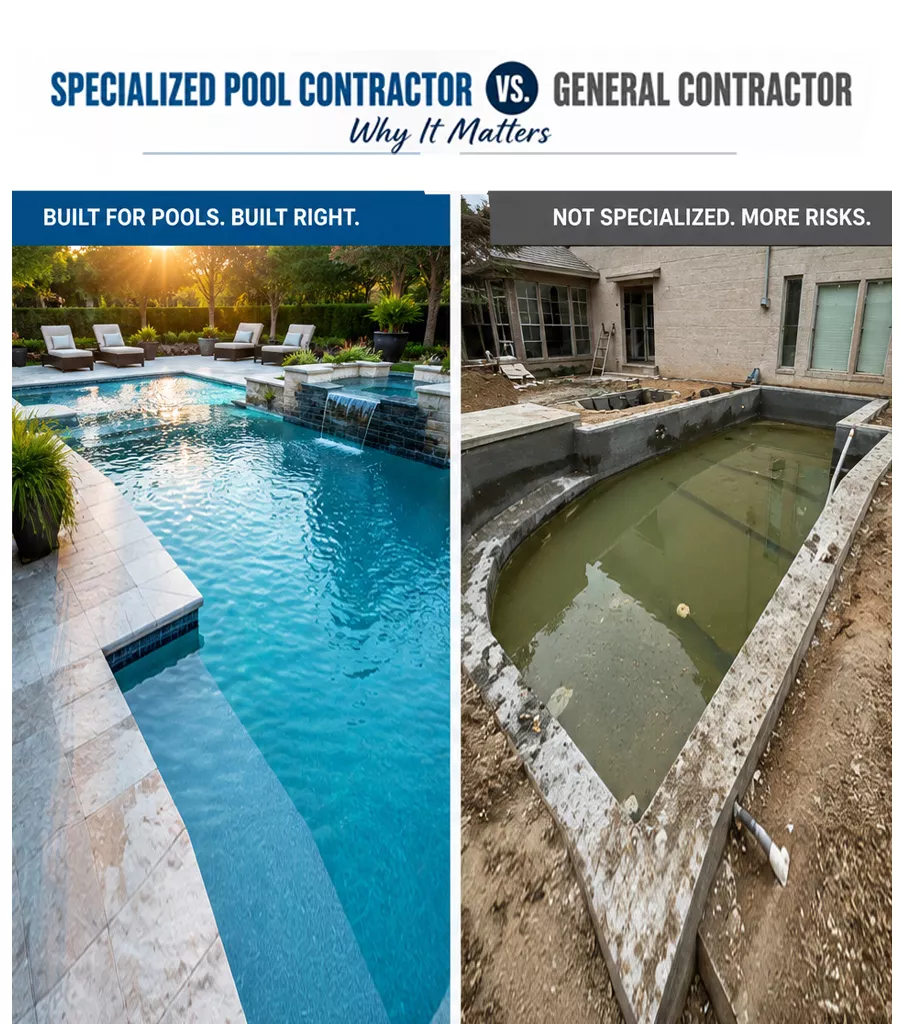
Specialized Swimming Pool Contractor vs. General Contractor — Why It Matters?
This distinction is consistently underestimated — and consistently expensive when it goes wrong.
A general pool contractor builds broadly — buildings, interiors, landscaping. A specialized swimming pool contractor has built their entire practice around pools. The difference shows up after construction, not during the sales process.
Waterproofing specification: Pool waterproofing requires continuous immersion-grade systems. General contractors often apply construction waterproofing (used for rooftops and basements) that is not designed for the hydrostatic pressure and chemical exposure a pool faces every day.
Hydraulic design: Filtration must be sized for pool volume and bather load. An undersized pump-filter combination leads to poor water turnover, algae growth, and high chemical consumption. Getting this right requires pool-specific knowledge that most general contractors do not have.
Finish selection: Pool finishes — plaster, glass mosaic, porcelain tile, fibreglass — have specific substrate and application requirements. The wrong adhesive, a skipped primer coat, or filling the pool before adequate cure time are mistakes a specialist team will not make.
Long-term accountability: A specialized pool contractor's reputation is built on pools. A general contractor taking a pool project as a side job has no such incentive to get it right the first time.
Types of Swimming Pools We Build
Before any work begins, the right pool type needs to be selected based on your site, budget, and intended use. Each type has specific structural and equipment requirements.
Concrete / Gunite Swimming Pools (RCC)
Reinforced concrete pools are the most common for residential and commercial use in India. We offer full design flexibility — any shape, depth, or dimension — and are highly durable when built with the correct concrete mix (minimum M25 grade) and reinforcement cover. This is the most durable option and the most appropriate for complex ground conditions in Delhi NCR.
Fibreglass Swimming Pools
Reinforced concrete pools are the most common for residential and commercial use in India. We offer full design flexibility — any shape, depth, or dimension — and are highly durable when built with the correct concrete mix (minimum M25 grade) and reinforcement cover. This is the most durable option and the most appropriate for complex ground conditions in Delhi NCR.
Vinyl Liner Swimming Pools
Steel or polymer frame with a custom-fitted vinyl liner. Lower initial cost but requires liner replacement every 8 to 10 years. Less common in India due to high UV exposure. Available from DS Water Technology where specifically requested.
Infinity and Overflow Swimming Pools
Water flows over one or more edges into a balance tank and is recirculated. Popular in hotels, resorts, and premium residences. The overflow edge must be level to within a few millimetres throughout its entire length — this requires careful hydraulic calculation and precise civil execution.
Rooftop and Indoor Swimming Pools
Rooftop pools require a structural assessment of the building slab — water weighs 1,000 kg per cubic metre, so even a modest 6m × 3m × 1.2m pool adds approximately 21 tonnes to the structure. Indoor pools require additional HVAC coordination to manage humidity and condensation inside the building enclosure. Both types are feasible; both require specialist design.
Lap Swimming Pools and Sport Pools
Lap pools are long, narrow pools built for fitness swimming. Competition pools are built to FINA standards — 50m or 25m lengths, defined lane widths, specific depth requirements, and timing touchpad provisions. DS Water Technology has built competition-standard pools for clubs and institutions across Delhi and NCR.
Luxury Swimming Pools
Luxury pools go beyond standard dimensions and finishes. Features include glass mosaic or natural stone finishes, in-pool seating and tanning ledges, integrated spa or jacuzzi sections, colour-changing LED lighting , automated chemical dosing systems, and bespoke water features. We approach luxury pool projects as architectural elements, working with landscape architects and interior designers to ensure the pool integrates with its surroundings rather than sitting awkwardly within the space.
Swimming Pool Construction Process — Step by Step
Every pool we build follows a defined, phase-by-phase construction sequence. Skipping or shortcutting any phase creates problems that surface after handover — often expensive ones.
Step 1: Site Inspection and Survey
Before any design is finalised, our engineers assess the site. This covers soil bearing capacity, presence of expansive soils such as black cotton soil, water table level, proximity to existing foundations, underground utilities, and access for excavation equipment. Site conditions directly affect the structural design and waterproofing specification.
Step 2: Design, Planning, and Approvals
Based on the site assessment, we prepare structural drawings, plumbing layout, equipment schedules, and finishing specifications. For commercial pools, hydraulic calculations confirm water turnover rates — typically six hours for public pools. Filtration and chemical dosing systems are sized at this stage. Required permits from local authorities are obtained before excavation begins.
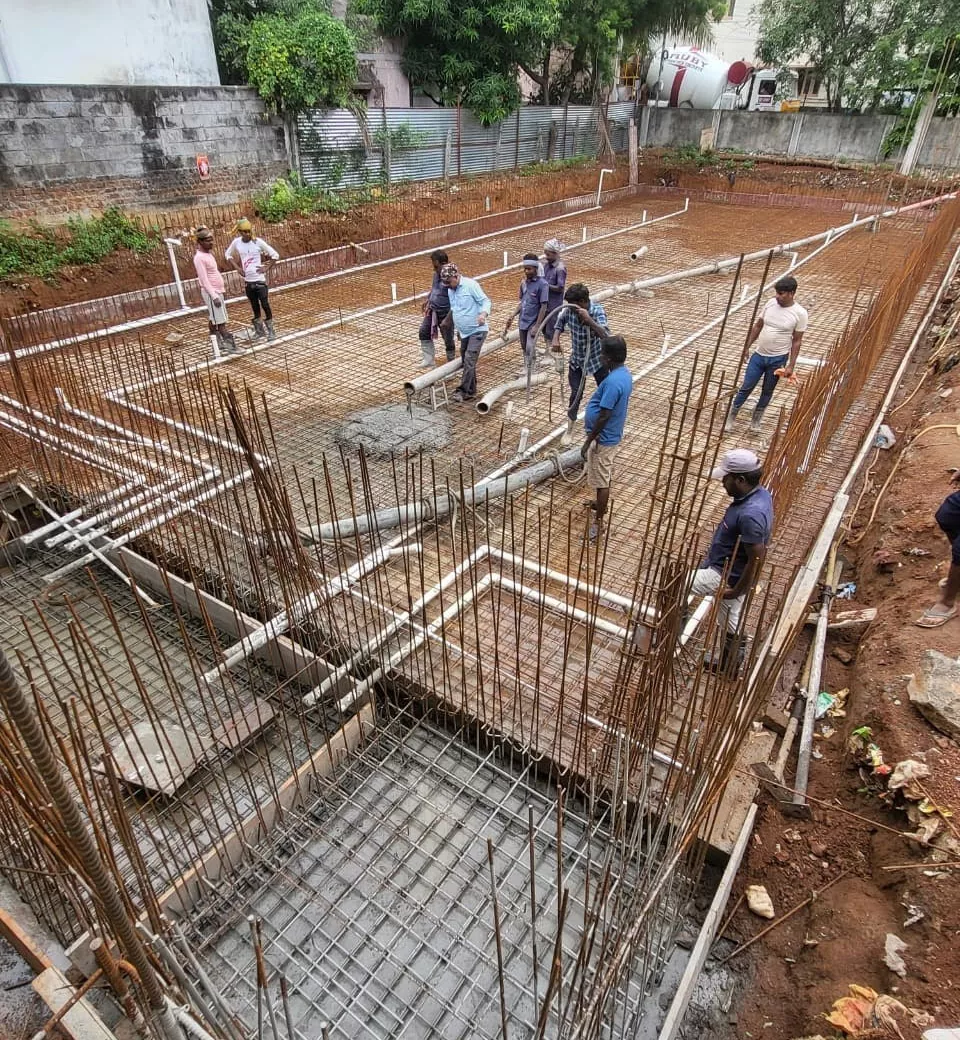
Step 3: Excavation
Carried out to the dimensions specified in structural drawings, with additional tolerance for working space and drainage layers. Over-excavation is avoided because backfill is rarely as stable as undisturbed soil. Shoring or benching is used where adjacent structures or soil conditions require it.
Step 4: Structural Work — RCC Shell
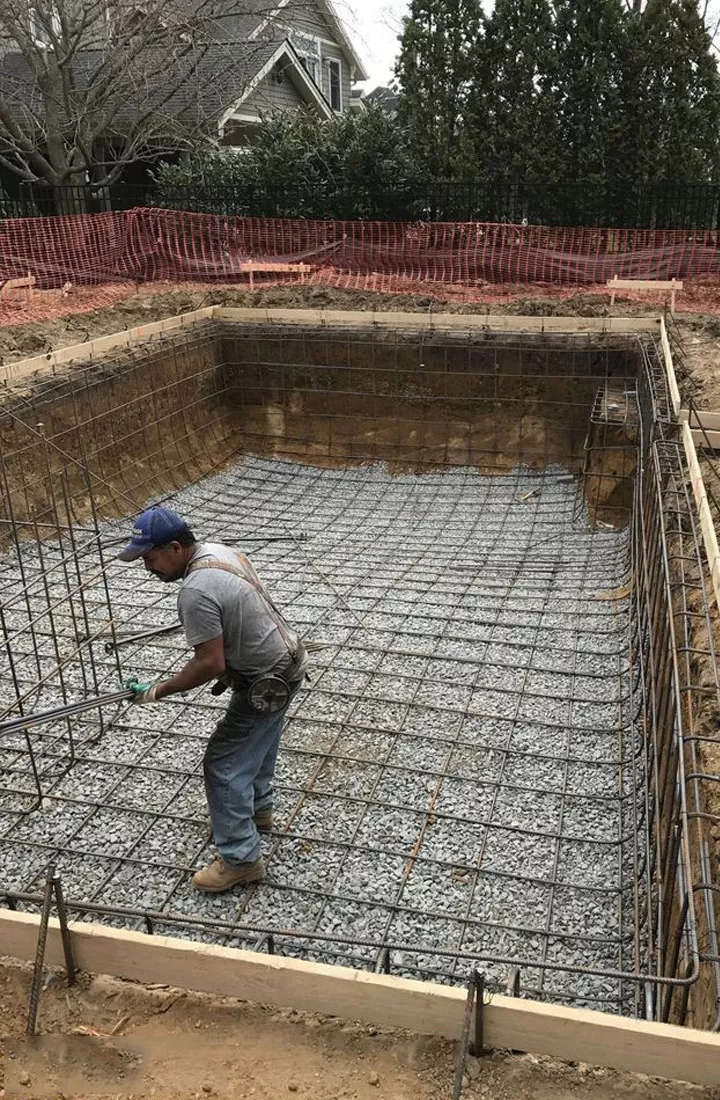
The pool shell is constructed using reinforced cement concrete. We use a minimum M25 grade mix with a low water-cement ratio to limit porosity. Reinforcement is placed with 40mm cover — the standard for underground structures exposed to ground moisture. The base slab is poured first, followed by the walls. Construction joints are treated with hydrophilic swelling strips to prevent water ingress at the joint interface.
Step 5: Plumbing and Equipment Installation
Main drain lines, skimmers, returns, and any spa jets are installed. Equipment — filtration tanks, pumps, chemical dosing systems, heat pumps or solar heating where specified — is positioned in the plant room and connected. Pipe sizing is calculated to maintain flow velocities within acceptable limits and avoid cavitation at the pump inlet.
Step 6: Waterproofing
Waterproofing is one of the most critical phases in swimming pool construction. We use a two-layer system: crystalline waterproofing admixture in the concrete mix itself — which forms crystals within the concrete matrix to block water migration — combined with a surface-applied cementitious or polyurethane membrane. All penetrations receive additional sealant treatment. The pool is water-tested by filling to the waterline and monitoring for 72 hours before any tiling or plastering begins.
Step 7: Surface Finishing
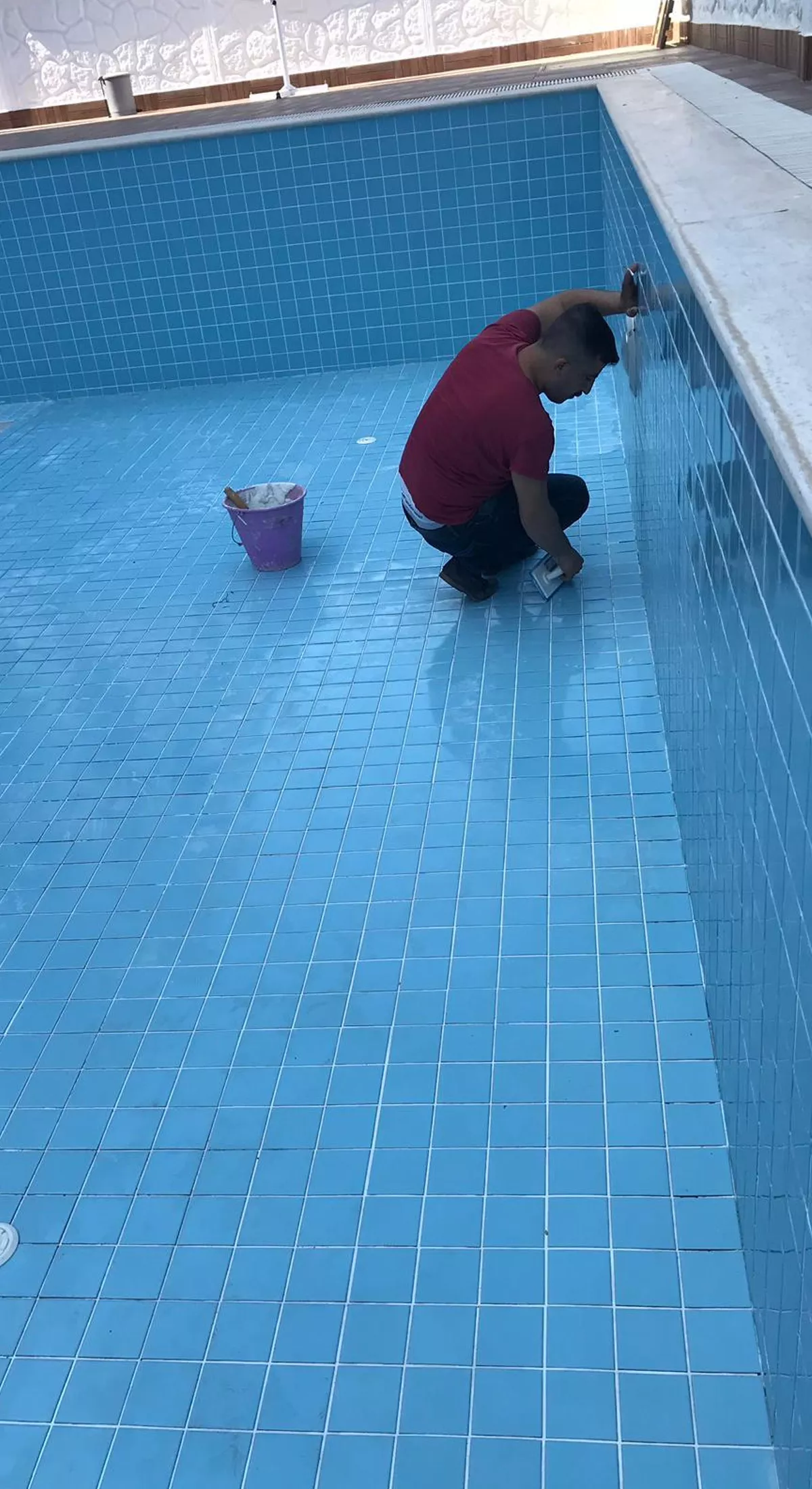
Pool interiors can be finished with ceramic or porcelain tiles, exposed aggregate plaster, or pebble finish. Tile selection for submerged surfaces must meet a minimum slip resistance rating. Grout and adhesives must be polymer-modified and rated for permanent water immersion. Pool copings, surrounds, and steps are finished to match the design and provide safe footing.
Step 8: Commissioning and Testing
Once the pool is filled, we balance water chemistry (pH 7.2–7.6, total alkalinity 80–120 ppm, free chlorine 1–3 ppm), verify flow rates at each inlet and outlet, check filter pressure and backwash cycles, and confirm all safety features including anti-entrapment drain covers. A commissioning report and full handover documentation including an equipment maintenance schedule are provided as standard.
Step 9: Training, Handover, and Ongoing Support
For commercial pools, we conduct a formal training session for facility management staff covering equipment operation, chemical handling, and emergency procedures. Every project receives: equipment manuals and warranty cards, a water chemistry report at handover, a written maintenance guide, and written confirmation of the defect liability period. Post-handover, we offer Annual Maintenance Contracts (AMC) covering routine servicing and equipment checks.
Materials Used in Swimming Pool Construction
Material selection affects both the long-term durability of the pool and its maintenance requirements. Below is a summary of key materials used in our pool construction projects.
| Component | Material Used | Why It Matters |
|---|---|---|
| Pool Shell | M25/M30 RCC with low W/C ratio | Controls porosity and structural strength |
| Waterproofing | Crystalline admixture + surface membrane | Prevents seepage through shell and joints |
| Reinforcement | Fe500 TMT bars with 40mm cover | Resists soil pressure and water table uplift |
| Pool Interior | Vitrified/porcelain tile or quartz plaster | Durability, hygiene, and appearance |
| Pipework | UPVC/CPVC pressure-rated pipe | Corrosion resistance and long service life |
| Filtration Media | Graded silica sand or glass media | Removes suspended particles to ≤0.1 NTU |
| Chemical Dosing | Automated chlorine and pH dosing | Maintains safe water chemistry consistently |
Mechanical Filtration and Equipment Installation for Swimming Pool
A pool requires a functioning mechanical core to stay clean, safe, and transparent. Three components do most of the work:
The pool pump — pulls water from skimmers and main drains, pushes it through the filtration loop, and returns it through the wall inlets. Pump sizing is critical: too small and the pool cannot achieve adequate turnover; too large and you create flow velocities that damage the filter media and increase energy costs.
The pool filter — removes suspended particles using sand, cartridge elements, or glass media. For commercial pools, multiple filter vessels are typically required to achieve the turnover rate needed for the bather load.
Sanitation units — chlorine feeders, salt chlorinators, UV systems, or ozone units eliminate biological contaminants and maintain safe water chemistry. Automated dosing systems are standard for commercial pools and increasingly common for residential projects.
Custom Swimming Pool Design and Building
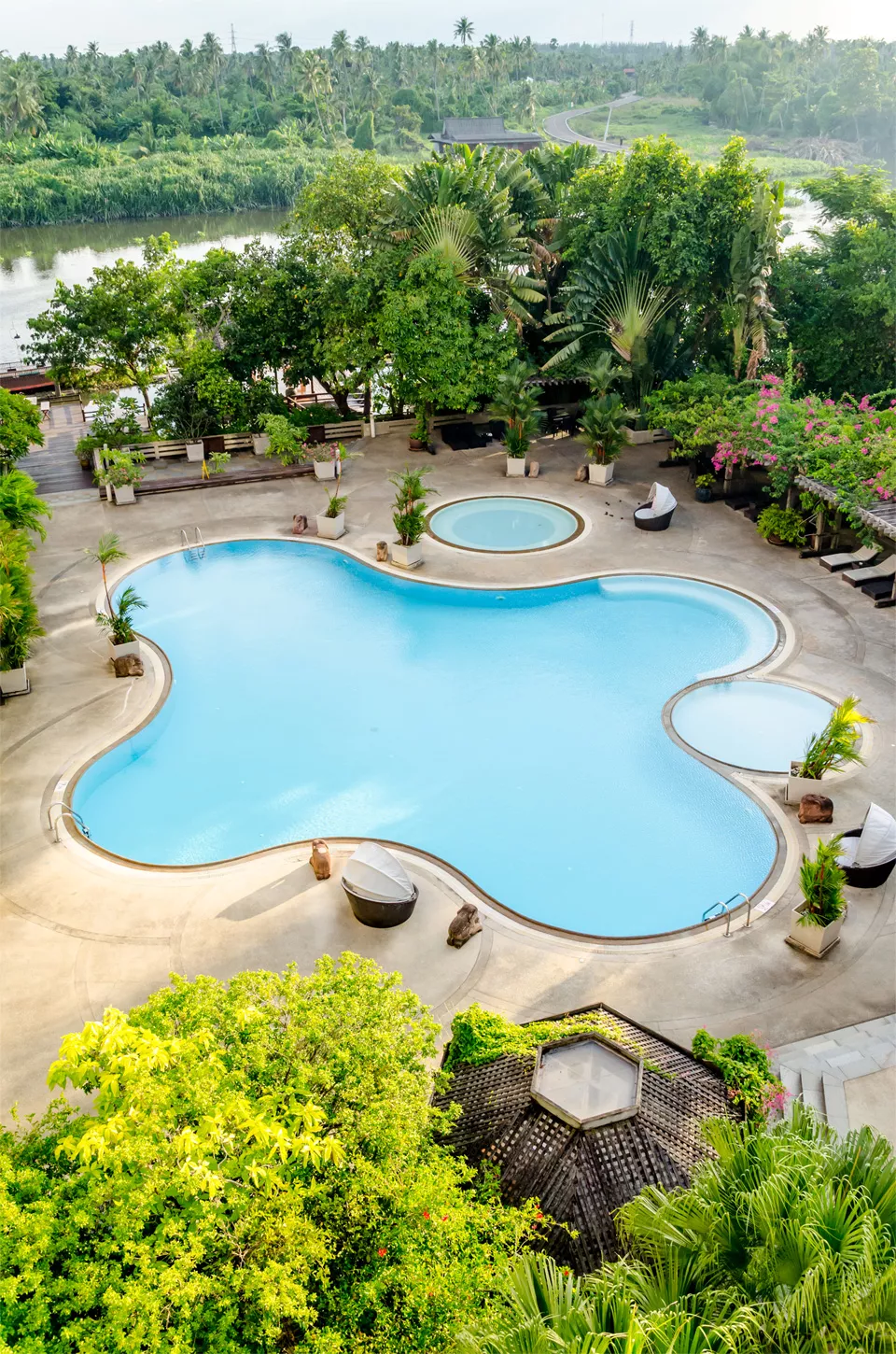
A custom swimming pool builder is not just someone who pours concrete. The design phase determines whether the finished pool fits the site, matches the architecture, works within the client's budget, and performs well over 20 to 30 years of use.
At DS Water Technology, our swimming pool building process starts with understanding what the pool is for — lap swimming, leisure, hospitality, or competition — and designing accordingly. A pool built without this clarity ends up being a compromise: too shallow for serious swimming, the wrong shape for the space, or over-specified for what the owner actually needs.
Custom design elements we work with:
- Pool shape and depth profile — including split-depth pools with a shallow leisure area and deeper swimming zone
- Integrated spa or jacuzzi
- Water features — deck jets, waterfalls, rain curtains
- Infinity or overflow edges with balance tank design
- Underwater LED lighting systems with colour control
- Automatic chemical dosing and pool management systems
- Solar or heat pump heating for year-round use
- Pool covers — automatic or manual — for heat retention and safety
Common mistakes when choosing a swimming pool builder: selecting purely on price without verifying completed work; accepting vague specifications rather than named equipment and materials; not clarifying who is responsible for approvals and compliance; and not asking what happens after handover if something goes wrong.
Swimming Pool Construction Cost in India
Cost estimates without a site assessment are unreliable. Ground conditions, water table, access for equipment, pool volume, and equipment specification all affect the final number significantly. That said, the ranges below reflect what clients building pools in Delhi NCR should expect.
Residential Swimming Pool Cost
In-ground concrete pool construction in Delhi by DS Water Technology typically costs between ₹800 and ₹1,450 per square foot. For infinity edges, rooftop pools, or pools with complex features, costs extend to ₹1,450–₹2,750 per square foot.
- Small plunge pool (approx. 10×20 ft): ₹8 lakhs – ₹12 lakhs
- Standard family pool (approx. 15×30 ft): ₹15 lakhs – ₹25 lakhs
- FRP modular pool (including installation): ₹2.5 lakhs – ₹4.5 lakhs
- Filtration systems and LED lighting: typically add ₹1 lakh – ₹2 lakhs to the project cost
Commercial Swimming Pool Cost
Commercial swimming pool construction typically ranges from ₹1,000 to ₹1,500 per square foot. Full turnkey projects for hotels, sports academies, and housing societies generally fall between ₹60 lakhs and ₹5 crore depending on size, depth, and features. Timeline for large commercial pools: approximately 2.5 to 3 months from excavation to commissioning.
Factors That Affect Swimming Pool Construction Cost
The following factors affect what you will pay, regardless of who builds the pool:
- Pool size and shape — larger pools and non-rectangular freeform designs cost more in material and skilled labour
- Ground conditions — rocky ground increases excavation cost; a high water table requires dewatering and heavier structural design
- Pool depth — a deep-end pool at 1.8m–2m uses significantly more material than a constant-depth leisure pool at 1.2m
- Equipment specification — variable speed pumps, UV disinfection, salt chlorinators, and heat pumps increase upfront cost but reduce operating costs over time
- Surface finishing — glass mosaic tiles cost considerably more than standard vitrified tiles; pebble plaster has different long-term maintenance characteristics
- Additional features — infinity edges, integrated spas, water features, pool covers, and automated management systems each add to project cost
What to Look for When Hiring Swimming Pool Contractors?
When comparing pool contractors, price alone is not a useful basis for decision-making. Here is what actually matters:
Completed project portfolio: Ask for completed project addresses — not renders or proposals. If possible, visit one or two sites and ask the owner about the post-handover experience.
Technical fluency: Ask the contractor to explain the waterproofing system they intend to use and why. Ask how they size the filtration system. A contractor who cannot answer these questions clearly is not equipped for the job.
In-house versus sub-contracted work: Find out whether the contractor has their own core civil team. Contractors who sub-contract the entire scope create an accountability gap — the person you signed with has no direct control over the people doing the work.
Insurance: For commercial projects, confirm the contractor carries workmen's compensation and third-party liability cover before work begins.
References, not testimonials: Ask for phone numbers of past clients. A confident contractor will provide them without hesitation.
Red Flags to Watch for Before Signing Swimming Pool Builder
These are not theoretical concerns - they come up regularly in pool project hiring:
Significantly Lower Quotes Without Explanation
If one contractor is quoting 30–40% below others for the same scope, something is being left out. Usually it is waterproofing quality, equipment grade, or the plan to renegotiate once you are committed and work has started.
Vague Equipment Specifications
"High-quality pump and filter" in a contract is meaningless. The contract must name the brand, model, and rated flow capacity. If the contractor refuses to specify, they are reserving the right to install whatever is cheapest.
No Defect Liability Clause
A professional contractor will include a defect liability period — typically 12 to 24 months for pool construction — during which they are responsible for fixing defects that emerge in normal use. A contractor who resists this clause does not believe in the quality of their own work.
Requesting Large Advance Payments
An advance of 20–25% before mobilisation is standard. Requests for 50% or more upfront are a financial risk signal.
Verbal Scope Changes
Any contractor who handles changes informally is setting up a dispute. Every change must be documented in writing with an agreed price and timeline impact before the work is done.
How Pool Contractor Contracts Are Structured in India?
Understanding contract structure protects you before, during, and after the project. Pool contracts in India follow three main models:
Lump sum (fixed price): A single fixed price for the entire defined scope. The cleanest arrangement for clients because the risk of cost overruns sits with the contractor. Works best when scope is fully defined before work begins.
Item rate contract: Payment is based on measured quantities of completed work items — cubic metres of concrete, square metres of waterproofing, running metres of pipework. Unit rates are fixed, but final cost varies with actual quantities. Common for larger commercial pools where exact quantities are hard to determine before excavation.
Percentage-based contract: The contractor charges a management fee (typically 10–18%) on top of actual costs. Places cost risk with the client. Not recommended unless you have a long-standing relationship with the contractor and independent quantity surveying in place.
Whichever model is used, the contract must specify: full scope of work, payment milestone schedule, material and equipment specifications by brand and model (not vague descriptions), timeline with key milestones, defect liability period, and process for handling scope changes. A contractor who resists putting detailed specifications in writing is telling you something.
How Contractor Fees Work for Pool Projects?
In a lump-sum pool contract, the contractor's margin is built into the total price. Typical contractor margins on pool projects in India range from 15% to 25% of total project cost, depending on size, complexity, and the contractor's overheads.
For commercial swimming pool projects — hotels, residential developers, sports academies, healthcare facilities — fees at the upper end of this range are normal. The documentation standards, compliance requirements, and risk exposure of a commercial project justify the additional margin.
When comparing quotes, ask every contractor for a BOQ (Bill of Quantities) — a line-item breakdown of materials, labour, and equipment. Without a BOQ, you are comparing totals that may cover entirely different scopes.
What a Proper Pool Contract Handover Looks Like?
The handover is where many contractors fall short — and where you find out whether you hired the right one.
A proper handover from DS Water Technology includes:
- Equipment documentation — manuals, warranty cards, and service contacts for every installed item: pumps, filters, chemical dosing units, lighting, heating systems
- Water test report — documented chemistry readings confirming pH, free chlorine, alkalinity, TDS, and turbidity are within acceptable ranges at handover
- Maintenance schedule — a written guide covering daily, weekly, monthly, and annual tasks with recommended chemical dosing quantities based on pool volume
- Operator training — for commercial pools, a formal session for facility management covering equipment operation, chemical handling, and emergency procedures
- Defect liability confirmation — written confirmation of warranty period start date and the process for logging and resolving defects
A contractor who hands you keys and walks away without this documentation leaves you on your own from day one.
Questions to Ask a Swimming Pool Builder Before Hiring
These questions will tell you more than any sales presentation:
Can you walk me through the waterproofing system you will use and why?
How do you size the filtration system — what calculations do you use?
Who specifically will be on site supervising daily work? Is that person your employee or a sub-contractor?
Can I speak with two or three clients from projects you completed in the last two years?
What is your defect liability period, and what does it cover?
How do you handle scope changes - what is your process?
What documentation will I receive at handover?
Do you offer an AMC after handover, and what does it cover?
Have you completed a project similar to mine in size and type?
What is a realistic timeline for this project, and what risks could affect it?
A contractor who answers these questions directly and in detail is worth taking seriously. One who deflects or gets defensive is showing you something important.
How DS Water Technology Swimming Pool Builder Handles Every Project?
DS Water Technology is a specialist pool construction company based in Rohini, Delhi, founded in 2011 by Dharmendra Singh. We focus on water-related construction — swimming pools, water treatment systems, and related infrastructure. This focus means our teams are experienced in the specific challenges of pool construction in North Indian conditions: high water tables in parts of Delhi NCR, expansive soils, and seasonal temperature extremes.
How our process works:
- Fixed-price lump-sum contracts with fully specified BOQs — every material and piece of equipment is named before work begins
- Core civil team employed directly — we do not sub-contract the entire scope
- Dedicated site engineer during all critical construction phases
- No sub-contracting of waterproofing or structural work — the phases where most failures begin
- Complete documentation file at handover as standard, not on request
- Residential and commercial pool construction across Delhi, Gurugram, Noida, Greater Noida, Faridabad, Ghaziabad, Sonipat, and other North India locations
- Post-construction AMC available for ongoing pool operation and equipment servicing
We work with homeowners building private pools, with commercial developers and hotel groups, and with clients who need remediation after a poor experience with an unqualified contractor. Either way, the process starts the same: a site assessment, a detailed proposal, and a clear scope before any commitment is made.