126, Mange Ram Park, Rohini, Delhi, India


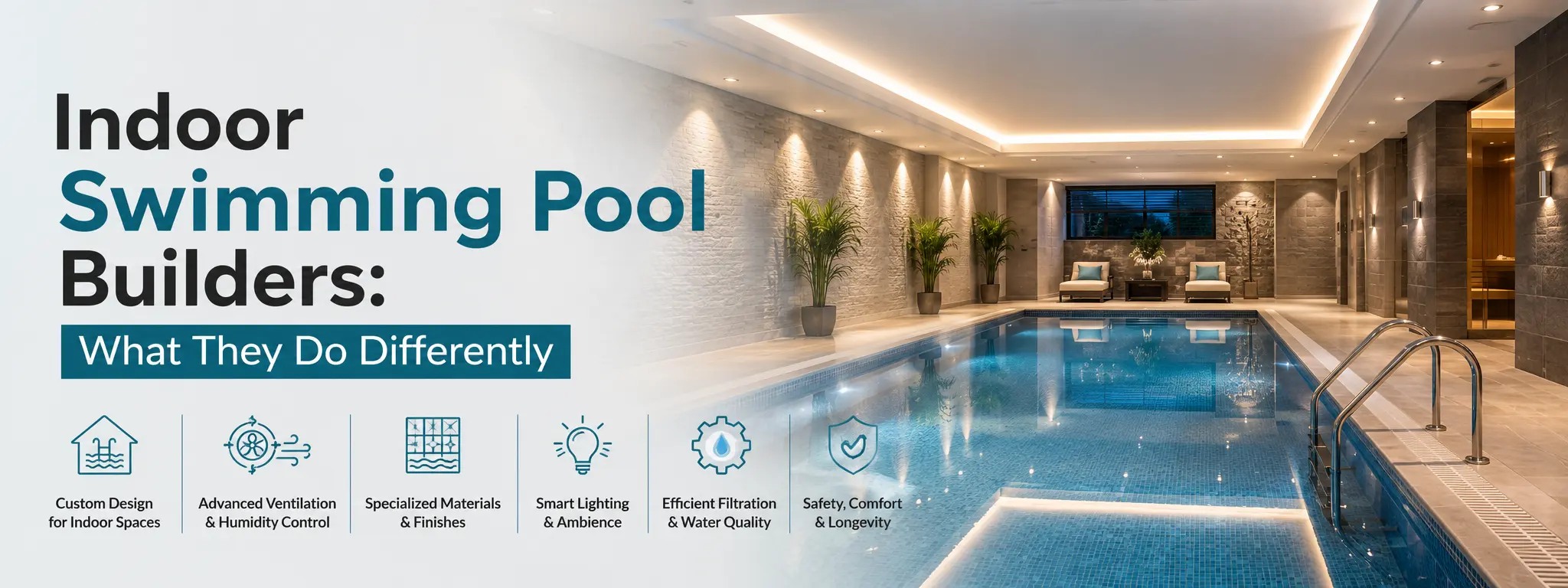
Most homeowners assume building an indoor pool is just "an outdoor pool with a roof over it." That assumption costs people tens of thousands of rupees in mold remediation, corroded fixtures, and redesigned HVAC systems within the first three years.
A qualified swimming pool builder who specializes in indoor construction treats the project as a building-science problem first and a water feature second. That distinction — engineering the environment around the water, not just the water itself — is the single biggest difference between a specialist and a general contractor who "also does pools."
This guide breaks down exactly what separates true indoor pool specialists from generalists, what changes when you move the project to a rooftop, and how design shifts when the pool is built specifically for adult use rather than family recreation.
Quick answer: Indoor pool builders differ from standard pool contractors primarily in how they manage humidity, air exchange, waterproofing membranes, and mechanical ventilation — factors that don't exist in outdoor installations but determine whether an indoor pool room survives structurally past year five.
What Is an Indoor Pool Builder
An indoor swimming builder is a specialized contractor who designs and constructs swimming pools inside enclosed structures, integrating dehumidification, moisture-resistant materials, structural waterproofing, and ventilation systems alongside the pool shell itself.
Unlike outdoor pool contractors, indoor specialists coordinate with HVAC engineers, structural engineers, and building-envelope consultants because an enclosed pool room behaves like a controlled industrial environment — not an open-air backyard feature.
Indoor Pools vs. Outdoor Pools: The Engineering Gap
The differences aren't cosmetic. They're physical.
Ventilation and Humidity Control
An outdoor pool releases evaporated moisture into open air. An indoor pool traps it.
A standard residential indoor pool room can generate 2-5 liters of evaporated water per square meter of surface area, per day, depending on water temperature and room humidity. Without a dedicated dehumidification system sized to that load, moisture condenses on ceilings, drips into wall cavities, and rusts steel reinforcement within the structure.
Specialist builders calculate this evaporation load using ASHRAE guidelines before laying a single tile — general contractors frequently skip this step entirely.
Structural Load and Waterproofing
Indoor pools sit inside a building envelope, meaning:
- The pool shell must be independently waterproofed from the surrounding structure
- Floor slabs need vapor barriers to stop moisture migration into adjoining rooms
- Steel and rebar require corrosion-resistant coatings rated for chlorinated, humid air
Water Chemistry in a Closed Environment
Chloramines — the byproduct of chlorine reacting with organic matter — evaporate into the air in outdoor pools and disperse harmlessly. Indoors, they accumulate, causing the sharp "chlorine smell" people mistakenly associate with clean water (it's actually a sign of poor ventilation). According to the National Swimming Pool Foundation, chloramine buildup is one of the most common indoor air quality complaints in enclosed pool facilities.
Key insight: If your indoor pool smells strongly of chlorine, your builder under-designed the air exchange system — not your pool chemistry.
7 Things Specialist Indoor Pool Builders Do Differently
- They design the HVAC system before the pool shape. Air handling dictates room geometry, not the other way around.
- They calculate dew point, not just room temperature, to prevent condensation on windows and ceilings.
- They use marine-grade or 316 stainless steel for all fixtures exposed to humid, chlorinated air.
- They install negative-pressure ventilation in the pool room relative to adjacent living spaces, preventing moisture migration into the rest of the house.
- They separate structural waterproofing from pool-shell waterproofing — two independent membrane systems, not one.
- They plan natural light carefully, since large glazing without thermal breaks becomes a condensation magnet.
- They provide a written moisture-management plan, not just a pool design — this is often the clearest sign you're working with a true specialist.
Expert framework: Think of an indoor pool built as "3 systems, 1 room" — the water system, the air system, and the structural envelope system. A generalist contractor typically only understands the first.
Custom Indoor Swimming Pool for Home: Design Considerations
When homeowners search for custom indoor swimming pools, they're usually balancing three competing goals: year-round usability, energy cost, and aesthetics.
Key design decisions include:
- Pool depth and shape — lap pools (2.5-3m wide) suit fitness-focused adults; freeform pools suit family use
- Water heating source — heat pumps are 3-5x more energy-efficient than electric resistance heaters for indoor use
- Flooring material around the pool deck — slip-resistant porcelain outperforms natural stone in humidity-heavy rooms
- Skylight vs. no skylight — skylights improve ambiance but require thermally broken frames to avoid condensation drip
A well-designed custom indoor pool typically costs 1.4-1.8x more than an equivalent outdoor pool, almost entirely due to the mechanical systems required to keep the room dry and structurally sound.
Rooftop Swimming Pool Design: Unique Challenges
Swimming pool design on rooftop projects introduces engineering constraints that don't exist at ground level.
| Challenge | Ground-Level Pool | Rooftop Pool |
|---|---|---|
| Structural load | Soil-bearing, flexible | Must match building's load-bearing design exactly |
| Waterproofing | Single membrane layer typical | Double-membrane, redundant drainage required |
| Wind exposure | Minimal | High — affects evaporation rate and heat loss |
| Access for maintenance | Easy | Requires planned crane/hoist access for equipment |
| Weight of water | Rarely a constraint | 1,000 liters = 1,000 kg — critical structural input |
Rooftop pools require a structural engineer's load assessment before design begins — not after. Builders who skip this step, or treat it as a formality, are the leading cause of rooftop pool project delays and cost overruns.
"The single biggest rooftop pool failure I've seen wasn't a leak — it was a structural engineer being brought in after the pool was already designed, forcing a complete redesign," notes a common observation among structural consultants working with pool contractors.
Swimming Pool Design for Adults: What Changes
A swimming pool for home for adult use differs meaningfully from a family-oriented pool.
Adult-focused pools typically prioritize:
- Consistent depth (1.2-1.4m) for lap swimming rather than varying depths for play
- Counter-current swim jets to enable lap swimming in compact spaces (useful where floor area is limited)
- Minimal step/ledge features, since these are primarily needed for young children
- Ambient design elements — mood lighting , integrated seating, spa-adjacent zones — reflecting relaxation and fitness use rather than recreation
- Quieter mechanical systems, since adult pools are often used for early-morning or late-evening swims when noise is more noticeable
Bottom line: Adult-oriented pools are engineered around routine and repetition (daily laps, consistent temperature), while family pools are engineered around variability (depth changes, play zones, safety margins for children).
How to Choose a Builder for Swimming Pool (Step-by-Step)
- Ask for indoor-specific project photos — not just outdoor pool portfolios
- Request their HVAC/dehumidification partner — if they don't have one, that's a red flag
- Ask how they calculate evaporation load — a specialist will have a clear methodology
- Review their waterproofing warranty— separately from their pool-finish warranty
- Check for structural engineering sign-off — on rooftop or upper-floor projects
- Get a written moisture-management plan,— not just a design rendering
- Ask about post-installation humidity monitoring — top builders offer this as standard
Indoor Pool Builder vs. General Contractor: Comparison Table
| Factor | Indoor Pool Specialist | General Contractor |
|---|---|---|
| HVAC Integration | Standard practice | Rarely included |
| Waterproofing Membranes | Dual-system design | Single-layer, often reused from outdoor methods |
| Structural Coordination | Built into process | Often an afterthought |
| Material Specification | Corrosion-rated (marine-grade) | Standard-grade materials |
| Moisture Warranty | Explicit, documented | Frequently undefined |
| Long-term Cost | Higher upfront, lower maintenance | Lower upfront, higher repair risk |
Cost Factors and Realistic Budgeting
Indoor pool costs vary based on:
- Room size and glazing (large windows increase HVAC load)
- Water heating system type (heat pump vs. gas vs. electric)
- Structural modifications required (especially for rooftop or upper-floor installs)
- Dehumidification equipment capacity, sized to room volume and water surface area
A realistic budget conversation with your builder should separate pool construction cost from environmental control system cost — treating them as one line item is a common way homeowners underestimate total spend.
Common Mistakes Homeowners Make
- Choosing based on pool aesthetics alone, ignoring the mechanical systems entirely
- Skipping structural review for rooftop or elevated installations
- Assuming outdoor-pool contractors can "just add a roof" to their standard process
- Underestimating running costs of dehumidification and heating over a full year
- Not budgeting for humidity-resistant finishes in adjacent rooms
Mini Case Study
A homeowner in a metro high-rise wanted a rooftop pool for daily adult lap swimming. Their first contractor — an outdoor-pool specialist — proposed a standard shell with a glass enclosure and no dedicated dehumidification plan.
An independent structural review flagged two issues: the glazing had no thermal break (guaranteeing condensation), and the proposed water load exceeded the rooftop's original design tolerance by 12%.
The redesign, handled by an indoor-specialist team, added a heat-pump-based dehumidification system and redistributed the pool's footprint to stay within structural limits. Post-installation monitoring showed room humidity stabilized at 55-60% RH — within the range recommended to prevent condensation damage — compared to over 80% RH in the original proposal's projected conditions.
The lesson: the design phase, not the construction phase, is where indoor pool projects succeed or fail.
Final Thoughts
Indoor pool construction rewards specialization. The builders who get it right treat air, water, and structure as one integrated system — not three separate contractors loosely coordinating.
If you're evaluating DS Water Technology or any other provider for pool-adjacent mechanical and power backup systems for your indoor pool project, ask specifically how their equipment integrates with your dehumidification and heating load — pool rooms are among the highest continuous-power-draw spaces in a modern home, and uninterrupted power matters for both heating systems and humidity control.
Ready to plan your indoor pool project the right way? Start with a builder who can show you a moisture-management plan before you see a single rendering.
FAQ Section
Q1: What is the difference between an indoor and outdoor swimming pool builder?
Indoor pool builders integrate HVAC, dehumidification, and structural waterproofing systems specific to enclosed environments, while outdoor pool builders focus primarily on the pool shell and surrounding landscape.
Q2: How much does an indoor swimming pool cost compared to an outdoor pool?
Indoor pools typically cost 1.4-1.8x more than equivalent outdoor pools, mainly due to ventilation, dehumidification, and waterproofing systems required for enclosed spaces.
Q3: Can any pool contractor build a rooftop swimming pool?
No. Rooftop pools require structural engineering sign-off before design begins, since water weight (1,000 kg per 1,000 liters) must be verified against the building's load-bearing capacity.
Q4: Why does my indoor pool smell strongly of chlorine?
A strong chlorine smell indoors usually indicates inadequate ventilation, not excess chlorine — chloramines are accumulating in the air rather than being exchanged out.
Q5: What size should an indoor pool be for adult lap swimming?
Adult lap pools are typically 2.5-3 meters wide with consistent depths of 1.2-1.4 meters; counter-current jets can enable lap swimming in smaller footprints.
Q6: How do I know if a builder is a genuine indoor pool specialist?
Ask for a written moisture-management plan, their HVAC partner details, and how they calculate evaporation load — specialists have clear, documented answers to all three.
Q7: Do indoor pools require special building permits?
Requirements vary by location, but indoor and rooftop pools generally require structural and mechanical system approvals beyond standard outdoor pool permitting — confirm specifics with your local building authority.
Important Keywords & Tags for swimming pool contractor in Delhi
Popular Search Terms: People searching for swimming pool contractor in Delhi also look for these related keywords and services.
Ready to build or
upgrade your pool?
Tell us about your swimming pool project and one of our experts will contact you within 24 hours with the best solution and pricing.
New Delhi - 110086, Delhi, India