126, Mange Ram Park, Rohini, Delhi, India


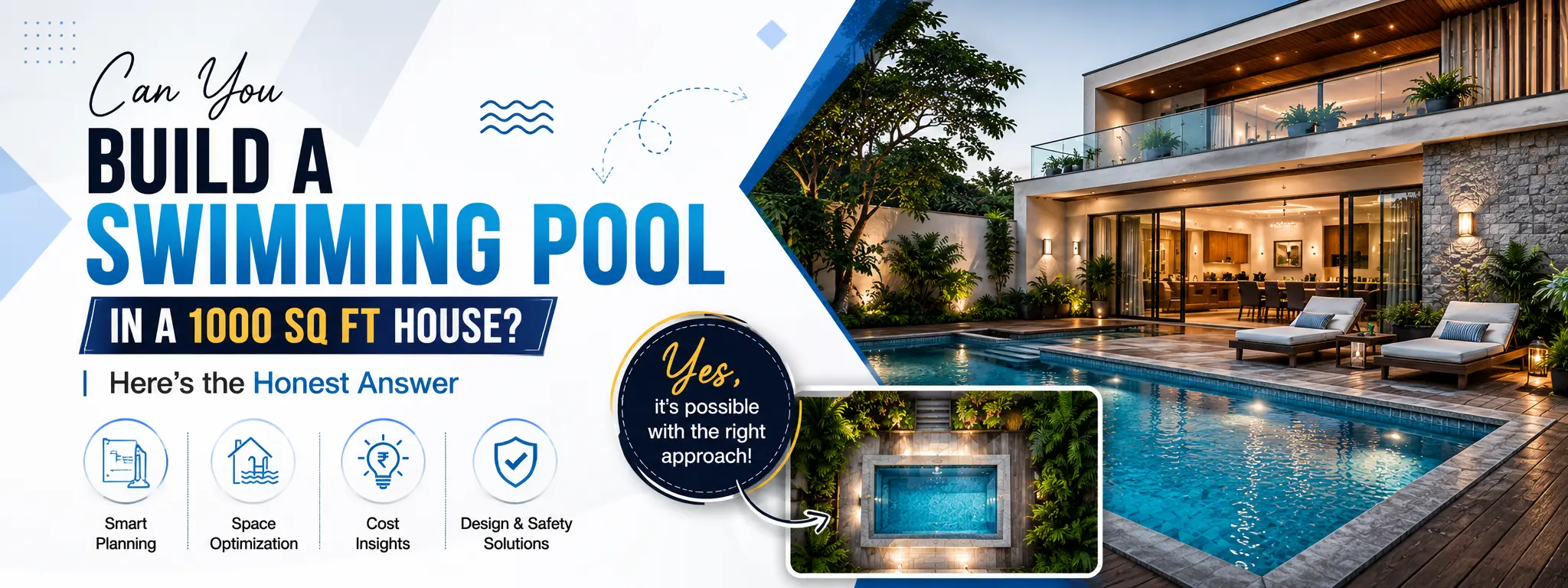
Yes — a swimming pool is possible in a 1000 sq ft house, but only if you redesign the layout around it rather than squeezing it into leftover space. With a plunge pool or compact lap pool measuring 8x15 ft to 10x20 ft, most 1000 sq ft plots with a reasonable setback can accommodate one. The real constraints aren't size — they're structural load, waterproofing, and local building bylaws, all of which a qualified pool professional evaluates before construction begins.
That's the short version. Below is what actually determines whether your plot qualifies, what it will cost, and how to avoid the mistakes that turn a dream pool into a leaking liability.
How Much Space Does a Swimming Pool Actually Need?
Most homeowners overestimate the footprint a pool requires. You don't need a resort-sized pool to get resort-level enjoyment.
Minimum functional pool sizes:
| Pool Type | Dimensions | Approx. Area | Water Volume |
|---|---|---|---|
| Plunge Pool | 8 × 12 ft | 96 sq ft | ~9,000 litres |
| Compact Lap Pool | 10 × 20 ft | 200 sq ft | ~20,000 litres |
| Family Pool | 12 × 24 ft | 288 sq ft | ~30,000 litres |
| Rooftop Dip Pool | 8 × 10 ft | 80 sq ft | ~7,500 litres |
A plunge pool takes up roughly 10% of a 1000 sq ft plot's footprint. That leaves ample room for a deck, garden, or seating area — the pool doesn't have to dominate the plot.
"The mistake most people make is designing the house first and asking about the pool later. On a 1000 sq ft plot, the pool has to be part of the architectural plan from day one — not an afterthought." — common guidance from residential pool consultants
Key takeaway: Space isn't the real bottleneck on a 1000 sq ft plot — sequencing the design correctly is.
Where the Pool Can Go in a Small Plot
On tight plots, location matters more than dimension. Three placements work reliably:
- Front or side setback pool — uses the mandatory open space around the house that's often left unused
- Rooftop or terrace pool — requires reinforced structural design but frees up ground-floor area entirely
- Courtyard/sunken pool — built into a central open-to-sky section, common in compact urban homes
Rooftop pools need the most engineering scrutiny since they add significant dead load to the structure — this is where hiring an experienced professional stops being optional.
Structural & Legal Checklist Before You Dig
Before any excavation or construction, these five checks decide feasibility:
- Soil bearing capacity — a soil test confirms whether the ground can support the pool's water load
- Setback compliance — local municipal bylaws dictate minimum distance from plot boundaries
- Structural load calculation — critical for rooftop or basement pools; needs a structural engineer's sign-off, guided by the National Building Code of India published by the Bureau of Indian Standards
- Waterproofing specification — determines long-term durability; this is where most budget pools fail within 3-5 years
- Drainage and overflow planning — prevents water damage to adjoining walls or foundations
Skipping any one of these is the single biggest cause of pool failures in compact homes — not the pool size itself.
Small Pool Types That Fit a 1000 Sq Ft Home
Not all pools work the same way structurally or cost-wise — for a deeper breakdown of each format, see our Types of Swimming Pools Explained guide. Here's a quick comparison for compact plots specifically:
| Type | Best For | Pros | Cons |
|---|---|---|---|
| Plunge Pool | Tight plots, cooling-off use | Low cost, quick install | Not for swimming laps |
| Skimmer Pool | Standard family use | Cost-effective filtration | Visible skimmer boxes |
| Overflow / Infinity-Edge Pool | Premium aesthetic | High visual appeal | 20-30% costlier |
| Fiber-Reinforced Plastic (FRP) Pool | Fast rooftop installs | Lightweight, quick build | Limited size customization |
For most 1000 sq ft homes, a plunge or skimmer-type pool offers the best balance of cost, structural safety, and usability.
Cost Comparison: What to Budget For
Costs vary by city, material, and finish, but a realistic range looks like this:
| Component | Approximate Cost (INR) |
|---|---|
| Excavation & civil work | ₹150-250 per sq ft |
| Waterproofing | ₹80-150 per sq ft |
| Tiling/finish (mosaic/glass) | ₹200-500 per sq ft |
| Filtration & pump system | ₹80,000-2,50,000 |
| Total (plunge pool, 100-150 sq ft) | ₹6,00,000-12,00,000 |
Bold insight: On a 1000 sq ft plot, the pool structure and waterproofing typically account for 60-70% of the total cost — not the tiling or aesthetics most homeowners fixate on first.
Case Study: A Real 1000 Sq Ft Build
A homeowner in a metro suburb approached DS WATER TECHNOLOGY with a 1000 sq ft plot and a firm request: a pool without sacrificing the living room or parking space.
The solution was an 8x14 ft plunge pool placed in the side setback, with a raised deck doubling as extra seating. Structural reinforcement was added only at the foundation edge closest to the pool wall — not the entire plot — keeping costs controlled.
The result: a fully functional pool delivered within the original footprint, with zero compromise on the house's built-up area.
Lesson: The limiting factor was never the 1000 sq ft plot size — it was finding a design team willing to plan the pool alongside the house rather than around it.
How to Choose the Right Swimming Pool Builder
Not every contractor who installs pools understands compact-plot engineering. When evaluating a swimming pool builder, ask these four questions:
- Do they conduct a soil and structural assessment before quoting?
- Can they show completed projects on similarly sized plots?
- What waterproofing warranty do they offer (5 years minimum is standard)?
- Is filtration system sizing included in the design, or added later?
A capable swimming pool contractor will walk you through load calculations and drainage design before discussing tile finishes — that sequence itself is a good filter for competence.
DS WATER TECHNOLOGY typically begins with a site feasibility study rather than a generic quote, which is the correct starting point for any compact-plot pool project.
Final Verdict
A 1000 sq ft house can absolutely accommodate a swimming pool — plunge pools, compact lap pools, and rooftop dip pools all fit comfortably within typical setback allowances. The deciding factors are soil capacity, structural load, and waterproofing quality, not the plot's total area.
If you're planning one, get a site feasibility assessment before finalizing your house layout. DS WATER TECHNOLOGY and similar specialist firms can confirm exact feasibility within a day of site inspection — a small step that prevents expensive redesigns later.
FAQ Section
Q1: What is the cost of constructing a swimming pool?
A basic plunge pool typically costs between ₹6,00,000 and ₹12,00,000 in India, depending on size, waterproofing quality, and finish. Larger family pools can exceed ₹20,00,000.
Q2: How much to fill a 50,000 litre pool?
Filling a 50,000 litre pool through a standard municipal or borewell connection usually takes 20-30 hours, and water cost ranges from ₹1,500 to ₹4,000 depending on the local water tariff and source.
Q3: How much does a 20x40 swimming pool cost in India?
A 20x40 ft pool (roughly 800 sq ft) typically costs between ₹40,00,000 and ₹70,00,000, including civil work, filtration, and premium finishing.
Q4: Is a swimming pool possible in a small house?
Yes, small houses as compact as 1000 sq ft can fit a plunge or compact pool, provided the setback space and structural load allow it — confirmed through a professional site assessment.
Q5: Do rooftop pools need special structural approval?
Yes, rooftop pools require a structural engineer's load calculation since they add significant weight to the building, and most municipalities require this approval before construction.
Q6: How long does it take to build a small pool?
A plunge or compact pool generally takes 6 to 10 weeks from excavation to filtration commissioning, depending on weather and waterproofing curing time.
Q7: What maintenance does a small pool need?
Small pools need weekly filtration checks, chlorine or salt-system balancing, and an annual waterproofing inspection to prevent seepage into the surrounding structure.
Ready to build or
upgrade your pool?
Tell us about your swimming pool project and one of our experts will contact you within 24 hours with the best solution and pricing.
New Delhi - 110086, Delhi, India